## Diagram: pCoT[poly(n)] Architecture
### Overview
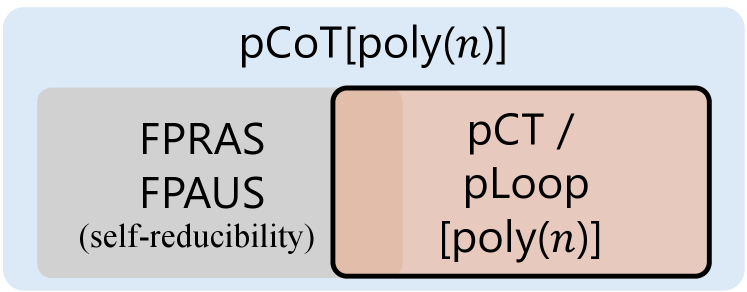
The image presents a two-part diagram with a title "pCoT[poly(n)]" at the top. It visually separates two conceptual components: a gray rectangle labeled "FPRAS FPAUS (self-reducibility)" on the left and a pink rectangle labeled "pCT / pLoop [poly(n)]" on the right. The layout suggests a comparative or hierarchical relationship between these elements.
### Components/Axes
- **Title**: "pCoT[poly(n)]" (centered at the top)
- **Left Component**:
- Label: "FPRAS FPAUS"
- Sub-label: "(self-reducibility)" (in parentheses)
- **Right Component**:
- Label: "pCT / pLoop"
- Sub-label: "[poly(n)]" (in brackets)
- **Visual Structure**:
- Two horizontally aligned rectangles with distinct colors (gray and pink)
- No axes, scales, or numerical data present
### Detailed Analysis
- **Textual Elements**:
- All labels are explicitly stated with no ambiguity.
- The bracketed "[poly(n)]" and parenthetical "(self-reducibility)" indicate contextual modifiers.
- **Spatial Relationships**:
- Title is centered above both components.
- Left component (gray) is positioned to the left of the right component (pink).
- No overlapping or hierarchical layering between components.
### Key Observations
1. The diagram contrasts two distinct concepts: "self-reducibility" (left) and "polynomial-time" (right).
2. The use of brackets and parentheses suggests nuanced distinctions within each component.
3. The title "pCoT[poly(n)]" implies a unifying framework or higher-level concept encompassing both components.
### Interpretation
This diagram likely represents a theoretical framework in computational complexity or algorithm design. The left component ("FPRAS FPAUS") relates to self-reducibility, a property where problems can be broken into smaller instances of the same problem. The right component ("pCT / pLoop") references polynomial-time algorithms (pCT = Polynomial-Time Computation, pLoop = Polynomial-Time Loop), emphasizing efficiency. The title "pCoT[poly(n)]" may denote a class of problems or algorithms that integrate both self-reducibility and polynomial-time constraints. The separation into two components suggests these are complementary or orthogonal properties within the broader framework.