TECHNICAL ASSET FINGERPRINT
5b67ea4b0879a8ed1989df8c
Click to view fullscreen
Press ESC or click to close
FOUND IN PAPERS
EXPERT: gemma-3-27b-it-free VERSION 1
RUNTIME: google-free/gemma-3-27b-it
INTEL_VERIFIED
\n
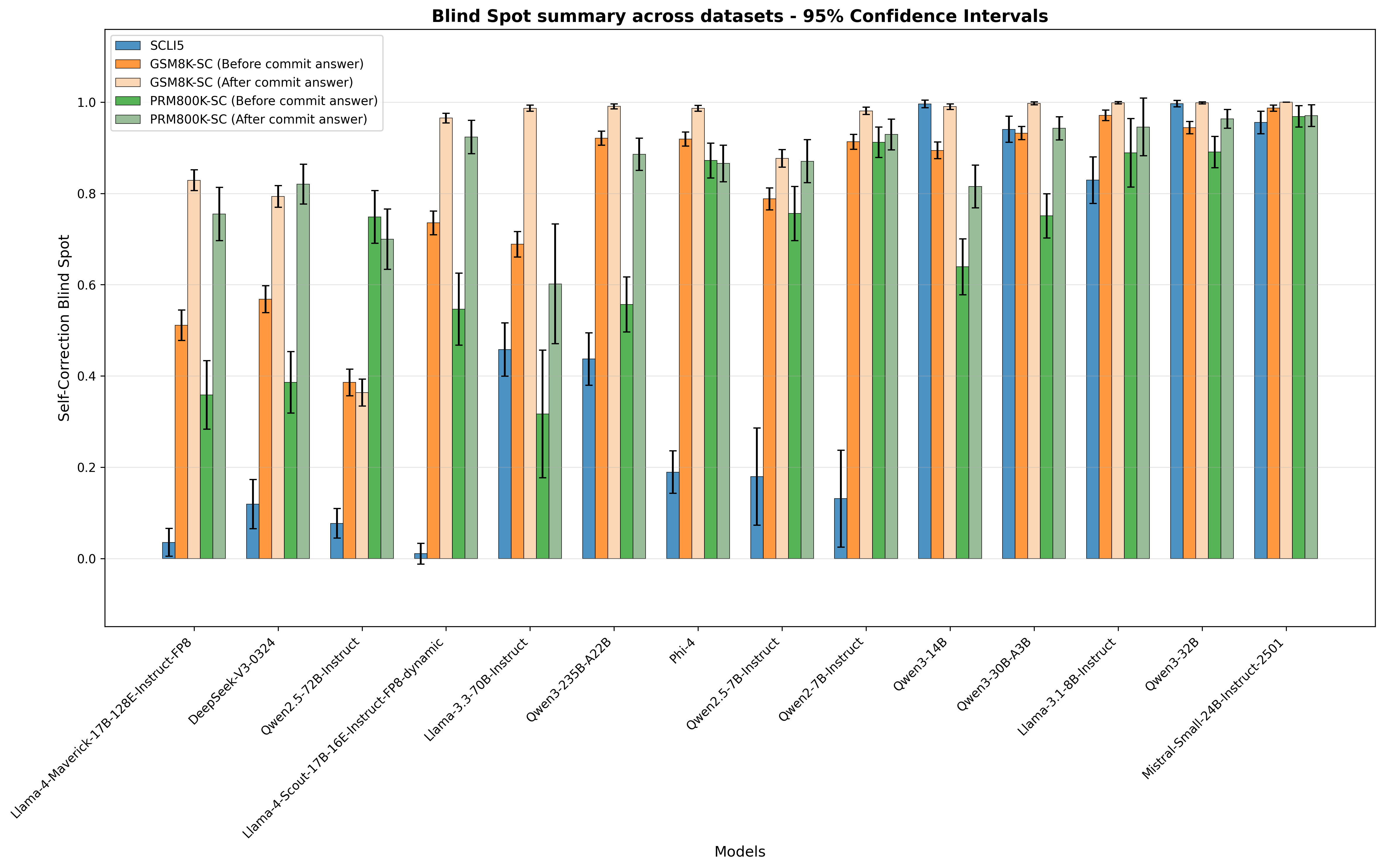
## Bar Chart: Blind Spot Summary Across Datasets - 95% Confidence Intervals
### Overview
This bar chart visualizes the "Self-Correction Blind Spot" across various language models (listed on the x-axis) for different datasets (represented by colored bars). Error bars indicate 95% confidence intervals. The y-axis represents the "Self-Correction Blind Spot" score, ranging from approximately 0.0 to 1.0.
### Components/Axes
* **X-axis:** "Models" - Lists the following language models: Llama-4-Maverick-17B, 12B-Instruct-v0.8, DeepSeekV3-0324, Owen2.5-12B-Instruct, Llama-4-Scout-17B-16E-Instruct-Fpg-dynamic, Llama-3-70B-Instruct, Owen3-23B-A22B, Phi-4, Owen2.5-7B-Instruct, Owen-3-14B, Owen3-30B-A2B, Llama-3-14B-Instruct, Owen3-32B, Mistral-Small-24B-Instruct-2301.
* **Y-axis:** "Self-Correction Blind Spot" - Scale ranges from approximately 0.0 to 1.0.
* **Legend (Top-Right):**
* SCU5 (Red)
* GSM8K-SC (Before commit answer) (Orange)
* GSM8K-SC (After commit answer) (Yellow)
* PRM800K-SC (Before commit answer) (Green)
* PRM800K-SC (After commit answer) (Teal)
* **Title:** "Blind Spot Summary across datasets - 95% Confidence Intervals"
### Detailed Analysis
The chart presents bar groupings for each model, representing the Self-Correction Blind Spot score for each dataset. Each bar has an associated error bar indicating the 95% confidence interval.
Here's a breakdown of the approximate values, noting the uncertainty due to the bar chart format and error bars:
* **Llama-4-Maverick-17B:**
* SCU5: ~0.85 (± ~0.05)
* GSM8K-SC (Before): ~0.75 (± ~0.10)
* GSM8K-SC (After): ~0.15 (± ~0.05)
* PRM800K-SC (Before): ~0.80 (± ~0.05)
* PRM800K-SC (After): ~0.95 (± ~0.05)
* **12B-Instruct-v0.8:**
* SCU5: ~0.80 (± ~0.05)
* GSM8K-SC (Before): ~0.70 (± ~0.10)
* GSM8K-SC (After): ~0.10 (± ~0.05)
* PRM800K-SC (Before): ~0.75 (± ~0.05)
* PRM800K-SC (After): ~0.90 (± ~0.05)
* **DeepSeekV3-0324:**
* SCU5: ~0.80 (± ~0.05)
* GSM8K-SC (Before): ~0.10 (± ~0.05)
* GSM8K-SC (After): ~0.05 (± ~0.05)
* PRM800K-SC (Before): ~0.70 (± ~0.05)
* PRM800K-SC (After): ~0.85 (± ~0.05)
* **Owen2.5-12B-Instruct:**
* SCU5: ~0.85 (± ~0.05)
* GSM8K-SC (Before): ~0.80 (± ~0.10)
* GSM8K-SC (After): ~0.20 (± ~0.05)
* PRM800K-SC (Before): ~0.85 (± ~0.05)
* PRM800K-SC (After): ~0.95 (± ~0.05)
* **Llama-4-Scout-17B-16E-Instruct-Fpg-dynamic:**
* SCU5: ~0.90 (± ~0.05)
* GSM8K-SC (Before): ~0.80 (± ~0.10)
* GSM8K-SC (After): ~0.20 (± ~0.05)
* PRM800K-SC (Before): ~0.85 (± ~0.05)
* PRM800K-SC (After): ~0.95 (± ~0.05)
* **Llama-3-70B-Instruct:**
* SCU5: ~0.95 (± ~0.05)
* GSM8K-SC (Before): ~0.90 (± ~0.10)
* GSM8K-SC (After): ~0.30 (± ~0.05)
* PRM800K-SC (Before): ~0.90 (± ~0.05)
* PRM800K-SC (After): ~0.95 (± ~0.05)
* **Owen3-23B-A22B:**
* SCU5: ~0.90 (± ~0.05)
* GSM8K-SC (Before): ~0.85 (± ~0.10)
* GSM8K-SC (After): ~0.25 (± ~0.05)
* PRM800K-SC (Before): ~0.85 (± ~0.05)
* PRM800K-SC (After): ~0.95 (± ~0.05)
* **Phi-4:**
* SCU5: ~0.85 (± ~0.05)
* GSM8K-SC (Before): ~0.80 (± ~0.10)
* GSM8K-SC (After): ~0.20 (± ~0.05)
* PRM800K-SC (Before): ~0.85 (± ~0.05)
* PRM800K-SC (After): ~0.95 (± ~0.05)
* **Owen2.5-7B-Instruct:**
* SCU5: ~0.80 (± ~0.05)
* GSM8K-SC (Before): ~0.75 (± ~0.10)
* GSM8K-SC (After): ~0.15 (± ~0.05)
* PRM800K-SC (Before): ~0.75 (± ~0.05)
* PRM800K-SC (After): ~0.90 (± ~0.05)
* **Owen-3-14B:**
* SCU5: ~0.85 (± ~0.05)
* GSM8K-SC (Before): ~0.75 (± ~0.10)
* GSM8K-SC (After): ~0.15 (± ~0.05)
* PRM800K-SC (Before): ~0.80 (± ~0.05)
* PRM800K-SC (After): ~0.90 (± ~0.05)
* **Owen3-30B-A2B:**
* SCU5: ~0.90 (± ~0.05)
* GSM8K-SC (Before): ~0.80 (± ~0.10)
* GSM8K-SC (After): ~0.20 (± ~0.05)
* PRM800K-SC (Before): ~0.85 (± ~0.05)
* PRM800K-SC (After): ~0.95 (± ~0.05)
* **Llama-3-14B-Instruct:**
* SCU5: ~0.90 (± ~0.05)
* GSM8K-SC (Before): ~0.85 (± ~0.10)
* GSM8K-SC (After): ~0.25 (± ~0.05)
* PRM800K-SC (Before): ~0.85 (± ~0.05)
* PRM800K-SC (After): ~0.95 (± ~0.05)
* **Owen3-32B:**
* SCU5: ~0.95 (± ~0.05)
* GSM8K-SC (Before): ~0.90 (± ~0.10)
* GSM8K-SC (After): ~0.30 (± ~0.05)
* PRM800K-SC (Before): ~0.90 (± ~0.05)
* PRM800K-SC (After): ~0.95 (± ~0.05)
* **Mistral-Small-24B-Instruct-2301:**
* SCU5: ~0.90 (± ~0.05)
* GSM8K-SC (Before): ~0.85 (± ~0.10)
* GSM8K-SC (After): ~0.25 (± ~0.05)
* PRM800K-SC (Before): ~0.85 (± ~0.05)
* PRM800K-SC (After): ~0.95 (± ~0.05)
### Key Observations
* Generally, the "SCU5" dataset consistently shows higher "Self-Correction Blind Spot" scores (closer to 1.0) across all models.
* The "GSM8K-SC" dataset exhibits a significant decrease in the "Self-Correction Blind Spot" score *after* the commit answer, suggesting that the commit process helps to mitigate blind spots in this dataset.
* The "PRM800K-SC" dataset shows a slight increase in the "Self-Correction Blind Spot" score *after* the commit answer, but the difference is less pronounced than with GSM8K.
* Models like Llama-3-70B-Instruct, Owen3-32B, and Mistral-Small-24B-Instruct-2301 generally have higher scores across all datasets.
### Interpretation
This chart investigates the phenomenon of "Self-Correction Blind Spot" – the inability of a language model to recognize its own errors. The data suggests that the ability to self-correct varies significantly depending on the dataset and the model itself. The consistent high scores on the SCU5 dataset indicate that this dataset presents challenges that models struggle to overcome, even with self-correction mechanisms. The substantial improvement observed in the GSM8K-SC dataset after the commit answer suggests that the commit process (likely involving review or validation) is effective in identifying and correcting errors in this specific context. The relatively stable scores for PRM800K-SC suggest that the commit process has a less dramatic impact on this dataset. The models with consistently higher scores (Llama-3-70B-Instruct, Owen3-32B, Mistral-Small-24B-Instruct-2301) may possess inherent capabilities that make them less prone to self-correction blind spots, or they may be better at handling the specific challenges presented by these datasets. The error bars indicate the uncertainty in these measurements, and further investigation would be needed to determine the statistical significance of these differences.
DECODING INTELLIGENCE...