## Screenshot: Coq/Lean Theorem Proof Snippet
### Overview
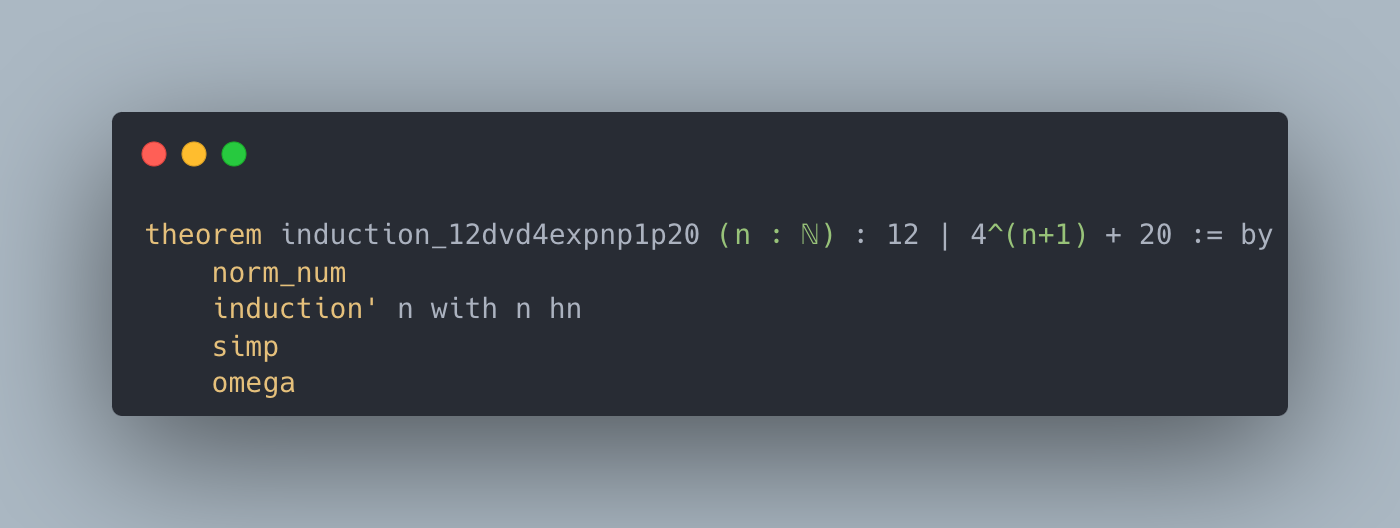
The image shows a code snippet from a formal proof assistant (likely Coq or Lean) containing a theorem declaration and its proof steps. The code uses mathematical notation and proof tactics to establish a divisibility property.
### Components/Axes
- **Theorem Declaration**:
`theorem induction_12dvd4expnp1p20 (n : N) : 12 | 4^(n+1) + 20 := by`
- Declares a theorem named `induction_12dvd4expnp1p20`
- Parameter: `n` of type natural numbers (`N`)
- Goal: Prove `12` divides `4^(n+1) + 20` (notation `12 | ...`)
- `:= by` introduces the proof script
- **Proof Steps**:
Indented lines represent proof tactics:
1. `norm_num`
2. `induction 'n with n hn`
3. `simp`
4. `omega`
### Detailed Analysis
1. **Theorem Statement**:
- Goal: Show `12 | 4^(n+1) + 20` for all natural numbers `n`.
- Mathematical expression: `4^(n+1) + 20` must be divisible by `12`.
2. **Proof Tactics**:
- `norm_num`: Simplifies numerical expressions (e.g., reduces `4^(n+1)` to `2^(2(n+1))`).
- `induction 'n with n hn`: Applies induction on `n`, introducing hypothesis `hn` for the inductive step.
- `simp`: Automatically simplifies subgoals using known lemmas.
- `omega`: Resolves arithmetic goals (e.g., inequalities or divisibility) using the `omega` library.
### Key Observations
- The theorem uses **mathematical induction** to prove a property holding for all natural numbers `n`.
- The expression `4^(n+1) + 20` simplifies to `2^(2n+2) + 20`, which is analyzed for divisibility by `12`.
- The `omega` tactic suggests the divisibility condition reduces to a linear arithmetic problem solvable by the `omega` algorithm.
### Interpretation
This code demonstrates a formal proof of the statement:
**"For all natural numbers `n`, `12` divides `4^(n+1) + 20`."**
- **Inductive Structure**:
- Base case: Likely verified via `norm_num` and `simp`.
- Inductive step: Assumes the property holds for `n` (via `hn`) and proves it for `n+1`.
- **Role of Tactics**:
- `norm_num` and `simp` handle algebraic simplifications.
- `omega` resolves the final divisibility condition, which may involve modular arithmetic (e.g., showing `4^(n+1) ≡ -20 mod 12`).
The proof leverages the power of automated theorem provers to verify properties that would be tedious to check manually. The use of `omega` implies the divisibility condition reduces to a linear equation solvable by integer programming techniques.