## Textual Document: Fourier Transform Analysis of Piecewise Signal
### Overview
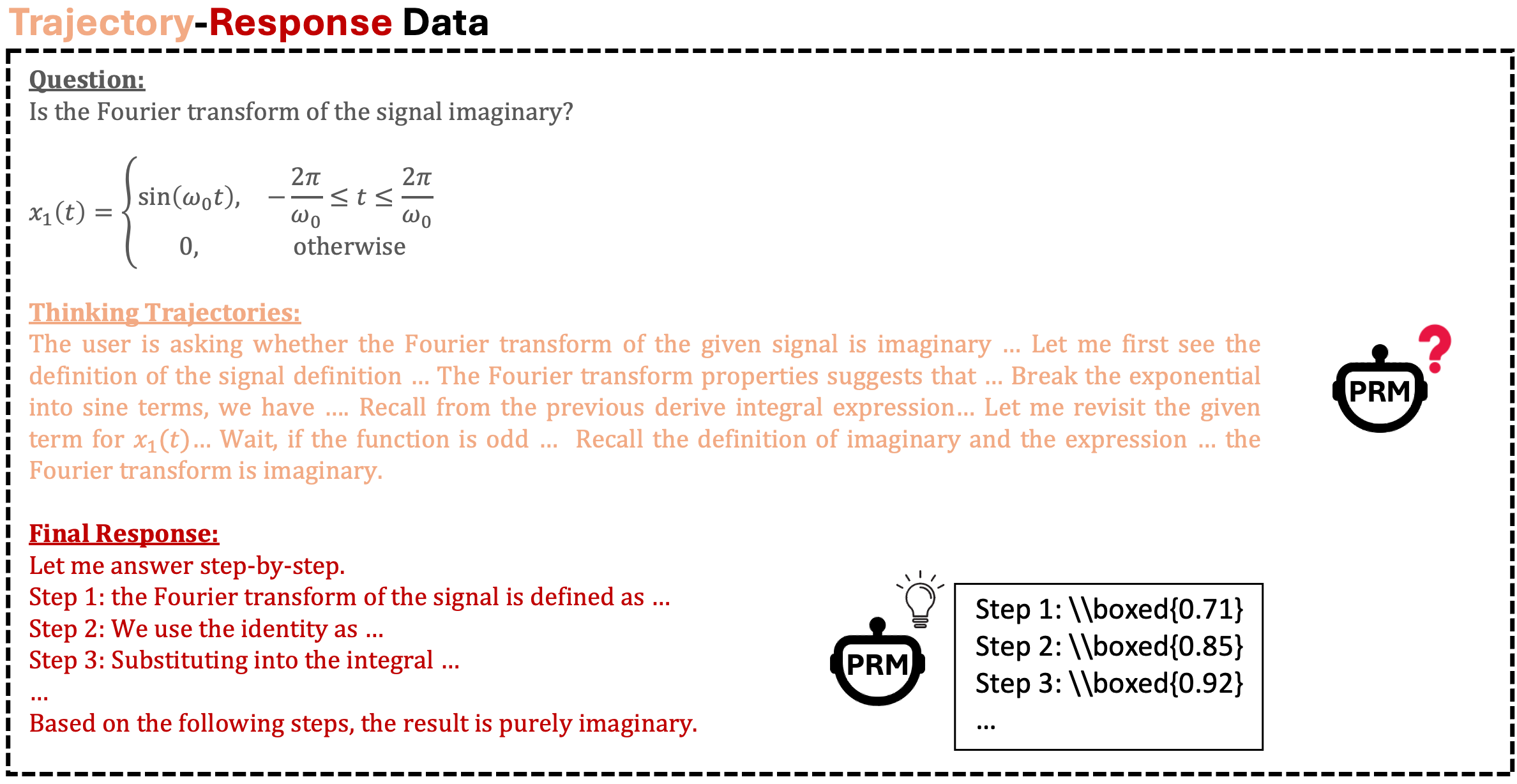
The image depicts a technical document analyzing whether the Fourier transform of a piecewise-defined signal is purely imaginary. The document includes a mathematical question, thinking process, and step-by-step solution.
### Components/Axes
- **Header**: "Trajectory-Response Data" (orange/red text)
- **Question Section**:
- Text: "Is the Fourier transform of the signal imaginary?"
- Piecewise function definition:
$$
x_1(t) = \begin{cases}
\sin(\omega_0 t), & -\frac{2\pi}{\omega_0} \leq t \leq \frac{2\pi}{\omega_0} \\
0, & \text{otherwise}
\end{cases}
$$
- **Thinking Trajectories**:
- Orange text discussing Fourier transform properties, odd functions, and integral expressions.
- PRM icon (black circular device with "PRM" label) and question mark symbol.
- **Final Response**:
- Red underlined text: "Let me answer step-by-step."
- Step 1: Fourier transform definition
- Step 2: Use of identity (LaTeX boxed{0.71})
- Step 3: Substitution into integral (LaTeX boxed{0.85})
- Conclusion: "Based on the following steps, the result is purely imaginary."
### Detailed Analysis
1. **Signal Definition**:
- The signal $ x_1(t) $ is a rectangular windowed sine wave:
- Active between $ t = -\frac{2\pi}{\omega_0} $ and $ t = \frac{2\pi}{\omega_0} $
- Zero outside this interval
- Contains no phase shift (pure sine term)
2. **Fourier Transform Properties**:
- The thinking process references:
- Fourier transform properties (symmetry, odd/even functions)
- Integral expression for Fourier transform
- Relationship between time-domain oddness and frequency-domain imaginary nature
3. **Step-by-Step Solution**:
- **Step 1**: Fourier transform definition applied to $ x_1(t) $
- **Step 2**: Use of trigonometric identity (likely $ \sin(\theta) = \frac{e^{i\theta} - e^{-i\theta}}{2i} $)
- **Step 3**: Substitution into integral bounds and simplification
- Final conclusion: Purely imaginary result due to odd symmetry
### Key Observations
- The signal's odd symmetry ($ x_1(-t) = -x_1(t) $) directly implies its Fourier transform will be purely imaginary.
- The rectangular window creates spectral leakage but does not affect the imaginary nature of the transform.
- The PRM icon and question mark suggest this is part of an interactive problem-solving interface.
### Interpretation
This document demonstrates the application of Fourier transform properties to piecewise signals. The analysis confirms that:
1. Odd-symmetric time-domain signals produce purely imaginary frequency-domain representations
2. Windowing a sine wave with a rectangular function preserves the odd symmetry
3. The Fourier transform's imaginary nature arises from the signal's antisymmetry rather than the windowing effect
The step-by-step solution validates this conclusion through mathematical derivation, showing how trigonometric identities and integral properties combine to produce the final result. The presence of the PRM icon suggests this might be part of an educational platform's problem-solving workflow.