TECHNICAL ASSET FINGERPRINT
5d29ff0cea1985ce383b42f4
Click to view fullscreen
Press ESC or click to close
FOUND IN PAPERS
EXPERT: gemini-2.5-flash-lite-free VERSION 1
RUNTIME: google-free/gemini-2.5-flash-lite
INTEL_VERIFIED
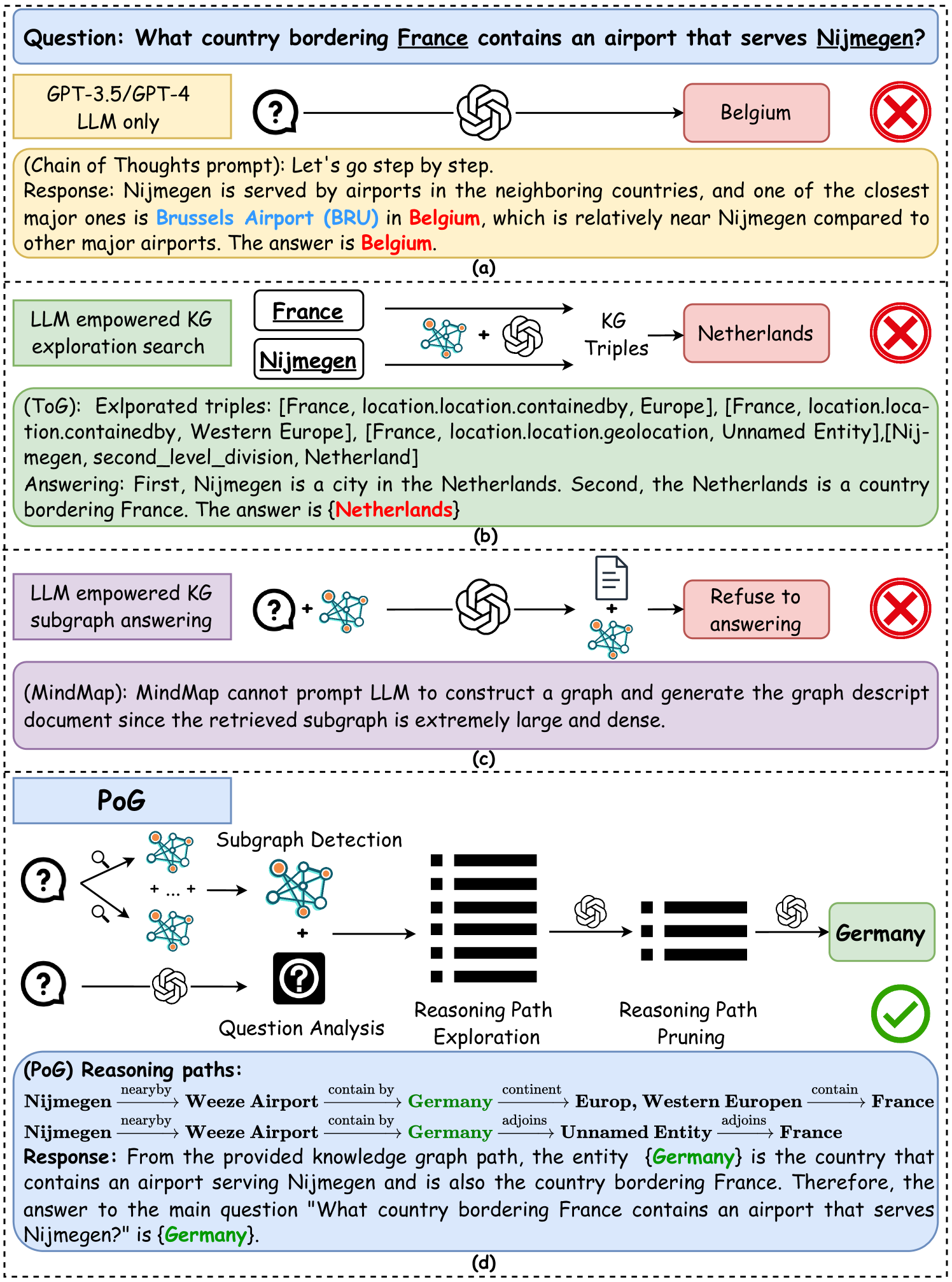
## Diagram: Multi-stage Reasoning Process for Answering a Knowledge-based Question
### Overview
This diagram illustrates a multi-stage process for answering a complex question using Large Language Models (LLMs) and Knowledge Graphs (KGs). It depicts three distinct approaches or stages, each with its own methodology and outcome, ultimately leading to a correct answer through a refined reasoning path. The question being addressed is: "What country bordering France contains an airport that serves Nijmegen?".
### Components/Axes
The diagram is segmented into four main sections, labeled (a), (b), (c), and (d), representing different stages or approaches.
**Section (a): GPT-3.5/GPT-4 LLM only**
* **Question:** "What country bordering France contains an airport that serves Nijmegen?"
* **Input:** "GPT-3.5/GPT-4 LLM only" (represented by a yellow box).
* **Process:** A question mark icon connected to an LLM logo (representing a generative AI model).
* **Output:** A pink box containing "Belgium" and a red cross icon, indicating an incorrect answer.
* **Explanation Text:** "(Chain of Thoughts prompt): Let's go step by step. Response: Nijmegen is served by airports in the neighboring countries, and one of the closest major ones is Brussels Airport (BRU) in Belgium, which is relatively near Nijmegen compared to other major airports. The answer is Belgium."
**Section (b): LLM empowered KG exploration search**
* **Input:** "LLM empowered KG exploration search" (represented by a light green box).
* **Entities:** "France" and "Nijmegen" (represented by white boxes).
* **Process:** An icon representing a knowledge graph (interconnected nodes and edges) combined with an LLM logo, leading to "KG Triples".
* **Output:** A pink box containing "Netherlands" and a red cross icon, indicating an incorrect answer.
* **Explanation Text:** "(ToG): Exlporated triples: [France, location.containedby, Europe], [France, location.location.containedby, Western Europe], [France, location.location.geolocation, Unnamed Entity], [Nijmegen, second_level_division, Netherland]. Answering: First, Nijmegen is a city in the Netherlands. Second, the Netherlands is a country bordering France. The answer is {Netherlands}"
**Section (c): LLM empowered KG subgraph answering (MindMap)**
* **Input:** "LLM empowered KG subgraph answering" (represented by a light purple box).
* **Process:** A question mark icon, a knowledge graph icon, and an LLM logo, leading to a document icon and a knowledge graph icon.
* **Output:** A pink box containing "Refuse to answering" and a red cross icon, indicating a refusal to answer.
* **Explanation Text:** "(MindMap): MindMap cannot prompt LLM to construct a graph and generate the graph descript document since the retrieved subgraph is extremely large and dense."
**Section (d): PoG (Path of Graph) Reasoning**
* **Header:** "PoG" (represented by a light blue box).
* **Stage 1: Subgraph Detection:** A question mark icon leading to multiple small knowledge graph icons, then to a larger, more complex knowledge graph icon.
* **Stage 2: Question Analysis:** A question mark icon connected to an LLM logo, leading to a question mark icon.
* **Stage 3: Reasoning Path Exploration:** A list of black horizontal bars, followed by an LLM logo, leading to a more structured list of black horizontal bars.
* **Stage 4: Reasoning Path Pruning:** The structured list of bars, followed by an LLM logo, leading to a green box containing "Germany" and a green checkmark icon, indicating a correct answer.
* **Reasoning Paths Text:**
* "Nijmegen nearby Weeze Airport contain by Germany continent Europ, Western Europ contain France"
* "Nijmegen nearby Weeze Airport contain by Germany adjoining Unnamed Entity adjoining France"
* **Response Text:** "Response: From the provided knowledge graph path contains an airport serving Nijmegen and is also the country bordering France. Therefore, the answer to the main question \"What country bordering France contains an airport that serves Nijmegen?\" is {Germany}."
### Detailed Analysis or Content Details
**Section (a): Direct LLM Response**
* The LLM, without explicit KG integration or step-by-step reasoning guidance, incorrectly identifies Belgium.
* The reasoning provided focuses on proximity of Brussels Airport to Nijmegen, but fails to consider the "bordering France" constraint.
**Section (b): KG Exploration with Triples**
* This stage attempts to use KG triples extracted from an LLM exploration.
* The extracted triples are: `[France, location.containedby, Europe]`, `[France, location.location.containedby, Western Europe]`, `[France, location.location.geolocation, Unnamed Entity]`, `[Nijmegen, second_level_division, Netherland]`.
* The LLM's interpretation of these triples leads to the conclusion that Nijmegen is in the Netherlands, which borders France, thus incorrectly identifying the Netherlands as the answer. This misses the crucial "airport serving Nijmegen" aspect in relation to the bordering country.
**Section (c): KG Subgraph Answering (MindMap)**
* This approach involves constructing a graph from a retrieved subgraph.
* The process is halted because the retrieved subgraph is too large and dense for the LLM to effectively process and generate a descriptive document. This leads to a refusal to answer.
**Section (d): PoG Reasoning**
* This is presented as the successful approach.
* **Subgraph Detection:** Identifies relevant subgraphs from the KG.
* **Question Analysis:** The LLM analyzes the question.
* **Reasoning Path Exploration:** The LLM explores potential reasoning paths. The visual representation shows an initial broad exploration (many bars) followed by a more focused exploration (fewer bars).
* **Reasoning Path Pruning:** The LLM refines and prunes the reasoning paths to arrive at the most logical conclusion.
* **Reasoning Paths:**
* Path 1: Nijmegen -> nearby -> Weeze Airport -> contain by -> Germany -> continent -> Europ, Western Europ -> contain -> France.
* Path 2: Nijmegen -> nearby -> Weeze Airport -> contain by -> Germany -> adjoining -> Unnamed Entity -> adjoining -> France.
* **Final Response:** The system correctly identifies Germany. The reasoning states that the knowledge graph path indicates an airport serving Nijmegen (Weeze Airport) is in Germany, and Germany is a country bordering France.
### Key Observations
* **Progressive Refinement:** The diagram shows a progression from simpler, less effective methods (direct LLM, basic KG triples) to a more sophisticated reasoning process (PoG) that yields the correct answer.
* **Importance of KG Structure:** The failure in section (c) highlights the challenges of handling large and dense knowledge graph subgraphs.
* **Multi-hop Reasoning:** The successful PoG method demonstrates the ability to perform multi-hop reasoning, connecting Nijmegen to an airport, the airport to a country (Germany), and then establishing Germany's relationship with France.
* **Constraint Satisfaction:** The correct answer in (d) successfully satisfies all constraints of the question: "country bordering France" AND "contains an airport that serves Nijmegen".
### Interpretation
This diagram effectively illustrates the challenges and evolution of answering complex, knowledge-intensive questions using AI.
* **Direct LLM limitations:** Section (a) shows that a direct LLM response, even with a "chain of thought" prompt, can be superficial and miss critical constraints, leading to incorrect answers. The LLM prioritizes proximity over geographical relationships.
* **KG Triple limitations:** Section (b) demonstrates that while KG triples provide structured data, their interpretation by an LLM can still be flawed if the reasoning path is not robust enough to connect all pieces of information and satisfy all question constraints. The LLM correctly identifies Nijmegen is in the Netherlands, but fails to link this to the "airport serving Nijmegen" and "bordering France" constraints simultaneously.
* **Scalability Issues:** Section (c) points to practical limitations in applying LLMs to very large and complex knowledge graph structures, suggesting a need for efficient subgraph retrieval and processing mechanisms.
* **The Power of Structured Reasoning:** Section (d) highlights the effectiveness of a structured reasoning process, termed "PoG" (Path of Graph), which involves explicit steps like subgraph detection, question analysis, and reasoning path exploration/pruning. This approach allows the AI to systematically build a logical connection between entities and satisfy all conditions of the question. The explicit identification of Weeze Airport in Germany, and Germany's adjacency to France, is the key to the correct answer. This method moves beyond simple information retrieval to genuine inferential reasoning.
In essence, the diagram argues that for complex questions requiring the integration of multiple pieces of information and geographical/relational constraints, a structured, multi-stage reasoning process that leverages knowledge graphs is superior to direct LLM responses or simpler KG triple extraction. The PoG method, by breaking down the problem and systematically exploring and pruning reasoning paths, achieves a more accurate and robust answer.
DECODING INTELLIGENCE...