## System Architecture Diagram: Dual-Loop Learning Pipeline
### Overview
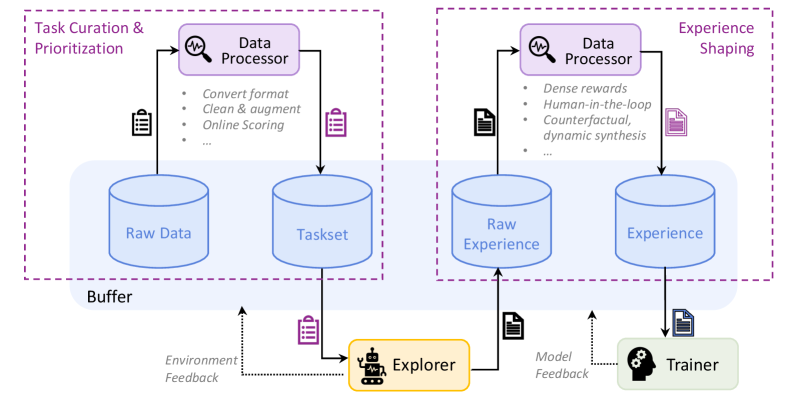
The image is a technical system architecture diagram illustrating a dual-loop learning or training pipeline. It depicts two primary, parallel processing stages—"Task Curation & Prioritization" and "Experience Shaping"—that interact with a central "Buffer" and two agent-like components, an "Explorer" and a "Trainer." The flow suggests a continuous cycle of data processing, exploration, and model training.
### Components/Axes
The diagram is organized into distinct regions and components:
1. **Top-Left Region: "Task Curation & Prioritization"**
* Enclosed in a purple dashed rectangle.
* **Data Processor** (Purple box with magnifying glass icon): Central processing unit.
* **Raw Data** (Blue cylinder): Input data store.
* **Taskset** (Blue cylinder): Output data store for curated tasks.
* **Flow:** `Raw Data` -> `Data Processor` -> `Taskset`.
* **Data Processor Functions (Bullet Points):**
* Convert format
* Clean & augment
* Online Scoring
* ...
2. **Top-Right Region: "Experience Shaping"**
* Enclosed in a purple dashed rectangle.
* **Data Processor** (Purple box with magnifying glass icon): Central processing unit.
* **Raw Experience** (Blue cylinder): Input data store.
* **Experience** (Blue cylinder): Output data store for shaped experiences.
* **Flow:** `Raw Experience` -> `Data Processor` -> `Experience`.
* **Data Processor Functions (Bullet Points):**
* Dense rewards
* Human-in-the-loop
* Counterfactual, dynamic synthesis
* ...
3. **Central Horizontal Band: "Buffer"**
* A light blue shaded area spanning the width of the diagram, positioned below the two main processing regions.
* It acts as a shared memory or communication channel between the upper processing loops and the lower agent components.
4. **Bottom Components:**
* **Explorer** (Yellow box with robot icon): Positioned centrally below the Buffer.
* **Trainer** (Light green box with head/gears icon): Positioned to the right of the Explorer.
5. **Data & Feedback Flows (Arrows and Icons):**
* **Task Flow:** `Taskset` (in Buffer) -> `Explorer` (downward arrow with clipboard icon).
* **Environment Feedback:** `Explorer` -> `Buffer` (dotted arrow pointing left, labeled "Environment Feedback").
* **Experience Flow:** `Explorer` -> `Raw Experience` (in Buffer) (upward arrow with document icon).
* **Shaped Experience Flow:** `Experience` (in Buffer) -> `Trainer` (downward arrow with document icon).
* **Model Feedback:** `Trainer` -> `Buffer` (dotted arrow pointing left, labeled "Model Feedback").
### Detailed Analysis
The diagram describes a closed-loop system with two distinct data processing pipelines that feed into and are informed by an interactive agent loop.
* **Left Pipeline (Task Curation):** Focuses on preparing structured tasks from raw data. The "Data Processor" here performs data engineering and prioritization tasks (format conversion, cleaning, scoring) to create a "Taskset."
* **Right Pipeline (Experience Shaping):** Focuses on processing experiential data, likely from interactions. The "Data Processor" here applies reward shaping, human feedback, and synthetic data generation techniques to create refined "Experience."
* **Central Buffer:** Serves as the integration point. It holds the `Taskset` for the Explorer, receives `Raw Experience` from the Explorer, and holds the shaped `Experience` for the Trainer.
* **Agent Interaction:**
* The **Explorer** consumes tasks from the `Taskset` and interacts with an external environment (implied by "Environment Feedback"). Its interactions generate `Raw Experience`.
* The **Trainer** consumes the shaped `Experience` to update a model. It provides "Model Feedback" back into the system, which likely influences future task curation or experience shaping.
### Key Observations
1. **Symmetry and Duality:** The two top processing blocks are structurally symmetrical (Data Processor + two cylinders) but functionally distinct (task preparation vs. experience refinement).
2. **Feedback Loops:** The system contains multiple feedback loops: Environment Feedback to the Buffer, Model Feedback to the Buffer, and the overarching cycle from Task -> Explorer -> Experience -> Trainer.
3. **Role of the Buffer:** The Buffer is not just a passive store; it's the central nervous system routing information between the curation, shaping, exploration, and training modules.
4. **Iconography:** Icons are used consistently to denote component types (magnifying glass for processors, cylinders for storage, robot for explorer, head/gears for trainer) and data types (clipboard for tasks, document for experiences).
### Interpretation
This diagram represents a sophisticated framework for **interactive machine learning or reinforcement learning**. It moves beyond a simple data->train pipeline by introducing two critical, specialized preprocessing stages:
1. **Proactive Task Curation:** Instead of feeding random data, the system actively curates and prioritizes tasks (`Taskset`) for the Explorer. This suggests an emphasis on efficient exploration or curriculum learning.
2. **Reactive Experience Shaping:** Raw interaction data (`Raw Experience`) is not used directly for training. It undergoes significant transformation (`Experience`) using advanced techniques like dense reward modeling and counterfactual synthesis. This is crucial for stabilizing learning and improving sample efficiency.
The **Explorer** acts as the embodied agent or data collector, while the **Trainer** is the learning algorithm. The **Buffer** and the two **Data Processors** form an intelligent middleware layer that manages the *quality* and *relevance* of both the inputs to the agent (tasks) and the inputs to the model (training experiences). The dual feedback loops (Environment and Model) allow the entire system to adapt dynamically, potentially enabling the task curation and experience shaping strategies to evolve based on the agent's performance and the model's learning progress. This architecture is designed for complex, interactive environments where data efficiency and strategic exploration are paramount.