## Diagram: 4x4 Number Grid with Irregular Cell Layout
### Overview
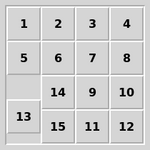
The image displays a 4x4 grid diagram with a light gray background and white grid lines. The grid contains numbers from 1 to 15, arranged in a non-sequential order. One cell in the third row is empty (white), and one cell in the third row spans two columns, creating an irregular layout. The overall appearance suggests a puzzle, a memory layout diagram, or a specific data structure representation.
### Components/Axes
* **Grid Structure:** A 4x4 matrix (4 rows, 4 columns).
* **Cell Content:** Numbers 1 through 15, plus one empty cell.
* **Visual Style:** Light gray cell backgrounds, white grid lines, black sans-serif text for numbers.
* **Spatial Layout:** The grid is presented head-on with no perspective distortion.
### Detailed Analysis
**Row-by-Row Content (Top to Bottom):**
* **Row 1 (Top):** Contains four separate cells.
* Column 1: `1`
* Column 2: `2`
* Column 3: `3`
* Column 4: `4`
* **Row 2:** Contains four separate cells.
* Column 1: `5`
* Column 2: `6`
* Column 3: `7`
* Column 4: `8`
* **Row 3:** This row has an irregular structure.
* Column 1: **Empty cell** (white background, no number).
* Columns 2 & 3: A single merged cell spanning two columns, containing the number `14`.
* Column 4: Contains the number `9`.
* *Note: The number `10` appears to be in a separate cell to the right of `9`, but within the same row. This suggests the grid might have an implied fifth column in this row, or the cell for `10` is part of the fourth column's space, making the layout ambiguous.*
* **Row 4 (Bottom):** Contains four separate cells.
* Column 1: `13`
* Column 2: `15`
* Column 3: `11`
* Column 4: `12`
**Complete Cell Inventory (by approximate position):**
1. Top-left: `1`
2. Top-center-left: `2`
3. Top-center-right: `3`
4. Top-right: `4`
5. Upper-middle-left: `5`
6. Upper-middle-center-left: `6`
7. Upper-middle-center-right: `7`
8. Upper-middle-right: `8`
9. Lower-middle-left: **[EMPTY]**
10. Lower-middle-center (spanning two columns): `14`
11. Lower-middle-right (center-right): `9`
12. Lower-middle-far-right: `10` *(positionally ambiguous)*
13. Bottom-left: `13`
14. Bottom-center-left: `15`
15. Bottom-center-right: `11`
16. Bottom-right: `12`
### Key Observations
1. **Non-Sequential Order:** The numbers are not arranged in a standard reading order (left-to-right, top-to-bottom). The sequence jumps significantly (e.g., from `8` to `14`, then back to `9`).
2. **Structural Anomaly:** The third row breaks the standard grid pattern with an empty cell and a merged cell, disrupting the expected 4x4 matrix.
3. **Number Set:** The numbers 1-15 are all present exactly once. The number 16 is absent, consistent with the empty cell.
4. **Potential Puzzle Configuration:** The layout strongly resembles the starting state of a classic "15-puzzle" or "sliding tile puzzle," where tiles numbered 1-15 are arranged in a 4x4 grid with one empty space. However, the specific order shown here (`14` in the center, `9` and `10` to its right) is not the standard solved state nor a common random shuffle, suggesting it may be a specific, possibly intermediate, configuration.
### Interpretation
This diagram is most likely a representation of a **sliding tile puzzle state**. The empty cell is the "blank" space into which adjacent tiles can slide. The irregular numbering and the merged cell appearance in the third row are likely visual artifacts of how the puzzle state is rendered, where the tile `14` is positioned in the center, and tiles `9` and `10` are to its right, creating the illusion of a merged cell in a rigid grid layout.
The data demonstrates a specific, non-solved configuration of such a puzzle. The key relationship is between the numbered tiles and the single empty space, which defines the possible moves. The notable anomaly is the placement of high-numbered tiles (`14`, `15`) near the center and bottom, while lower numbers (`1`, `2`, `3`, `4`) are correctly positioned in the top row. This suggests the puzzle is in a partially solved state, with the first row complete but the remaining tiles disordered. The purpose of the image is likely to illustrate a problem state for algorithmic solving, game theory, or as a visual example in a technical document about puzzles or search algorithms.