\n
## Bar Chart: Naming Variation by Concept (Inconsistency Measure)
### Overview
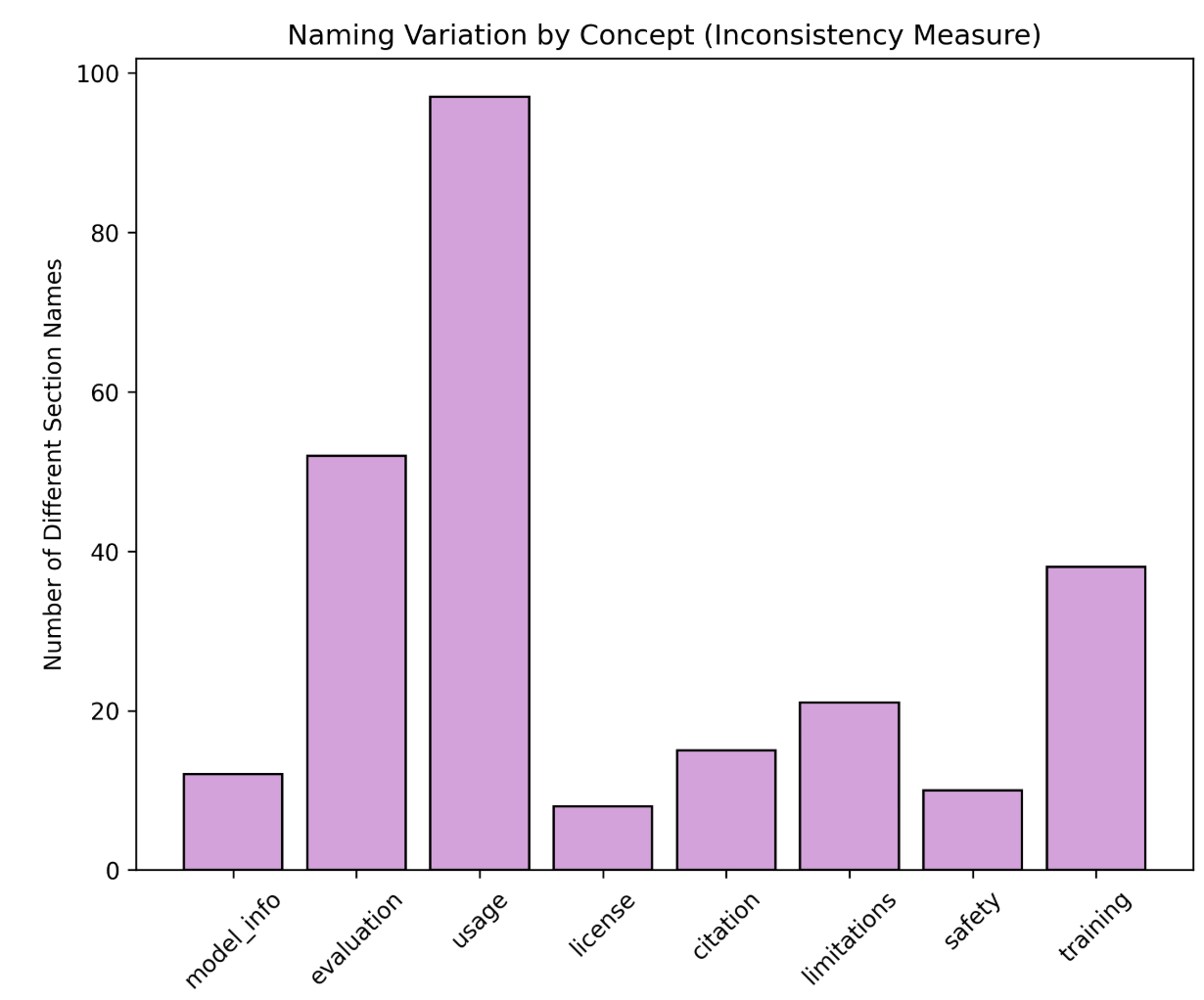
The image displays a vertical bar chart titled "Naming Variation by Concept (Inconsistency Measure)". It quantifies the inconsistency in terminology used for different conceptual sections within a body of technical documentation (likely AI model cards or similar reports). The metric is the count of distinct names used to refer to the same underlying concept.
### Components/Axes
* **Chart Title:** "Naming Variation by Concept (Inconsistency Measure)" (Top center).
* **Y-Axis:** Labeled "Number of Different Section Names". The scale runs from 0 to 100, with major tick marks at intervals of 20 (0, 20, 40, 60, 80, 100).
* **X-Axis:** Contains eight categorical labels, each representing a conceptual section. The labels are rotated approximately 45 degrees for readability. From left to right, they are:
1. `model_info`
2. `evaluation`
3. `usage`
4. `license`
5. `citation`
6. `limitations`
7. `safety`
8. `training`
* **Data Series:** A single series represented by light purple bars with black outlines. There is no legend, as the categories are directly labeled on the x-axis.
### Detailed Analysis
The chart presents the following approximate values for the number of different names used for each concept. Values are estimated based on bar height relative to the y-axis scale.
| Concept (X-Axis Label) | Approximate Number of Different Names (Y-Axis Value) | Visual Trend Description |
| :--- | :--- | :--- |
| `model_info` | ~12 | Short bar, indicating low naming variation. |
| `evaluation` | ~52 | Tall bar, indicating high naming variation. |
| `usage` | ~97 | The tallest bar by a significant margin, indicating extremely high naming variation. |
| `license` | ~8 | The shortest bar, indicating the lowest naming variation. |
| `citation` | ~15 | Short bar, similar in height to `model_info`. |
| `limitations` | ~21 | Moderate height, slightly taller than `citation`. |
| `safety` | ~10 | Very short bar, similar to `license`. |
| `training` | ~38 | Moderate height, the third tallest bar. |
### Key Observations
1. **Extreme Outlier:** The concept `usage` shows by far the highest inconsistency, with nearly 100 different names used across the analyzed documents. This is almost double the next highest category (`evaluation`).
2. **High Variation Cluster:** `evaluation` (~52) and `training` (~38) also demonstrate significant naming inconsistency.
3. **Low Variation Cluster:** `license` (~8), `safety` (~10), `model_info` (~12), and `citation` (~15) show relatively consistent naming, with fewer than 20 distinct terms for each.
4. **Overall Pattern:** There is no clear linear trend across the ordered categories. The variation is highly dependent on the specific concept, with practical/operational concepts (`usage`, `evaluation`, `training`) showing much higher inconsistency than formal/legal concepts (`license`, `citation`).
### Interpretation
This chart diagnoses a significant problem in the standardization of technical documentation, likely within the AI/ML field. The data suggests:
* **Communication & Searchability Risk:** The extreme inconsistency for core concepts like `usage` (e.g., might be called "How to Use," "Application," "Deployment," "Inference," etc.) creates barriers for users trying to find information and for automated tools trying to parse or compare documents. It indicates a lack of a shared, controlled vocabulary.
* **Documentation Maturity:** Concepts with low variation (`license`, `citation`) are likely governed by strong external conventions (e.g., standard license types, academic citation formats). Concepts with high variation are more internal and subjective, revealing where community standards are weakest.
* **Actionable Insight:** The chart provides a clear priority list for style guide development or taxonomy creation. Efforts to standardize terminology should focus first on `usage`, then `evaluation` and `training`, to achieve the greatest improvement in document clarity and interoperability. The low variation for `safety` is notable and could be studied as a potential model for standardization.