## Line Charts: HMC Step vs. Value for Different 'd' Values
### Overview
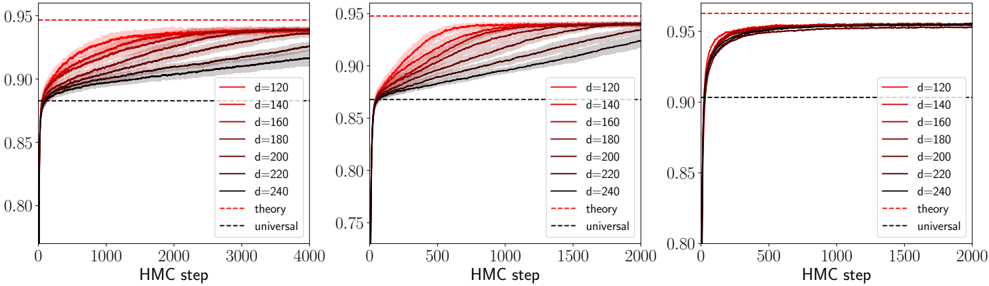
The image presents three line charts arranged horizontally. Each chart plots the relationship between the "HMC step" (x-axis) and a value (y-axis) for different values of 'd' (ranging from 120 to 240). The charts also include lines representing "theory" and "universal" baselines. The x-axis scale varies across the three charts, with the first chart extending to 4000 HMC steps, while the other two extend to 2000 HMC steps.
### Components/Axes
* **X-axis (Horizontal):** "HMC step". The first chart ranges from 0 to 4000, while the second and third range from 0 to 2000.
* **Y-axis (Vertical):** Value. All three charts share the same y-axis scale, ranging from 0.80 to 0.95.
* **Data Series:**
* `d=120`: Red line
* `d=140`: Dark red line
* `d=160`: Brownish-red line
* `d=180`: Dark brown line
* `d=200`: Dark grey line
* `d=220`: Grey line
* `d=240`: Black line
* `theory`: Dashed red line
* `universal`: Dashed black line
* **Legend:** Located on the right side of the first and second charts, and in the middle of the third chart. It maps the 'd' values and the "theory" and "universal" baselines to their corresponding line colors and styles.
* **Chart Titles:** There are no explicit chart titles.
### Detailed Analysis
**Chart 1 (Left):**
* **X-axis:** 0 to 4000 HMC steps.
* **Y-axis:** 0.80 to 0.95.
* **Data Series Trends:**
* `d=120` (Red): Starts around 0.88, rises sharply, and plateaus around 0.94 after approximately 2000 steps.
* `d=140` (Dark Red): Starts around 0.88, rises sharply, and plateaus around 0.93 after approximately 2000 steps.
* `d=160` (Brownish-Red): Starts around 0.88, rises sharply, and plateaus around 0.92 after approximately 2000 steps.
* `d=180` (Dark Brown): Starts around 0.88, rises sharply, and plateaus around 0.91 after approximately 2000 steps.
* `d=200` (Dark Grey): Starts around 0.88, rises sharply, and plateaus around 0.90 after approximately 2000 steps.
* `d=220` (Grey): Starts around 0.88, rises sharply, and plateaus around 0.90 after approximately 2000 steps.
* `d=240` (Black): Starts around 0.88, rises sharply, and plateaus around 0.89 after approximately 2000 steps.
* `theory` (Dashed Red): Horizontal line at approximately 0.95.
* `universal` (Dashed Black): Horizontal line at approximately 0.88.
**Chart 2 (Middle):**
* **X-axis:** 0 to 2000 HMC steps.
* **Y-axis:** 0.75 to 0.95.
* **Data Series Trends:**
* `d=120` (Red): Starts around 0.88, rises sharply, and plateaus around 0.94 after approximately 500 steps.
* `d=140` (Dark Red): Starts around 0.88, rises sharply, and plateaus around 0.93 after approximately 500 steps.
* `d=160` (Brownish-Red): Starts around 0.88, rises sharply, and plateaus around 0.92 after approximately 500 steps.
* `d=180` (Dark Brown): Starts around 0.88, rises sharply, and plateaus around 0.91 after approximately 500 steps.
* `d=200` (Dark Grey): Starts around 0.88, rises sharply, and plateaus around 0.90 after approximately 500 steps.
* `d=220` (Grey): Starts around 0.88, rises sharply, and plateaus around 0.90 after approximately 500 steps.
* `d=240` (Black): Starts around 0.88, rises sharply, and plateaus around 0.89 after approximately 500 steps.
* `theory` (Dashed Red): Horizontal line at approximately 0.95.
* `universal` (Dashed Black): Horizontal line at approximately 0.88.
**Chart 3 (Right):**
* **X-axis:** 0 to 2000 HMC steps.
* **Y-axis:** 0.80 to 0.95.
* **Data Series Trends:**
* `d=120` (Red): Starts around 0.88, rises sharply, and plateaus around 0.94 after approximately 200 steps.
* `d=140` (Dark Red): Starts around 0.88, rises sharply, and plateaus around 0.93 after approximately 200 steps.
* `d=160` (Brownish-Red): Starts around 0.88, rises sharply, and plateaus around 0.92 after approximately 200 steps.
* `d=180` (Dark Brown): Starts around 0.88, rises sharply, and plateaus around 0.91 after approximately 200 steps.
* `d=200` (Dark Grey): Starts around 0.88, rises sharply, and plateaus around 0.90 after approximately 200 steps.
* `d=220` (Grey): Starts around 0.88, rises sharply, and plateaus around 0.90 after approximately 200 steps.
* `d=240` (Black): Starts around 0.88, rises sharply, and plateaus around 0.89 after approximately 200 steps.
* `theory` (Dashed Red): Horizontal line at approximately 0.95.
* `universal` (Dashed Black): Horizontal line at approximately 0.88.
### Key Observations
* All 'd' values start at approximately the same value (around 0.88), which coincides with the "universal" baseline.
* As 'd' increases, the plateau value decreases. The red line (`d=120`) plateaus at the highest value, while the black line (`d=240`) plateaus at the lowest value.
* The "theory" baseline is consistently higher than all the 'd' values.
* The rate at which the lines plateau varies across the three charts. The first chart shows a slower plateauing compared to the second and third charts.
### Interpretation
The charts illustrate the convergence behavior of a process (likely an algorithm or simulation) as a function of the number of HMC steps, for different values of a parameter 'd'. The 'd' parameter seems to influence the final value that the process converges to, with smaller 'd' values leading to higher final values. The "universal" baseline represents a lower bound or initial state, while the "theory" baseline represents an upper bound or theoretical limit. The fact that all 'd' values start at the "universal" baseline suggests that this is the initial condition of the process. The difference in plateauing rates across the three charts suggests that the x-axis scaling is different, and the process converges faster in the third chart compared to the first. The data suggests that the process approaches the theoretical limit, but the rate of convergence and the final value depend on the parameter 'd'.