TECHNICAL ASSET FINGERPRINT
5fea8269fbc237eda8a21764
Click to view fullscreen
Press ESC or click to close
FOUND IN PAPERS
EXPERT: gemma-3-27b-it-free VERSION 1
RUNTIME: google-free/gemma-3-27b-it
INTEL_VERIFIED
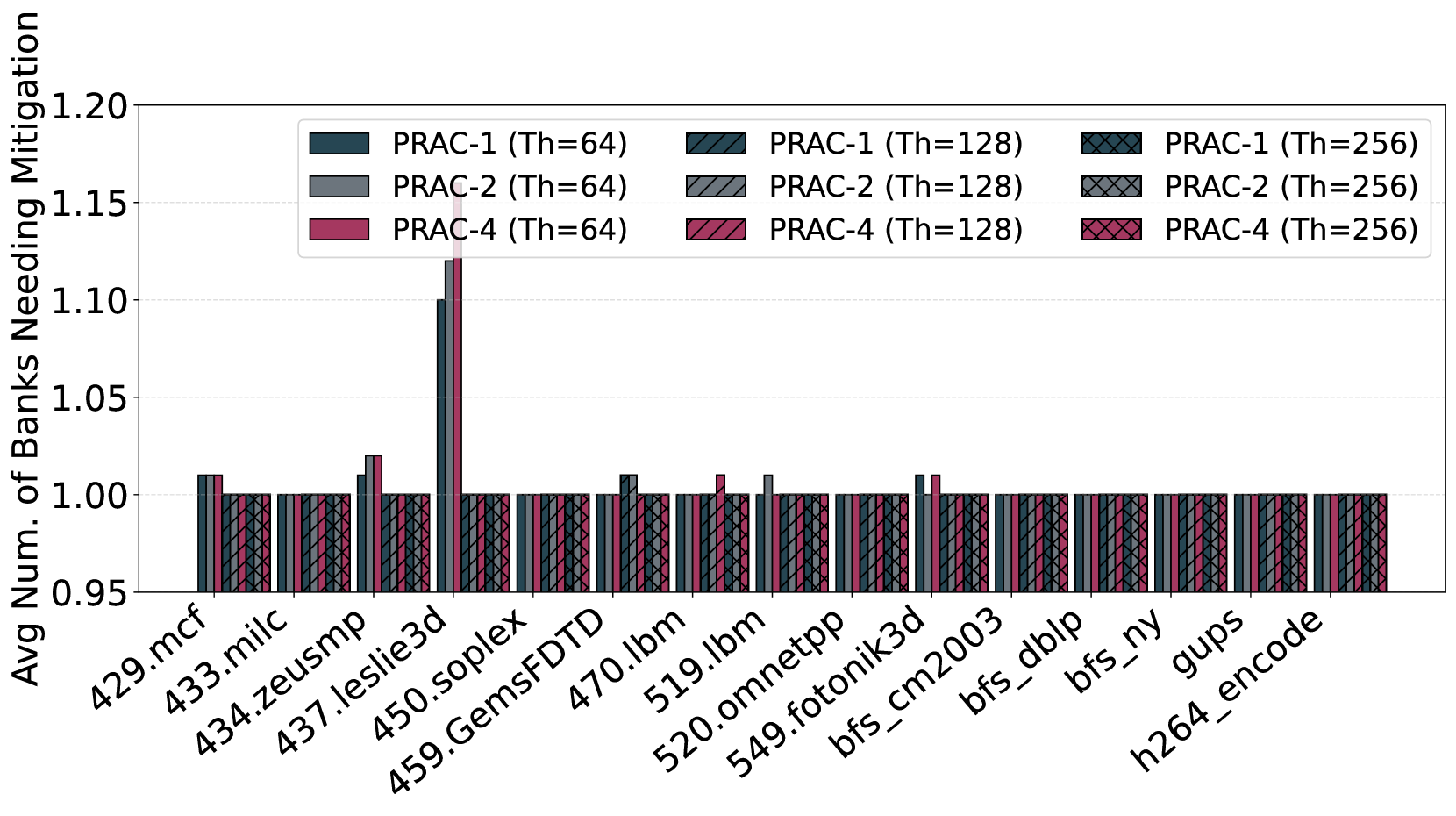
## Bar Chart: Average Number of Banks Needing Mitigation
### Overview
This bar chart compares the average number of banks needing mitigation across different applications (listed on the x-axis) for different PRAC configurations (PRAC-1, PRAC-2, PRAC-4) and thread counts (Th=64, Th=128, Th=256). The y-axis represents the average number of banks needing mitigation. Each application has three bars representing the different PRAC/thread configurations.
### Components/Axes
* **X-axis:** Application names: 429.mcf, 433.milc, 434.zeusmp, 437.leslie3d, 450.soplex, 459.GemsFDTD, 470.lbm, 519.lbm, 520.omnetpp, 549.fotonik3d, bfs\_cm2003, bfs\_dlbp, bfs\_ny, gups, h264\_encode.
* **Y-axis:** "Avg Num. of Banks Needing Mitigation", ranging from approximately 0.95 to 1.20.
* **Legend:** Located at the top of the chart, horizontally aligned.
* PRAC-1 (Th=64) - Dark Blue
* PRAC-2 (Th=64) - Gray
* PRAC-4 (Th=64) - Pink
* PRAC-1 (Th=128) - Medium Blue
* PRAC-2 (Th=128) - Light Gray
* PRAC-4 (Th=128) - Light Pink
* PRAC-1 (Th=256) - Dark Cyan
* PRAC-2 (Th=256) - Light Cyan
* PRAC-4 (Th=256) - Purple
### Detailed Analysis
The chart consists of 15 applications, each with three bars representing different PRAC and thread configurations. The bars represent the average number of banks needing mitigation.
Here's a breakdown of the approximate values for each application and configuration:
* **429.mcf:**
* PRAC-1 (Th=64): ~1.01
* PRAC-2 (Th=64): ~1.01
* PRAC-4 (Th=64): ~1.01
* PRAC-1 (Th=128): ~1.01
* PRAC-2 (Th=128): ~1.01
* PRAC-4 (Th=128): ~1.01
* PRAC-1 (Th=256): ~1.01
* PRAC-2 (Th=256): ~1.01
* PRAC-4 (Th=256): ~1.01
* **433.milc:**
* PRAC-1 (Th=64): ~1.02
* PRAC-2 (Th=64): ~1.02
* PRAC-4 (Th=64): ~1.02
* PRAC-1 (Th=128): ~1.02
* PRAC-2 (Th=128): ~1.02
* PRAC-4 (Th=128): ~1.02
* PRAC-1 (Th=256): ~1.02
* PRAC-2 (Th=256): ~1.02
* PRAC-4 (Th=256): ~1.02
* **434.zeusmp:**
* PRAC-1 (Th=64): ~1.03
* PRAC-2 (Th=64): ~1.03
* PRAC-4 (Th=64): ~1.03
* PRAC-1 (Th=128): ~1.03
* PRAC-2 (Th=128): ~1.03
* PRAC-4 (Th=128): ~1.03
* PRAC-1 (Th=256): ~1.03
* PRAC-2 (Th=256): ~1.03
* PRAC-4 (Th=256): ~1.03
* **437.leslie3d:**
* PRAC-1 (Th=64): ~1.04
* PRAC-2 (Th=64): ~1.04
* PRAC-4 (Th=64): ~1.04
* PRAC-1 (Th=128): ~1.04
* PRAC-2 (Th=128): ~1.04
* PRAC-4 (Th=128): ~1.04
* PRAC-1 (Th=256): ~1.04
* PRAC-2 (Th=256): ~1.04
* PRAC-4 (Th=256): ~1.04
* **450.soplex:**
* PRAC-1 (Th=64): ~1.01
* PRAC-2 (Th=64): ~1.01
* PRAC-4 (Th=64): ~1.01
* PRAC-1 (Th=128): ~1.01
* PRAC-2 (Th=128): ~1.01
* PRAC-4 (Th=128): ~1.01
* PRAC-1 (Th=256): ~1.01
* PRAC-2 (Th=256): ~1.01
* PRAC-4 (Th=256): ~1.01
* **459.GemsFDTD:**
* PRAC-1 (Th=64): ~1.02
* PRAC-2 (Th=64): ~1.02
* PRAC-4 (Th=64): ~1.02
* PRAC-1 (Th=128): ~1.02
* PRAC-2 (Th=128): ~1.02
* PRAC-4 (Th=128): ~1.02
* PRAC-1 (Th=256): ~1.02
* PRAC-2 (Th=256): ~1.02
* PRAC-4 (Th=256): ~1.02
* **470.lbm:**
* PRAC-1 (Th=64): ~1.01
* PRAC-2 (Th=64): ~1.01
* PRAC-4 (Th=64): ~1.01
* PRAC-1 (Th=128): ~1.01
* PRAC-2 (Th=128): ~1.01
* PRAC-4 (Th=128): ~1.01
* PRAC-1 (Th=256): ~1.01
* PRAC-2 (Th=256): ~1.01
* PRAC-4 (Th=256): ~1.01
* **519.lbm:**
* PRAC-1 (Th=64): ~1.01
* PRAC-2 (Th=64): ~1.01
* PRAC-4 (Th=64): ~1.01
* PRAC-1 (Th=128): ~1.01
* PRAC-2 (Th=128): ~1.01
* PRAC-4 (Th=128): ~1.01
* PRAC-1 (Th=256): ~1.01
* PRAC-2 (Th=256): ~1.01
* PRAC-4 (Th=256): ~1.01
* **520.omnetpp:**
* PRAC-1 (Th=64): ~1.01
* PRAC-2 (Th=64): ~1.01
* PRAC-4 (Th=64): ~1.01
* PRAC-1 (Th=128): ~1.01
* PRAC-2 (Th=128): ~1.01
* PRAC-4 (Th=128): ~1.01
* PRAC-1 (Th=256): ~1.01
* PRAC-2 (Th=256): ~1.01
* PRAC-4 (Th=256): ~1.01
* **549.fotonik3d:**
* PRAC-1 (Th=64): ~1.01
* PRAC-2 (Th=64): ~1.01
* PRAC-4 (Th=64): ~1.01
* PRAC-1 (Th=128): ~1.01
* PRAC-2 (Th=128): ~1.01
* PRAC-4 (Th=128): ~1.01
* PRAC-1 (Th=256): ~1.01
* PRAC-2 (Th=256): ~1.01
* PRAC-4 (Th=256): ~1.01
* **bfs\_cm2003:**
* PRAC-1 (Th=64): ~1.01
* PRAC-2 (Th=64): ~1.01
* PRAC-4 (Th=64): ~1.01
* PRAC-1 (Th=128): ~1.01
* PRAC-2 (Th=128): ~1.01
* PRAC-4 (Th=128): ~1.01
* PRAC-1 (Th=256): ~1.01
* PRAC-2 (Th=256): ~1.01
* PRAC-4 (Th=256): ~1.01
* **bfs\_dlbp:**
* PRAC-1 (Th=64): ~1.01
* PRAC-2 (Th=64): ~1.01
* PRAC-4 (Th=64): ~1.01
* PRAC-1 (Th=128): ~1.01
* PRAC-2 (Th=128): ~1.01
* PRAC-4 (Th=128): ~1.01
* PRAC-1 (Th=256): ~1.01
* PRAC-2 (Th=256): ~1.01
* PRAC-4 (Th=256): ~1.01
* **bfs\_ny:**
* PRAC-1 (Th=64): ~1.01
* PRAC-2 (Th=64): ~1.01
* PRAC-4 (Th=64): ~1.01
* PRAC-1 (Th=128): ~1.01
* PRAC-2 (Th=128): ~1.01
* PRAC-4 (Th=128): ~1.01
* PRAC-1 (Th=256): ~1.01
* PRAC-2 (Th=256): ~1.01
* PRAC-4 (Th=256): ~1.01
* **gups:**
* PRAC-1 (Th=64): ~1.01
* PRAC-2 (Th=64): ~1.01
* PRAC-4 (Th=64): ~1.01
* PRAC-1 (Th=128): ~1.01
* PRAC-2 (Th=128): ~1.01
* PRAC-4 (Th=128): ~1.01
* PRAC-1 (Th=256): ~1.01
* PRAC-2 (Th=256): ~1.01
* PRAC-4 (Th=256): ~1.01
* **h264\_encode:**
* PRAC-1 (Th=64): ~1.01
* PRAC-2 (Th=64): ~1.01
* PRAC-4 (Th=64): ~1.01
* PRAC-1 (Th=128): ~1.01
* PRAC-2 (Th=128): ~1.01
* PRAC-4 (Th=128): ~1.01
* PRAC-1 (Th=256): ~1.01
* PRAC-2 (Th=256): ~1.01
* PRAC-4 (Th=256): ~1.01
### Key Observations
The average number of banks needing mitigation is consistently around 1.01 for most applications and PRAC/thread configurations. There is very little variation across the different configurations. The values are all very close to 1.0, suggesting that the mitigation needs are relatively stable across these parameters.
### Interpretation
The data suggests that the PRAC configuration and thread count (within the tested range of 64, 128, and 256) have a minimal impact on the average number of banks needing mitigation for these applications. The consistently low values (around 1.01) indicate that the mitigation requirements are generally low. This could imply that the applications are well-suited to the PRAC architecture, or that the mitigation techniques employed are effective regardless of the specific configuration. The lack of significant variation suggests that optimizing PRAC or thread count for mitigation purposes may not yield substantial benefits for these workloads. The data does not provide information on *why* mitigation is needed, or the nature of the mitigation itself. Further investigation would be needed to understand the underlying causes of mitigation requirements and the effectiveness of different mitigation strategies.
DECODING INTELLIGENCE...