\n
## Diagram: FlowForge Task Breakdown & LLM Interaction
### Overview
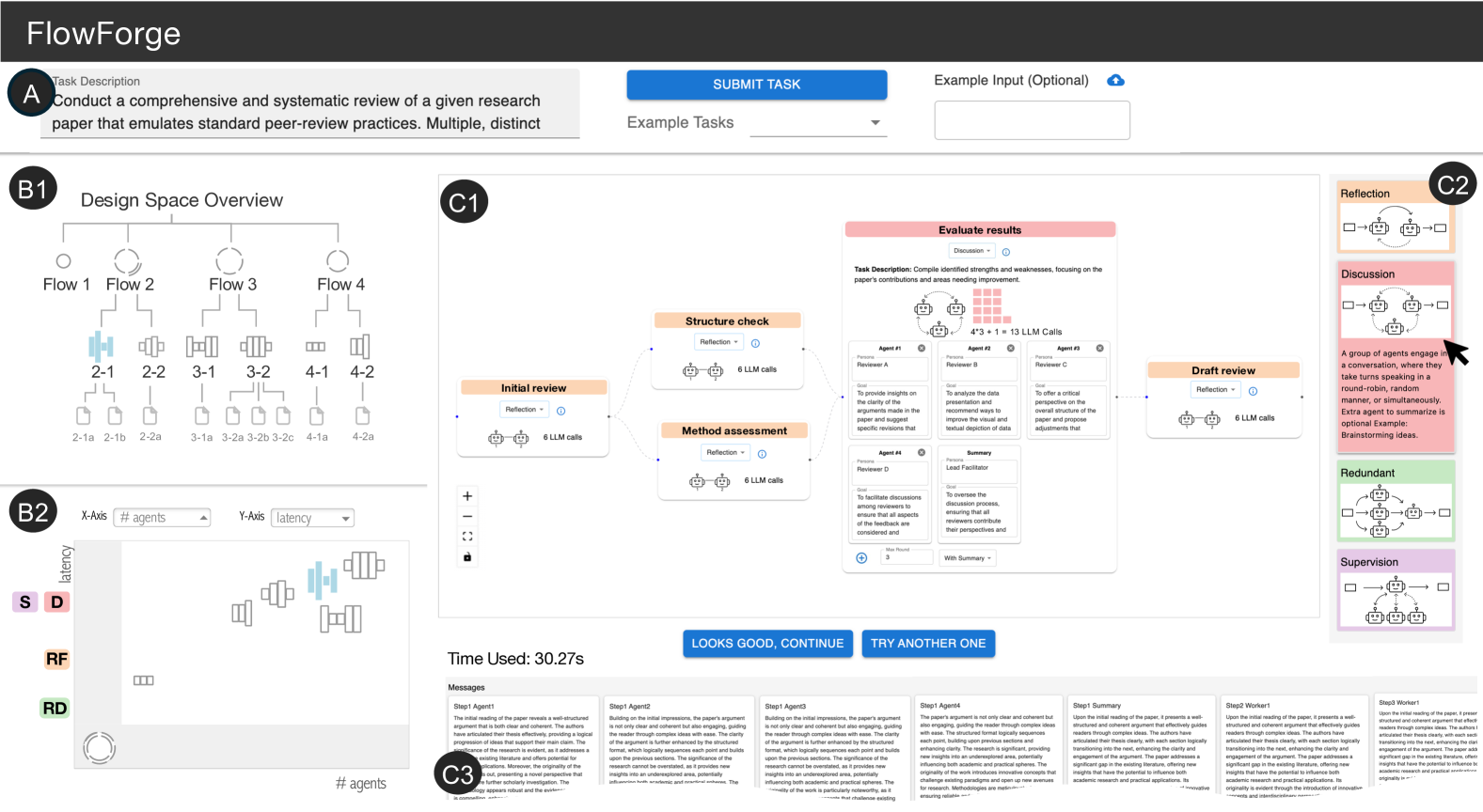
This diagram illustrates the workflow of a task within the FlowForge system, focusing on a peer-review process powered by Large Language Models (LLMs). The diagram is segmented into several areas: a task description at the top, a design space overview (B1), latency charts (B2), a detailed process flow (C1 & C2), and a message log with agent interactions (bottom). The diagram highlights the use of multiple LLM calls throughout the process.
### Components/Axes
* **Top Bar:** "FlowForge", "Task Description: Conduct a comprehensive and systematic review of a given research paper that emulates standard peer-review practices. Multiple, distinct...", "SUBMIT TASK", "Example Input (Optional)"
* **B1 - Design Space Overview:** Four flows labeled "Flow 1", "Flow 2", "Flow 3", "Flow 4". Each flow is represented by a series of vertical bars with numerical labels below (2-1, 2-2 for Flow 1, etc.).
* **B2 - Latency Charts:** Two bar charts.
* X-axis: "# agents" (ranging from 1 to 6)
* Y-axis: "Latency" (units not specified, but visually ranging from 0 to approximately 10)
* Two data series represented by different colored bars: "S" and "D".
* **C1 - Evaluate Results/Structure Check/Method Assessment:** A process flow diagram with boxes representing stages: "Initial review", "Structure check", "Method assessment", "Evaluate results", "Draft review". Each stage indicates the number of LLM calls used.
* **C2 - Discussion/Redundant/Supervision:** A process flow diagram with boxes representing stages: "Discussion", "Redundant", "Supervision".
* **Bottom Section - Message Log:** Displays messages from different agents (Agent A, Agent B, Agent C, Agent D, Agent E, Agent F, Agent G, Agent H, Agent I) and a "Dashboard" output.
* **Footer:** "Time Used: 30.27s", "Looks Good, Continue", "Try Another One", "c3" (bottom right corner).
### Detailed Analysis or Content Details
**B1 - Design Space Overview:**
* Flow 1: Bars at 2-1 and 2-2.
* Flow 2: Bars at 2-1 and 2-2.
* Flow 3: Bars at 3-1 and 3-2.
* Flow 4: Bars at 4-1 and 4-2.
**B2 - Latency Charts:**
* **Series "S":**
* 1 agent: ~1.5 latency
* 2 agents: ~2.5 latency
* 3 agents: ~3.5 latency
* 4 agents: ~4.5 latency
* 5 agents: ~5.5 latency
* 6 agents: ~6.5 latency
* Trend: Linearly increasing latency with the number of agents.
* **Series "D":**
* 1 agent: ~0.5 latency
* 2 agents: ~1.5 latency
* 3 agents: ~2.5 latency
* 4 agents: ~3.5 latency
* 5 agents: ~4.5 latency
* 6 agents: ~5.5 latency
* Trend: Linearly increasing latency with the number of agents.
**C1 - Evaluate Results/Structure Check/Method Assessment:**
* Initial review: 6 LLM calls.
* Structure check: +2 + 1 = 13 LLM Calls. Agent A, Agent B, Agent C, Agent D, Agent E, Agent F, Agent G.
* Method assessment: 6 LLM calls.
* Evaluate results: 6 LLM calls.
* Draft review: 6 LLM calls.
**C2 - Discussion/Redundant/Supervision:**
* Discussion: A group of 6 agents engage in a conversation.
* Redundant: A process that appears to be a check for redundancy.
* Supervision: A final oversight stage.
**Bottom Section - Message Log:**
* Agent A: "The prompt contributes to the clarity of the arguments made in the research paper and the overall structure of the data collection."
* Agent B: "To ensure the task is completed with the required rigor and attention to detail, it is essential to assess the overall structure of the research paper and its arguments."
* Agent C: "The structure check is essential for ensuring that all aspects of the research paper are logically sound."
* Agent D: "The method assessment is essential for ensuring that all aspects of the research paper are logically sound."
* Agent E: "The evaluate results stage is essential for ensuring that all aspects of the research paper are logically sound."
* Agent F: "The draft review stage is essential for ensuring that all aspects of the research paper are logically sound."
* Agent G: "The draft review stage is essential for ensuring that all aspects of the research paper are logically sound."
* Agent H: "The draft review stage is essential for ensuring that all aspects of the research paper are logically sound."
* Agent I: "The draft review stage is essential for ensuring that all aspects of the research paper are logically sound."
* Dashboard: "With Summary"
### Key Observations
* The latency increases linearly with the number of agents involved.
* Each stage of the review process utilizes a consistent number of LLM calls (6, except for Structure Check).
* The message log shows a repetitive response from Agents D through I, indicating a potential issue with the LLM's output or a loop in the process.
* The "Looks Good, Continue" button suggests a positive evaluation of the current state.
### Interpretation
The diagram demonstrates a workflow for automated peer review using LLMs. The system breaks down the review process into distinct stages (Initial Review, Structure Check, Method Assessment, Evaluation, Draft Review), each leveraging LLM calls to analyze the research paper. The latency charts suggest a trade-off between the number of agents involved and the time taken for the review. The repetitive responses from multiple agents in the message log are a significant anomaly, potentially indicating a problem with the LLM's reasoning or a flaw in the prompt design. The overall design appears to be iterative, with the "Looks Good, Continue" button allowing for progression through the workflow. The "Design Space Overview" (B1) suggests exploration of different flow configurations, potentially optimizing the review process. The diagram highlights the potential of LLMs to automate aspects of peer review, but also underscores the importance of careful monitoring and refinement to address issues like repetitive outputs and ensure the quality of the review.