## Diagram: AI Agent Navigation in Domestic Environment (Task: Count Cushions on Red Sofa)
### Overview
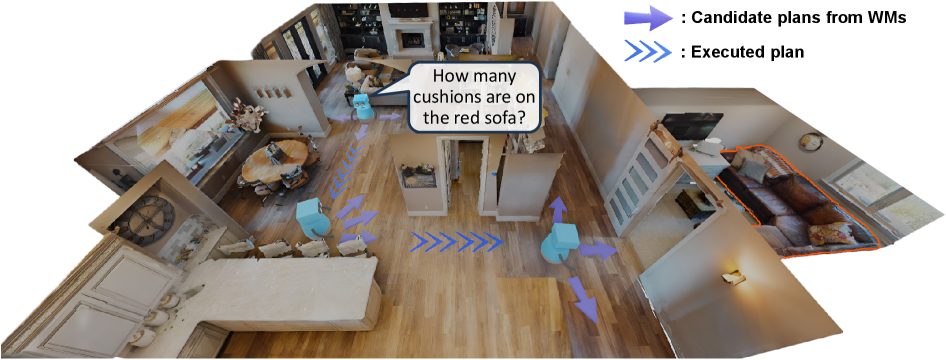
The image is a 3D-rendered top-down floor plan of a house, illustrating an AI agent’s (blue robotic figure) navigation and task planning to answer the question: *“How many cushions are on the red sofa?”* The diagram includes a legend for plan types, a speech bubble with the task, and a spatial layout of rooms/objects.
### Components/Axes
- **Legend (Top-Right)**:
- Purple arrow (single): *“Candidate plans from WMs”* (World Models, likely alternative navigation paths).
- Blue arrow (double): *“Executed plan”* (the path the agent actually took).
- **Rooms/Objects**:
- **Red Sofa**: Outlined in orange, located in the right-side living room area (visible cushions: ~3–4, though exact count is unclear from the diagram).
- **Dining Area**: Table with chairs, near the center-left.
- **Kitchen**: Cabinets and appliances, center.
- **Bedroom**: Bed and furniture, bottom-left.
- **Agents/Robots**: Blue, boxy figures with directional arrows (indicating movement plans).
- **Speech Bubble**: Contains the task: *“How many cushions are on the red sofa?”* (positioned near a blue agent in the middle-left area).
### Detailed Analysis
- **Spatial Layout**: The floor plan is a 3D perspective, showing interconnected rooms. The red sofa is a focal object (outlined in orange) in the right living room.
- **Agent Paths**:
- **Executed Plan (Blue Double Arrows)**: A path from the kitchen area (center) toward the red sofa (right), indicating the agent’s actual movement.
- **Candidate Plans (Purple Single Arrows)**: Multiple alternative paths (e.g., from the dining area, near the red sofa) showing potential navigation options from World Models.
- **Task Context**: The speech bubble frames the agent’s goal: counting cushions on the red sofa, requiring navigation to the sofa’s location.
### Key Observations
- The red sofa is a critical target object, outlined for emphasis.
- The diagram distinguishes between *planned* (candidate) and *executed* paths, highlighting decision-making in navigation.
- The agent’s position (blue figure) and arrows suggest a sequence: planning (purple) → execution (blue) → task completion (counting cushions).
### Interpretation
This diagram illustrates a scenario in **embodied AI/robotics** where an agent navigates a domestic environment to complete a visual task (counting cushions). The “candidate plans from WMs” represent the agent’s internal model of possible paths, while the “executed plan” shows the chosen path. The red sofa’s outline and the task question emphasize object interaction and spatial reasoning. This setup is relevant for testing AI agents’ ability to plan, navigate, and perform object-centric tasks in realistic environments, bridging perception (seeing the sofa) and action (moving to it). The diagram’s structure (legend, paths, task) clarifies the agent’s decision-making process, making it a useful tool for visualizing AI navigation and task execution.
*(Note: The image contains no numerical data or charts—only a diagrammatic representation of a robotic navigation task.)*