## Diagram: Directed Relationship Graph with Indexed Variables
### Overview
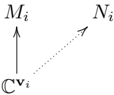
The image displays a simple directed graph or flow diagram illustrating relationships between three mathematical variables. The diagram uses standard mathematical notation with subscripts and directional arrows to indicate connections or transformations.
### Components/Axes
The diagram consists of three labeled nodes and two directed edges (arrows):
1. **Nodes (Variables):**
* **C_i**: Located at the bottom-left of the diagram. The label is the capital letter "C" with a subscript "i".
* **M_i**: Located directly above `C_i`. The label is the capital letter "M" with a subscript "i".
* **N_i**: Located to the right of `M_i`. The label is the capital letter "N" with a subscript "i".
2. **Edges (Relationships):**
* A **solid, upward-pointing arrow** originates from `C_i` and points directly to `M_i`.
* A **dashed, rightward-pointing arrow** originates from `C_i` and points diagonally upward to `N_i`.
### Detailed Analysis
* **Spatial Layout:** The diagram is arranged in a rough "L" shape. `C_i` is the foundational node at the bottom-left. `M_i` is positioned vertically above it, and `N_i` is positioned horizontally to the right of `M_i`, creating a right angle.
* **Arrow Types:** The use of two distinct arrow styles (solid vs. dashed) is a critical visual cue, implying a difference in the nature of the relationships being depicted.
* **Notation:** The consistent use of the subscript "i" on all three variables (`C_i`, `M_i`, `N_i`) strongly suggests these are indexed elements of a series or set (e.g., for i = 1, 2, 3...).
### Key Observations
1. **Asymmetric Relationships:** The diagram shows that `C_i` has a direct relationship with both `M_i` and `N_i`, but there is no direct arrow shown between `M_i` and `N_i`.
2. **Visual Hierarchy:** The solid arrow to `M_i` is more visually prominent than the dashed arrow to `N_i`, which may imply a stronger, more direct, or primary relationship.
3. **Indexed Consistency:** All variables share the same subscript `i`, indicating they belong to the same indexed instance or iteration of a model.
### Interpretation
This diagram is a conceptual model, likely from mathematics, theoretical computer science, or systems theory. It visually encodes a specific logical or functional relationship.
* **What it Suggests:** The model proposes that a base element or condition `C_i` gives rise to two distinct outcomes or components, `M_i` and `N_i`. The solid arrow to `M_i` suggests a direct, deterministic, or primary transformation. The dashed arrow to `N_i` suggests a secondary, conditional, probabilistic, or derived relationship.
* **Relationship Between Elements:** `C_i` is the common antecedent or source. `M_i` and `N_i` are parallel consequences or outputs from `C_i`, but they are generated through different mechanisms (as indicated by the arrow styles). The lack of a connecting arrow between `M_i` and `N_i` implies they may be independent of each other once generated from `C_i`.
* **Notable Implications:** The subscript "i" is crucial. It indicates this is not a single relationship but a template for a family of relationships. For each index `i`, there exists a triplet (`C_i`, `M_i`, `N_i`) connected in this specific way. This is common in models describing iterative processes, indexed data structures, or parameterized systems. The diagram's power lies in its abstraction; without additional context, `C`, `M`, and `N` could represent any concepts—causes and effects, input and output states, variables in an equation, or components in a logical proof. The arrow styles are the primary carriers of specific relational meaning.