\n
## Scatter Plots: Performance Comparison of Classifiers
### Overview
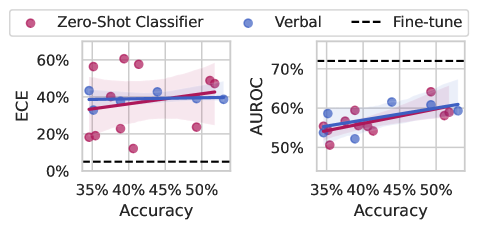
The image presents two scatter plots comparing the performance of a "Zero-Shot Classifier" and a "Verbal" model, against a "Fine-tune" baseline. The plots visualize the relationship between Accuracy and two different metrics: Expected Calibration Error (ECE) in the left plot, and Area Under the Receiver Operating Characteristic curve (AUROC) in the right plot. Each plot includes a regression line with a shaded confidence interval for each model type.
### Components/Axes
* **X-axis (Both Plots):** Accuracy, ranging from 35% to 50%, with markers at 35%, 40%, 45%, and 50%.
* **Y-axis (Left Plot):** Expected Calibration Error (ECE), ranging from 0% to 60%, with markers at 0%, 20%, 40%, and 60%.
* **Y-axis (Right Plot):** Area Under the ROC Curve (AUROC), ranging from 50% to 70%, with markers at 50%, 55%, 60%, 65%, and 70%.
* **Legend (Top-Center):**
* Pink circles: Zero-Shot Classifier
* Blue circles: Verbal
* Black dashed line: Fine-tune
* **Horizontal Dashed Line (Both Plots):** Represents the Fine-tune baseline. The line is at 0% ECE for the left plot and 60% AUROC for the right plot.
### Detailed Analysis or Content Details
**Left Plot (ECE vs. Accuracy):**
* **Fine-tune Baseline:** A horizontal dashed black line at approximately 0% ECE.
* **Zero-Shot Classifier (Pink):** The regression line slopes slightly upwards.
* Approximate data points (visually estimated):
* Accuracy 35%: ECE ~ 55%
* Accuracy 40%: ECE ~ 45%
* Accuracy 45%: ECE ~ 35%
* Accuracy 50%: ECE ~ 25%
* **Verbal (Blue):** The regression line is relatively flat.
* Approximate data points (visually estimated):
* Accuracy 35%: ECE ~ 42%
* Accuracy 40%: ECE ~ 40%
* Accuracy 45%: ECE ~ 38%
* Accuracy 50%: ECE ~ 36%
**Right Plot (AUROC vs. Accuracy):**
* **Fine-tune Baseline:** A horizontal dashed black line at approximately 60% AUROC.
* **Zero-Shot Classifier (Pink):** The regression line slopes upwards.
* Approximate data points (visually estimated):
* Accuracy 35%: AUROC ~ 55%
* Accuracy 40%: AUROC ~ 58%
* Accuracy 45%: AUROC ~ 62%
* Accuracy 50%: AUROC ~ 65%
* **Verbal (Blue):** The regression line slopes slightly upwards.
* Approximate data points (visually estimated):
* Accuracy 35%: AUROC ~ 55%
* Accuracy 40%: AUROC ~ 57%
* Accuracy 45%: AUROC ~ 60%
* Accuracy 50%: AUROC ~ 62%
### Key Observations
* In both plots, the Zero-Shot Classifier exhibits a positive correlation between Accuracy and the performance metric (ECE and AUROC). As Accuracy increases, ECE decreases and AUROC increases.
* The Verbal model shows a weaker correlation. Its performance is relatively stable across the range of Accuracy values.
* The Zero-Shot Classifier consistently performs worse than the Fine-tune baseline in terms of ECE (left plot), but performs similarly to the Fine-tune baseline in terms of AUROC (right plot).
* The confidence intervals (shaded areas) around the regression lines indicate the variability in the data.
### Interpretation
The data suggests that while the Zero-Shot Classifier's performance improves with increasing Accuracy, it suffers from calibration issues (high ECE). This means that its predicted probabilities are not well-aligned with the actual observed frequencies. However, its ability to discriminate between classes (AUROC) is comparable to a Fine-tuned model.
The Verbal model appears to be more stable and well-calibrated, but its overall performance is not as sensitive to changes in Accuracy.
The Fine-tune baseline provides a benchmark for expected performance. The Zero-Shot Classifier's ECE is significantly higher than the baseline, indicating a potential drawback. The AUROC values are close to the baseline, suggesting that the Zero-Shot Classifier can achieve similar discriminatory power with appropriate calibration adjustments.
The plots highlight a trade-off between calibration and discrimination. The Zero-Shot Classifier excels in discrimination but requires calibration, while the Verbal model is well-calibrated but less discriminative. The choice of model depends on the specific application and the relative importance of these two factors.