## Line Chart: ASR vs. Attack Ratio for Different Federated Learning Methods
### Overview
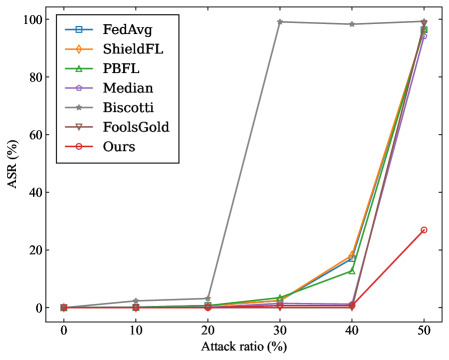
The image is a line chart comparing the Attack Success Rate (ASR) of different federated learning methods against varying attack ratios. The chart plots ASR (in percentage) on the y-axis against the attack ratio (in percentage) on the x-axis. Several federated learning methods are compared, including FedAvg, ShieldFL, PBFL, Median, Biscotti, FoolsGold, and "Ours".
### Components/Axes
* **Title:** There is no explicit title on the chart.
* **X-axis:** Attack ratio (%), with markers at 0, 10, 20, 30, 40, and 50.
* **Y-axis:** ASR (%), with markers at 0, 20, 40, 60, 80, and 100.
* **Legend:** Located in the top-left corner, the legend identifies each line by its corresponding federated learning method:
* Blue square: FedAvg
* Orange diamond: ShieldFL
* Green triangle: PBFL
* Purple star: Median
* Gray pentagon: Biscotti
* Brown inverted triangle: FoolsGold
* Red circle: Ours
### Detailed Analysis
* **FedAvg (Blue):** The ASR remains near 0% until an attack ratio of 40%, then sharply increases to approximately 75% at 50% attack ratio.
* (0, ~0), (10, ~0), (20, ~0), (30, ~0), (40, ~0), (50, ~75)
* **ShieldFL (Orange):** Similar to FedAvg, the ASR is low until 40% attack ratio, then increases to approximately 72% at 50% attack ratio.
* (0, ~0), (10, ~1), (20, ~1), (30, ~2), (40, ~17), (50, ~72)
* **PBFL (Green):** The ASR is low until 40% attack ratio, then increases to approximately 73% at 50% attack ratio.
* (0, ~0), (10, ~2), (20, ~0), (30, ~3), (40, ~13), (50, ~73)
* **Median (Purple):** The ASR is low until 40% attack ratio, then increases to approximately 74% at 50% attack ratio.
* (0, ~0), (10, ~2), (20, ~0), (30, ~1), (40, ~0), (50, ~74)
* **Biscotti (Gray):** The ASR increases sharply from 20% attack ratio and remains near 100% for attack ratios of 30% and above.
* (0, ~0), (10, ~2), (20, ~2), (30, ~99), (40, ~98), (50, ~98)
* **FoolsGold (Brown):** The ASR is low until 40% attack ratio, then increases to approximately 72% at 50% attack ratio.
* (0, ~0), (10, ~2), (20, ~0), (30, ~1), (40, ~0), (50, ~72)
* **Ours (Red):** The ASR remains low until 40% attack ratio, then increases to approximately 27% at 50% attack ratio.
* (0, ~0), (10, ~2), (20, ~0), (30, ~0), (40, ~0), (50, ~27)
### Key Observations
* Biscotti is highly vulnerable to attacks, with ASR reaching nearly 100% at relatively low attack ratios.
* FedAvg, ShieldFL, PBFL, Median, and FoolsGold show similar trends, with low ASR until a 40% attack ratio, followed by a sharp increase.
* "Ours" consistently has the lowest ASR compared to other methods, indicating better resilience against attacks.
### Interpretation
The chart demonstrates the vulnerability of different federated learning methods to attacks. Biscotti is highly susceptible, while "Ours" appears to be the most robust against the attacks represented in the chart. The other methods (FedAvg, ShieldFL, PBFL, Median, and FoolsGold) exhibit similar vulnerabilities, with a sharp increase in ASR at higher attack ratios. The data suggests that the "Ours" method provides a significant improvement in security compared to the other methods tested. The sharp increase in ASR for most methods at 40% attack ratio suggests a critical threshold where the attacks become significantly more effective.