## Bar Charts: MUSHRA Scores for Audio Codecs AcrossBitrates
### Overview
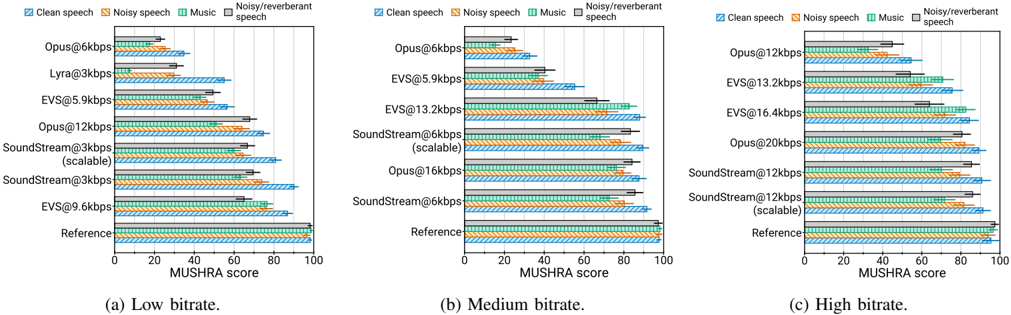
The image contains three side-by-side bar charts comparing MUSHRA (Multidimensional Speech Quality Evaluation) scores for audio codecs under three bitrate categories: **Low**, **Medium**, and **High**. Each chart evaluates four conditions: **Clean speech**, **Noisy speech**, **Music**, and **Noisy/reverberant speech**. The y-axis lists codecs (e.g., Opus, ESVs, SoundStream) with their bitrates, while the x-axis represents scores from 0 to 100. The **Reference** codec consistently achieves the highest scores across all conditions and bitrates.
### Components/Axes
- **X-axis**: MUSHRA score (0–100), labeled "MUSHRA score".
- **Y-axis**: Audio codecs and bitrates (e.g., "Opus@6kbps", "SoundStream@3kbps (scalable)").
- **Legend**: Located on the left, with four categories:
- **Clean speech** (blue, solid bars)
- **Noisy speech** (orange, dashed bars)
- **Music** (green, dotted bars)
- **Noisy/reverberant speech** (gray, striped bars)
- **Charts**: Three horizontal bar charts labeled **(a) Low bitrate**, **(b) Medium bitrate**, **(c) High bitrate**.
### Detailed Analysis
#### Low Bitrate (a)
- **Opus@6kbps**: Clean (~30), Noisy (~25), Music (~20), Noisy/reverberant (~15).
- **Lyra@3kbps**: Clean (~40), Noisy (~35), Music (~30), Noisy/reverberant (~25).
- **EVS@5.9kbps**: Clean (~50), Noisy (~45), Music (~40), Noisy/reverberant (~35).
- **SoundStream@3kbps (scalable)**: Clean (~60), Noisy (~55), Music (~50), Noisy/reverberant (~45).
- **Reference**: All conditions ~90.
#### Medium Bitrate (b)
- **Opus@6kbps**: Clean (~40), Noisy (~35), Music (~30), Noisy/reverberant (~25).
- **EVS@5.9kbps**: Clean (~50), Noisy (~45), Music (~40), Noisy/reverberant (~35).
- **EVS@13.2kbps**: Clean (~70), Noisy (~60), Music (~55), Noisy/reverberant (~50).
- **SoundStream@6kbps (scalable)**: Clean (~80), Noisy (~75), Music (~70), Noisy/reverberant (~65).
- **Opus@16kbps**: Clean (~85), Noisy (~78), Music (~72), Noisy/reverberant (~68).
- **Reference**: All conditions ~95.
#### High Bitrate (c)
- **Opus@12kbps**: Clean (~50), Noisy (~45), Music (~40), Noisy/reverberant (~35).
- **EVS@13.2kbps**: Clean (~70), Noisy (~60), Music (~55), Noisy/reverberant (~50).
- **EVS@16.4kbps**: Clean (~80), Noisy (~75), Music (~70), Noisy/reverberant (~65).
- **Opus@20kbps**: Clean (~85), Noisy (~78), Music (~72), Noisy/reverberant (~68).
- **SoundStream@12kbps (scalable)**: Clean (~90), Noisy (~85), Music (~80), Noisy/reverberant (~75).
- **Reference**: All conditions ~98.
### Key Observations
1. **Reference Codec Dominance**: The Reference codec consistently achieves the highest scores (~90–98) across all bitrates and conditions, serving as the benchmark.
2. **Bitrate Impact**: Higher bitrates improve performance for all codecs, but the gap between codecs narrows at higher bitrates (e.g., SoundStream@12kbps in High bitrate approaches Reference scores).
3. **Noisy/Reverberant Speech**: All codecs perform worst under noisy/reverberant conditions, with scores 10–20 points lower than Clean speech.
4. **SoundStream Scalability**: SoundStream (scalable) shows strong performance in Medium and High bitrates, often outperforming fixed-bitrate codecs like Opus.
5. **EVS Performance**: EVS improves with higher bitrates (e.g., EVS@16.4kbps in High bitrate scores ~80 for Clean speech).
### Interpretation
The data demonstrates that **bitrate significantly influences codec performance**, with higher bitrates enabling better fidelity. The **Reference codec** remains the gold standard, but scalable codecs like **SoundStream** adapt effectively to higher bitrates, closing performance gaps. Noisy/reverberant conditions universally degrade scores, highlighting challenges in real-world environments. The results suggest that **codec efficiency and adaptability** (e.g., SoundStream’s scalability) are critical for applications requiring robust performance across varying network conditions.