## Line Graphs: Model Performance vs. Token Count
### Overview
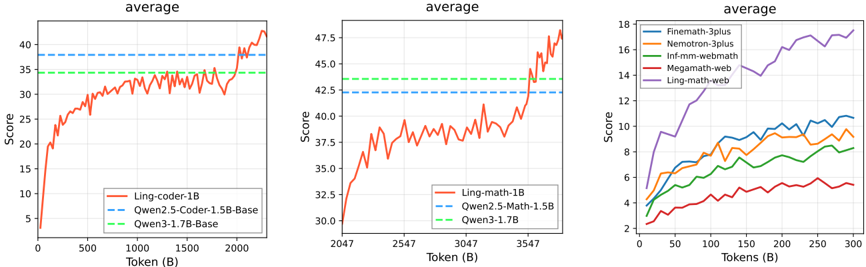
The image contains three line graphs comparing the performance of different AI models across tasks as token count increases. Each graph tracks "Score" on the y-axis against "Token (B)" on the x-axis, with distinct data series represented by colored lines and legends.
---
### Components/Axes
1. **Graph 1: "average"**
- **X-axis**: Token (B) (0–2000)
- **Y-axis**: Score (0–40)
- **Legend**:
- Red: Ling-coder-1B
- Blue dashed: Qwen2.5-Coder-1.5B-Base
- Green dashed: Qwen3-1.7B-Base
2. **Graph 2: "average"**
- **X-axis**: Token (B) (2047–3547)
- **Y-axis**: Score (30–47.5)
- **Legend**:
- Red: Ling-math-1B
- Blue dashed: Qwen2.5-Math-1.5B
- Green dashed: Qwen3-1.7B
3. **Graph 3: "average"**
- **X-axis**: Token (B) (0–300)
- **Y-axis**: Score (2–18)
- **Legend**:
- Blue: Finemath-3plus
- Orange: Nemotron-3plus
- Green: Inf-mm-webmath
- Red: Megamath-web
- Purple: Ling-math-web
---
### Detailed Analysis
#### Graph 1: Ling-coder-1B vs. Qwen Models
- **Ling-coder-1B (Red)**: Starts at ~5, rises sharply to ~40 by 2000 tokens, with fluctuations.
- **Qwen2.5-Coder-1.5B-Base (Blue dashed)**: Flat line at ~35.
- **Qwen3-1.7B-Base (Green dashed)**: Flat line at ~35.
#### Graph 2: Ling-math-1B vs. Qwen Math Models
- **Ling-math-1B (Red)**: Starts at ~30, rises to ~47.5 by 3547 tokens, with volatility.
- **Qwen2.5-Math-1.5B (Blue dashed)**: Flat line at ~42.5.
- **Qwen3-1.7B (Green dashed)**: Flat line at ~42.5.
#### Graph 3: Math/Web Math Models
- **Finemath-3plus (Blue)**: Starts at ~4, peaks at ~11 by 300 tokens.
- **Nemotron-3plus (Orange)**: Starts at ~3, peaks at ~9 by 300 tokens.
- **Inf-mm-webmath (Green)**: Starts at ~2, peaks at ~8 by 300 tokens.
- **Megamath-web (Red)**: Starts at ~2, peaks at ~5 by 300 tokens.
- **Ling-math-web (Purple)**: Starts at ~5, peaks at ~17 by 300 tokens.
---
### Key Observations
1. **Ling Models Dominance**:
- Ling-coder-1B and Ling-math-1B consistently outperform Qwen models in their respective graphs, suggesting superior scalability or optimization.
- Ling-math-web (purple) in Graph 3 shows the steepest growth, surpassing all other models.
2. **Qwen Model Stagnation**:
- Qwen2.5 and Qwen3 models in Graphs 1–2 remain flat, indicating no improvement with increased tokens (possibly base models without fine-tuning).
3. **Task-Specific Performance**:
- Graph 3 reveals divergent trends: Finemath-3plus and Nemotron-3plus perform better in math tasks, while Ling-math-web excels in web math.
---
### Interpretation
- **Scalability Insights**: Ling models demonstrate strong token efficiency, likely due to specialized training (e.g., code/math tasks). Qwen models’ flat lines suggest they are static base models.
- **Task Optimization**: Ling-math-web’s rapid improvement in Graph 3 highlights its effectiveness in web math, outperforming generalist models like Finemath-3plus.
- **Anomalies**: The abrupt rise in Ling-coder-1B (Graph 1) and Ling-math-1B (Graph 2) may indicate task-specific breakthroughs or dataset biases.
This analysis underscores the importance of model architecture and training focus in achieving token-efficient performance across domains.