## Text Comparison: Problem Solving Approaches
### Overview
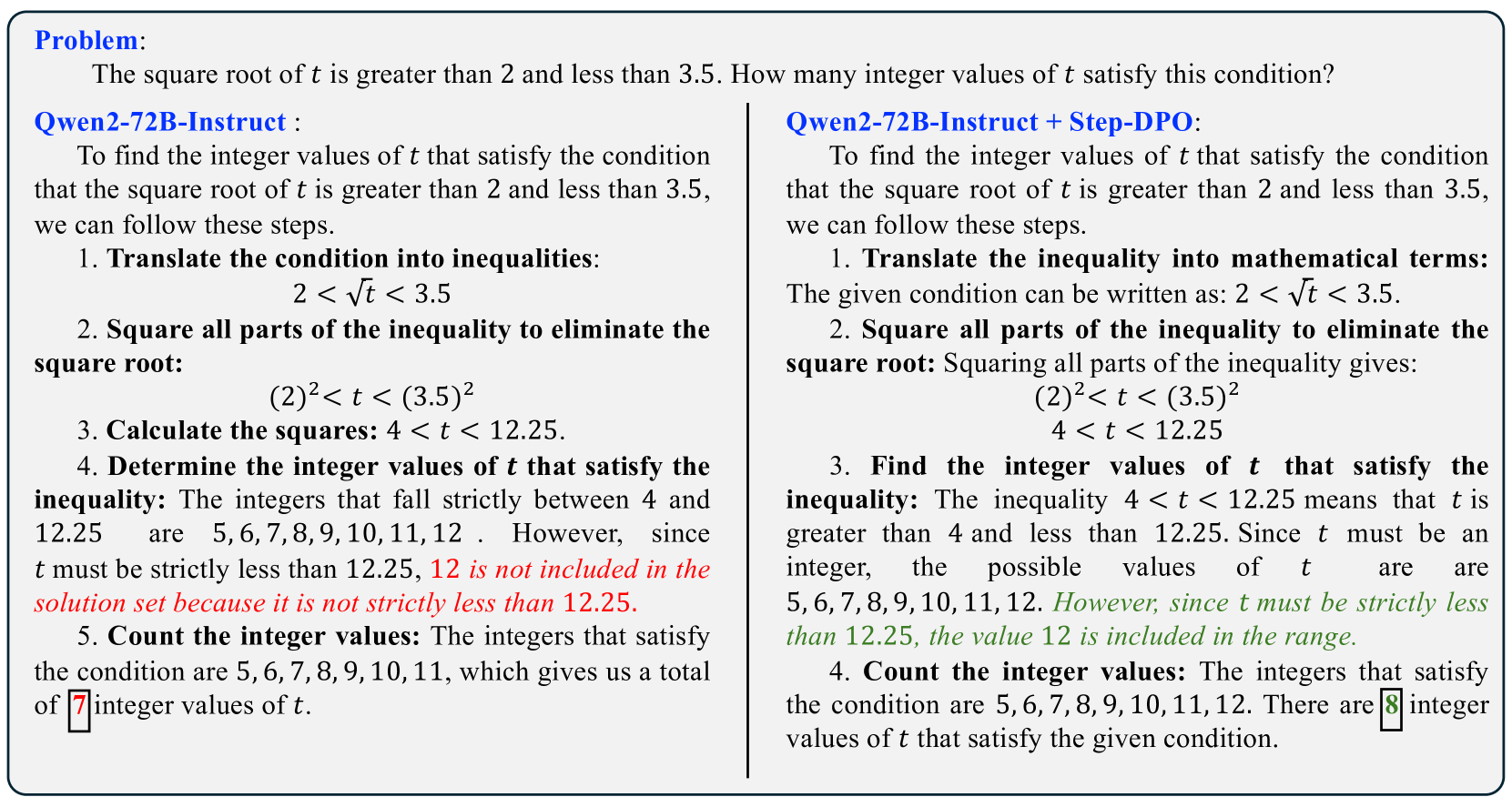
The image presents two different approaches to solving a mathematical problem. The problem asks for the number of integer values of 't' that satisfy the condition where the square root of 't' is greater than 2 and less than 3.5. The left side shows a solution using "Qwen2-72B-Instruct," while the right side uses "Qwen2-72B-Instruct + Step-DPO." The key difference lies in how the integer values are handled at the upper bound of the inequality.
### Components/Axes
* **Problem Statement:** Defines the mathematical problem to be solved.
* **Solution Method 1:** "Qwen2-72B-Instruct" - A step-by-step approach to solving the problem.
* **Solution Method 2:** "Qwen2-72B-Instruct + Step-DPO" - A slightly different step-by-step approach.
* **Steps:** Both solutions break down the problem into numbered steps.
* **Inequalities:** Mathematical expressions representing the problem's constraints.
* **Integer Values:** Lists of integers that satisfy the derived inequalities.
* **Final Answer:** The total number of integer values that satisfy the condition.
### Detailed Analysis or ### Content Details
**Left Side: Qwen2-72B-Instruct**
1. **Problem:** The square root of t is greater than 2 and less than 3.5. How many integer values of t satisfy this condition?
2. **Qwen2-72B-Instruct:** To find the integer values of t that satisfy the condition that the square root of t is greater than 2 and less than 3.5, we can follow these steps.
3. **Step 1: Translate the condition into inequalities:** 2 < √t < 3.5
4. **Step 2: Square all parts of the inequality to eliminate the square root:** (2)² < t < (3.5)²
5. **Step 3: Calculate the squares:** 4 < t < 12.25
6. **Step 4: Determine the integer values of t that satisfy the inequality:** The integers that fall strictly between 4 and 12.25 are 5, 6, 7, 8, 9, 10, 11, 12. However, since t must be strictly less than 12.25, 12 is not included in the solution set because it is not strictly less than 12.25.
7. **Step 5: Count the integer values:** The integers that satisfy the condition are 5, 6, 7, 8, 9, 10, 11, which gives us a total of 7 integer values of t.
**Right Side: Qwen2-72B-Instruct + Step-DPO**
1. **Qwen2-72B-Instruct + Step-DPO:** To find the integer values of t that satisfy the condition that the square root of t is greater than 2 and less than 3.5, we can follow these steps.
2. **Step 1: Translate the inequality into mathematical terms:** The given condition can be written as: 2 < √t < 3.5.
3. **Step 2: Square all parts of the inequality to eliminate the square root:** Squaring all parts of the inequality gives: (2)² < t < (3.5)² which simplifies to 4 < t < 12.25
4. **Step 3: Find the integer values of t that satisfy the inequality:** The inequality 4 < t < 12.25 means that t is greater than 4 and less than 12.25. Since t must be an integer, the possible values of t are 5, 6, 7, 8, 9, 10, 11, 12. However, since t must be strictly less than 12.25, the value 12 is included in the range.
5. **Step 4: Count the integer values:** The integers that satisfy the condition are 5, 6, 7, 8, 9, 10, 11, 12. There are 8 integer values of t that satisfy the given condition.
### Key Observations
* Both methods correctly translate the problem into an inequality and square it to find the range for 't'.
* The critical difference is in the interpretation of the upper bound (12.25). The left side excludes 12, while the right side includes it.
* The left side arrives at a final answer of 7, while the right side arrives at 8.
### Interpretation
The difference in the final answers stems from the interpretation of whether the integer 12 should be included in the solution set. The left side ("Qwen2-72B-Instruct") explicitly excludes 12 because 't' must be *strictly* less than 12.25. The right side ("Qwen2-72B-Instruct + Step-DPO") includes 12, implying a slightly different interpretation of the inequality or a different rounding/inclusion rule.
The "Step-DPO" addition seems to allow for the inclusion of the integer 12, even though the inequality is strict. This could be due to a specific design choice in the "Step-DPO" algorithm to handle such boundary cases differently.