## Diagram: Monte Carlo Tree Search (MCTS) Process
### Overview
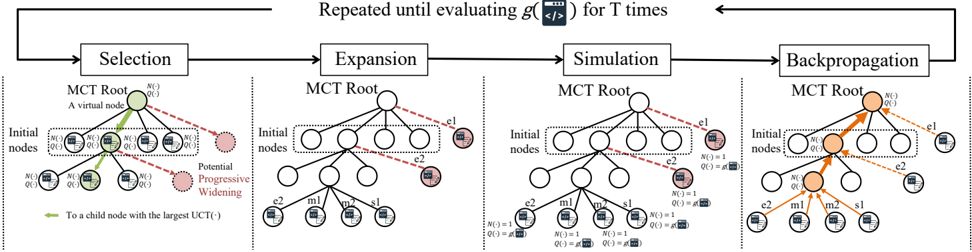
The image illustrates the four main stages of the Monte Carlo Tree Search (MCTS) algorithm: Selection, Expansion, Simulation, and Backpropagation. The diagram shows how the search tree evolves through these stages, starting from an initial virtual root node and expanding based on simulation results. The process is repeated until a certain condition is met, indicated by "Repeated until evaluating g(</> ) for T times".
### Components/Axes
* **Stages (Top, Left to Right):**
* Selection
* Expansion
* Simulation
* Backpropagation
* **Tree Structure:** Each stage depicts a tree structure with nodes and branches.
* **Nodes:** Represented by circles. Some nodes are labeled with N(-) and Q(-), likely representing visit counts and action values.
* **Edges:** Represented by lines connecting nodes.
* **Legend (Bottom-Left):** "To a child node with the largest UCT(-)" (indicated by a green arrow).
* **Labels:**
* "MCT Root" (appears in each stage)
* "Initial nodes" (appears in each stage)
* "Potential Progressive Widening" (appears in the Selection stage)
* "e1", "e2", "m1", "m2", "s1" (appear near nodes in Expansion, Simulation, and Backpropagation stages)
* **Text:** "Repeated until evaluating g(</> ) for T times" (at the top of the diagram).
### Detailed Analysis
**1. Selection (Leftmost):**
* **Description:** Starts with an "MCT Root" labeled as "A virtual node" (green node).
* **Initial Nodes:** A group of nodes is labeled as "Initial nodes". These nodes have labels N(-) and Q(-).
* **Potential Progressive Widening:** Two nodes are marked as "Potential Progressive Widening" (red nodes).
* **Arrow:** A green arrow points from the root node to a child node, indicating selection based on the largest UCT(-).
**2. Expansion:**
* **Description:** Expands the tree by adding new nodes.
* **Initial Nodes:** A group of nodes is labeled as "Initial nodes".
* **New Nodes:** Two new nodes, labeled "e1" and "e2", are added (red nodes).
* **Other Nodes:** Nodes labeled "m1", "m2", and "s1" are present.
**3. Simulation:**
* **Description:** Simulates outcomes from the expanded nodes.
* **Initial Nodes:** A group of nodes is labeled as "Initial nodes".
* **Node Values:** Some nodes are labeled with N(-) = 1 and Q(-) = g(</>).
* **New Nodes:** Two new nodes, labeled "e1" and "e2", are present (red nodes).
* **Other Nodes:** Nodes labeled "m1", "m2", and "s1" are present.
**4. Backpropagation (Rightmost):**
* **Description:** Updates the values of nodes along the path from the simulated node back to the root.
* **MCT Root:** The root node is now colored orange, indicating updated values.
* **Initial Nodes:** A group of nodes is labeled as "Initial nodes".
* **Updated Paths:** Orange arrows indicate the paths along which values are backpropagated.
* **New Nodes:** Two new nodes, labeled "e1" and "e2", are present.
* **Other Nodes:** Nodes labeled "m1", "m2", and "s1" are present.
### Key Observations
* The diagram illustrates the iterative nature of MCTS, with the process repeating until a termination condition is met.
* The tree expands as the algorithm explores different possibilities.
* Node values are updated based on simulation results.
* The "Potential Progressive Widening" suggests a strategy for adding new nodes to the tree.
### Interpretation
The diagram provides a high-level overview of the MCTS algorithm. It demonstrates how the algorithm explores a search space by iteratively selecting, expanding, simulating, and backpropagating values. The "Potential Progressive Widening" indicates a method to balance exploration and exploitation. The repetition of the process "until evaluating g(</> ) for T times" suggests that the algorithm continues until a certain number of simulations (T) have been performed, or until a certain evaluation threshold is reached. The values N(-) and Q(-) likely represent the number of times a node has been visited and the estimated value of the action represented by that node, respectively. The g(</> ) function likely represents the reward or outcome of a simulation.