## Scatter Plot with Trend Lines: Overall Accuracy (%) vs. Training Steps
### Overview
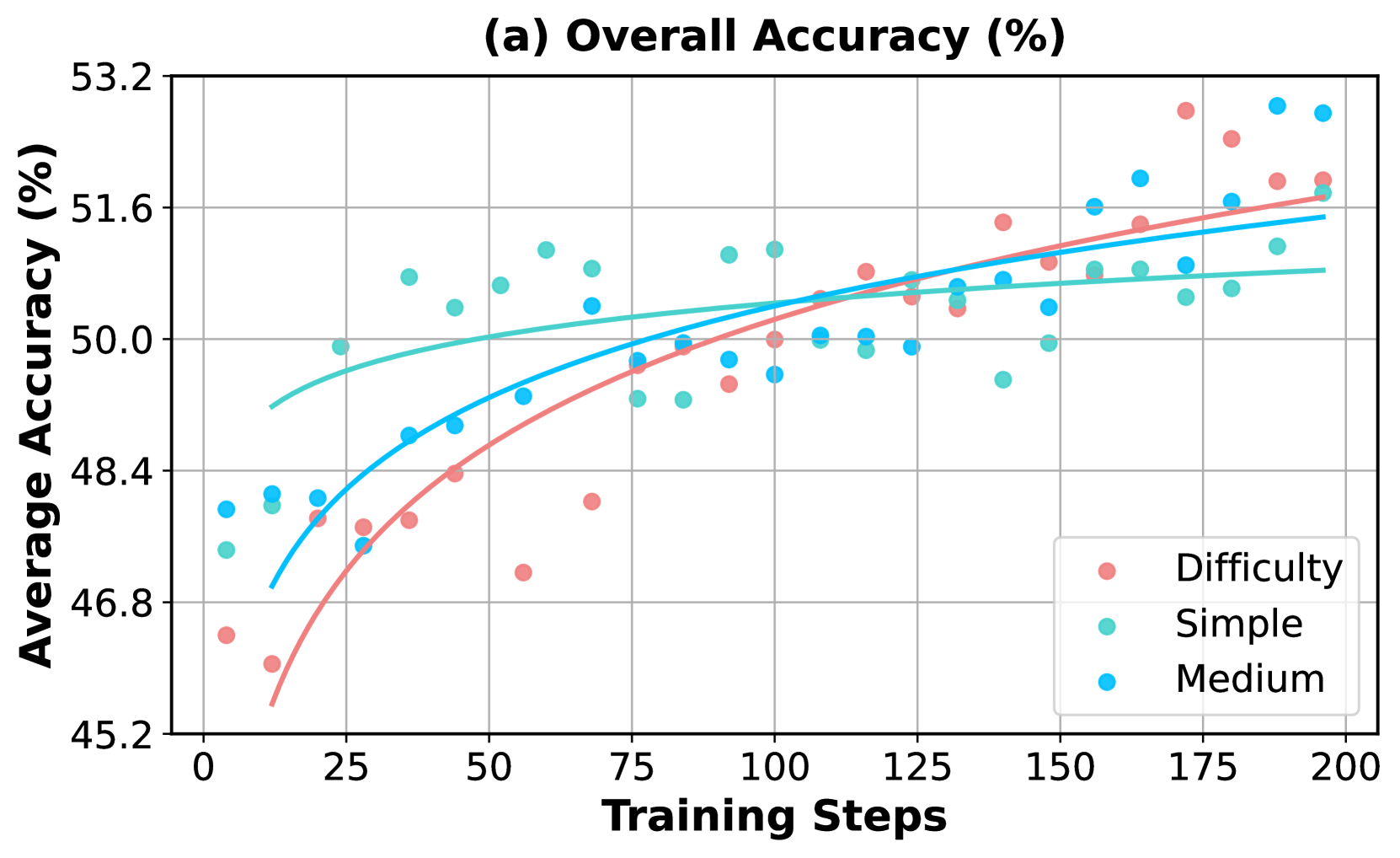
The image is a scatter plot chart titled "(a) Overall Accuracy (%)". It displays the relationship between the number of training steps (x-axis) and the average accuracy percentage (y-axis) for three different task difficulty categories: "Difficulty", "Simple", and "Medium". Each category is represented by colored data points and a corresponding fitted trend line.
### Components/Axes
* **Chart Title:** "(a) Overall Accuracy (%)" (Top center)
* **Y-Axis:**
* **Label:** "Average Accuracy (%)" (Left side, rotated vertically)
* **Scale:** Linear scale ranging from 45.2 to 53.2.
* **Major Tick Marks:** 45.2, 46.8, 48.4, 50.0, 51.6, 53.2.
* **X-Axis:**
* **Label:** "Training Steps" (Bottom center)
* **Scale:** Linear scale ranging from 0 to 200.
* **Major Tick Marks:** 0, 25, 50, 75, 100, 125, 150, 175, 200.
* **Legend:** Located in the bottom-right quadrant of the chart area.
* **"Difficulty":** Represented by red/salmon-colored circular points and a matching red/salmon trend line.
* **"Simple":** Represented by teal/turquoise-colored circular points and a matching teal/turquoise trend line.
* **"Medium":** Represented by bright blue/cyan-colored circular points and a matching bright blue/cyan trend line.
* **Grid:** A light gray grid is present, aligning with the major tick marks on both axes.
### Detailed Analysis
**Trend Verification & Data Point Approximation:**
* **"Difficulty" (Red/Salmon Series):**
* **Trend:** The trend line shows a steep, concave-down increase from low accuracy at the start, which gradually flattens as training steps increase. It starts as the lowest-performing category but shows the most significant improvement.
* **Approximate Data Points (Trend Line):**
* Step ~10: ~45.5%
* Step 50: ~48.8%
* Step 100: ~50.2%
* Step 150: ~51.0%
* Step 200: ~51.8%
* **Notable Scatter:** There is significant variance in the individual data points. For example, a point near step 60 is notably lower (~47.2%) than the trend line, while points after step 150 show high variance, with some reaching near 53.0%.
* **"Simple" (Teal/Turquoise Series):**
* **Trend:** The trend line starts at the highest accuracy level but has the shallowest slope, indicating the slowest rate of improvement. It is nearly linear with a very slight curve.
* **Approximate Data Points (Trend Line):**
* Step ~10: ~49.2%
* Step 50: ~50.0%
* Step 100: ~50.5%
* Step 150: ~50.8%
* Step 200: ~51.0%
* **Notable Scatter:** The data points are relatively tightly clustered around the trend line compared to the other series, suggesting more consistent performance on simple tasks.
* **"Medium" (Bright Blue/Cyan Series):**
* **Trend:** The trend line shows a moderate, concave-down increase, positioned between the "Difficulty" and "Simple" lines in both starting point and slope.
* **Approximate Data Points (Trend Line):**
* Step ~10: ~47.0%
* Step 50: ~49.2%
* Step 100: ~50.4%
* Step 150: ~51.2%
* Step 200: ~51.5%
* **Notable Scatter:** The scatter is moderate. A cluster of points around step 100-125 sits slightly below the trend line.
**Spatial Grounding:** The legend is positioned in the bottom-right, overlapping the lower portion of the data field. The "Difficulty" (red) trend line begins lowest on the left (y ~45.5 at x~10) and ends highest on the right (y ~51.8 at x=200). The "Simple" (teal) line begins highest on the left (y ~49.2 at x~10) and ends lowest on the right (y ~51.0 at x=200). The "Medium" (blue) line is intermediate at both ends.
### Key Observations
1. **Convergence and Crossover:** All three trend lines converge in the region of 100-125 training steps, where their accuracy values are very close (~50.2-50.5%). After this point, the "Difficulty" line surpasses the others.
2. **Diminishing Returns:** All three curves show signs of diminishing returns (concave-down shape), where the gain in accuracy per additional training step decreases as training progresses.
3. **Performance Hierarchy Inversion:** The initial performance hierarchy ("Simple" > "Medium" > "Difficulty") inverts by the end of the plotted training steps ("Difficulty" > "Medium" > "Simple").
4. **Variance:** The "Difficulty" category exhibits the highest variance in data points, especially at higher step counts, suggesting less predictable outcomes when training on hard tasks.
### Interpretation
This chart demonstrates the learning dynamics of a model across tasks of varying difficulty. The data suggests that:
* **Model Learning is Non-Linear:** Accuracy does not improve at a constant rate; the most significant gains happen early in training.
* **Task Difficulty Impacts Learning Trajectory:** The model starts with a better baseline on simple tasks but learns more from complex ("Difficulty") tasks over time. The steeper slope for "Difficulty" indicates that the model's capacity to handle complex problems improves more dramatically with extended training.
* **Potential for Further Training:** Since the curves, especially for "Difficulty" and "Medium," have not fully plateaued by 200 steps, it is plausible that accuracy could continue to increase with further training, though at a slower rate.
* **Training Stability:** The higher variance in the "Difficulty" series might indicate that training on hard tasks is less stable or more sensitive to specific data batches or training conditions.
The inversion of performance hierarchy is a key insight. It implies that while simple tasks are easier to learn initially, sustained training disproportionately benefits the model's ability to solve more challenging problems, ultimately leading to higher overall accuracy on those hard tasks. This is a common and desirable pattern in machine learning, indicating the model is developing robust, generalizable features rather than just memorizing simple patterns.