## Diagram: 8x8 Grid with Symbolic Elements and Numerical Annotations
### Overview
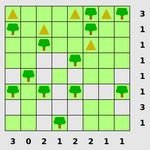
The image displays an 8x8 grid composed of alternating light green and white squares, resembling a checkerboard pattern. The grid contains two types of symbolic icons: green deciduous trees and yellow triangles. Some trees have a small red dot at their apex. Numerical values are aligned along the right vertical edge and the bottom horizontal edge of the grid, likely serving as row and column identifiers or counts.
### Components/Axes
* **Grid Structure:** 8 rows by 8 columns.
* **Row Labels (Right Side):** A vertical column of numbers positioned to the right of the grid, aligned with each row. From top to bottom: `1, 3, 1, 1, 1, 1, 3, 1`.
* **Column Labels (Bottom):** A horizontal row of numbers positioned below the grid, aligned with each column. From left to right: `3, 0, 2, 1, 2, 2, 1, 1`.
* **Symbols:**
* **Green Tree:** A stylized, rounded green tree icon. Some instances have a small red dot centered on the top of the canopy.
* **Yellow Triangle:** A simple, upward-pointing yellow triangle.
* **Grid Cells:** The background alternates between a solid light green and white in a standard checkerboard pattern.
### Detailed Analysis
**Symbol Placement (Row, Column) - using 1-based indexing from top-left:**
* **Yellow Triangles:**
* (1, 1)
* (1, 4)
* (1, 6)
* (1, 7)
* (2, 3)
* **Green Trees (without red dot):**
* (2, 2)
* (4, 5)
* (5, 1)
* (5, 3)
* (5, 6)
* (5, 8)
* (6, 2)
* (6, 4)
* (6, 7)
* (7, 1)
* (7, 5)
* (7, 8)
* **Green Trees (with red dot):**
* (1, 2)
* (2, 1)
* (3, 2)
* (4, 1)
* (4, 3)
* (4, 6)
* (4, 8)
* (6, 1)
* (6, 3)
* (6, 6)
* (7, 2)
* (7, 4)
* (7, 7)
* (8, 1)
* (8, 3)
* (8, 5)
* (8, 7)
**Numerical Annotations:**
* **Right-side (Row) Values:** `1, 3, 1, 1, 1, 1, 3, 1`
* **Bottom (Column) Values:** `3, 0, 2, 1, 2, 2, 1, 1`
### Key Observations
1. **Symbol Distribution:** Yellow triangles are confined to the top two rows. Green trees (both types) are distributed throughout the remaining grid, with a higher concentration in the lower half (rows 5-8).
2. **Red Dot Pattern:** The red dot appears on a significant majority of the tree icons (17 out of 23 total trees). Its presence does not follow an immediately obvious spatial pattern but is frequent in columns 1, 3, and 7.
3. **Numerical Correlation:** The numbers along the edges do not have an immediately obvious direct correlation with the count of symbols in their respective rows or columns. For example, Row 2 has a label of `3` but contains only one tree and one triangle. Column 1 has a label of `3` and contains four trees (three with red dots). This suggests the numbers may represent a different metric, such as a puzzle clue, a score, or a constraint.
### Interpretation
This diagram most likely represents the state of a logic puzzle, a grid-based game (similar to Minesweeper or a nonogram), or a spatial constraint problem. The trees and triangles are distinct types of objects or markers placed on the board. The numbers on the periphery are almost certainly clues or constraints related to the puzzle's rules.
* **Potential Rule Hypothesis:** The numbers could indicate the total count of a specific type of object (e.g., trees with red dots, or all trees) within that row or column. However, a quick visual count does not match the provided numbers, indicating a more complex rule. For instance, the rule might involve the sum of objects in a row/column *and* their adjacency to other objects or grid edges.
* **Symbolic Meaning:** The red dot on the trees likely differentiates them as a special subtype, crucial for solving the underlying puzzle. The yellow triangles, being only at the top, might represent a starting condition, a different class of object, or markers for a specific rule.
* **Purpose:** The image serves as a visual record of a specific puzzle configuration. To solve it, one would need the accompanying rule set that defines how the peripheral numbers relate to the placement of the trees and triangles within the grid. Without those rules, the diagram is a static representation of a problem state, not a solution.