\n
## Diagram: Surgical Instruments - Sharp (Sastras)
### Overview
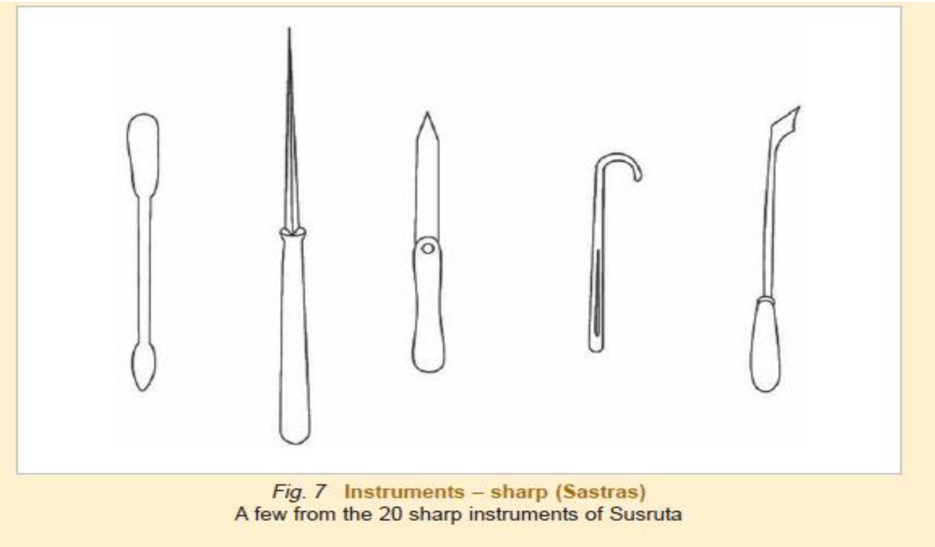
The image is a black and white line drawing depicting five surgical instruments, identified as "sharp (Sastras)" and attributed to Susruta. The instruments are arranged horizontally across the image. The image appears to be an illustration from a historical or medical text.
### Components/Axes
There are no axes or scales present. The image consists solely of the illustrations of the instruments and a caption.
* **Caption:** "Fig. 7 Instruments – sharp (Sastras) A few from the 20 sharp instruments of Susruta"
### Detailed Analysis or Content Details
The instruments, from left to right, appear to be:
1. **Spoon-shaped instrument:** A rounded, spoon-like end attached to a narrow handle. Approximately 8cm in length.
2. **Sharp-pointed instrument:** A long, slender instrument with a sharply pointed tip. Approximately 10cm in length.
3. **Blade-like instrument:** A folding instrument resembling a small knife or scalpel, with a pivot point near the handle. Approximately 7cm in length when closed.
4. **Curved instrument:** A curved, hook-like instrument with a pointed end. Approximately 8cm in length.
5. **Hooked instrument:** An instrument with a curved, hooked end and a handle with a rounded base. Approximately 9cm in length.
The instruments are all depicted in a simple line drawing style, with minimal shading or detail.
### Key Observations
The image showcases a selection of surgical tools used by Susruta, an ancient Indian surgeon. The instruments are relatively simple in design, suggesting a focus on functionality over complex mechanics. The caption indicates that these are just a few of the 20 sharp instruments used by Susruta.
### Interpretation
The image provides a glimpse into the surgical practices of ancient India. Susruta is considered a pioneer in surgical techniques, and these instruments demonstrate the level of sophistication achieved during that period. The variety of instruments suggests that Susruta performed a range of surgical procedures, including incisions, dissections, and possibly even more complex operations. The fact that these are described as "sharp (Sastras)" indicates the importance of precise cutting and dissection in his surgical approach. The image serves as a historical artifact, illustrating the tools and techniques used by one of the earliest known surgeons. The instruments are not presented with any scale or context of use, so the interpretation is limited to their visual form and the accompanying caption.