## Text Block: Set Theory Problem
### Overview
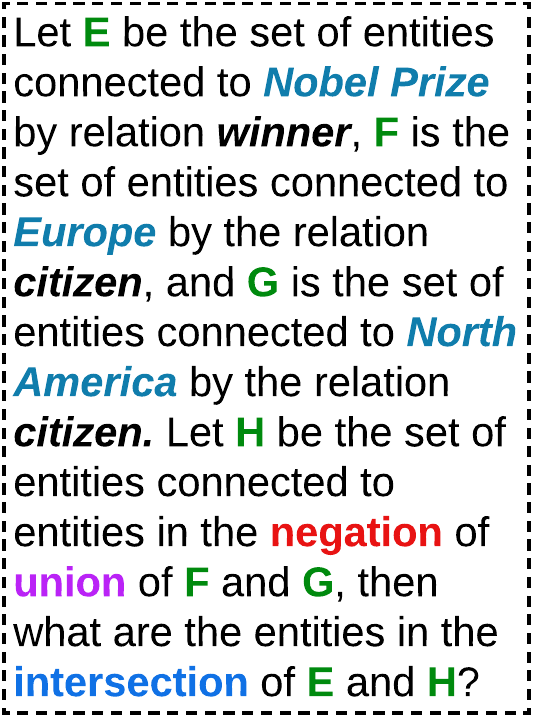
The image contains a textual problem involving set theory and relations. It defines four sets (E, F, G, H) based on connections to entities via specific relations and asks for the intersection of E and H. Key terms are color-coded for emphasis.
### Components/Axes
- **Text Structure**:
- **Bold Text**: Highlights key terms (e.g., *winner*, *citizen*, *intersection*).
- **Colored Text**:
- **Blue**: "Nobel Prize," "Europe," "North America," "intersection."
- **Red**: "negation."
- **Purple**: "union."
- **Green**: Variables **E, F, G, H**.
### Content Details
1. **Set Definitions**:
- **E**: Entities connected to *Nobel Prize* via the relation *winner*.
- **F**: Entities connected to *Europe* via the relation *citizen*.
- **G**: Entities connected to *North America* via the relation *citizen*.
- **H**: Entities connected to the *negation of the union of F and G*.
2. **Question**:
- What are the entities in the *intersection* of **E** and **H**?
### Key Observations
- **Color Coding**:
- Blue highlights geographic regions (*Europe*, *North America*) and the final query (*intersection*).
- Red emphasizes *negation*, critical to defining **H**.
- Purple highlights *union*, which combines **F** and **G** before negation.
- **Logical Flow**:
- **H** is derived from the complement of the union of **F** and **G** (i.e., entities not in Europe or North America).
- The intersection of **E** and **H** seeks Nobel Prize winners who are not citizens of Europe or North America.
### Interpretation
- **Set Operations**:
- **Union (F ∪ G)**: Combines European and North American citizens.
- **Negation (¬(F ∪ G))**: Represents entities outside Europe and North America.
- **Intersection (E ∩ H)**: Identifies Nobel Prize winners who are not citizens of Europe or North America.
- **Implications**:
- The problem tests understanding of set theory operations (union, negation, intersection) and their application to real-world relations (citizenship, awards).
- No numerical data is provided; the focus is on logical relationships.
### Notable Patterns
- The use of color coding aids in distinguishing regions, operations, and variables.
- The problem assumes familiarity with set theory notation and relations.
### Final Answer
The entities in the intersection of **E** and **H** are those connected to Nobel Prize winners who are **not** citizens of Europe or North America.