## Diagram: Reasoning Path Visualization
### Overview
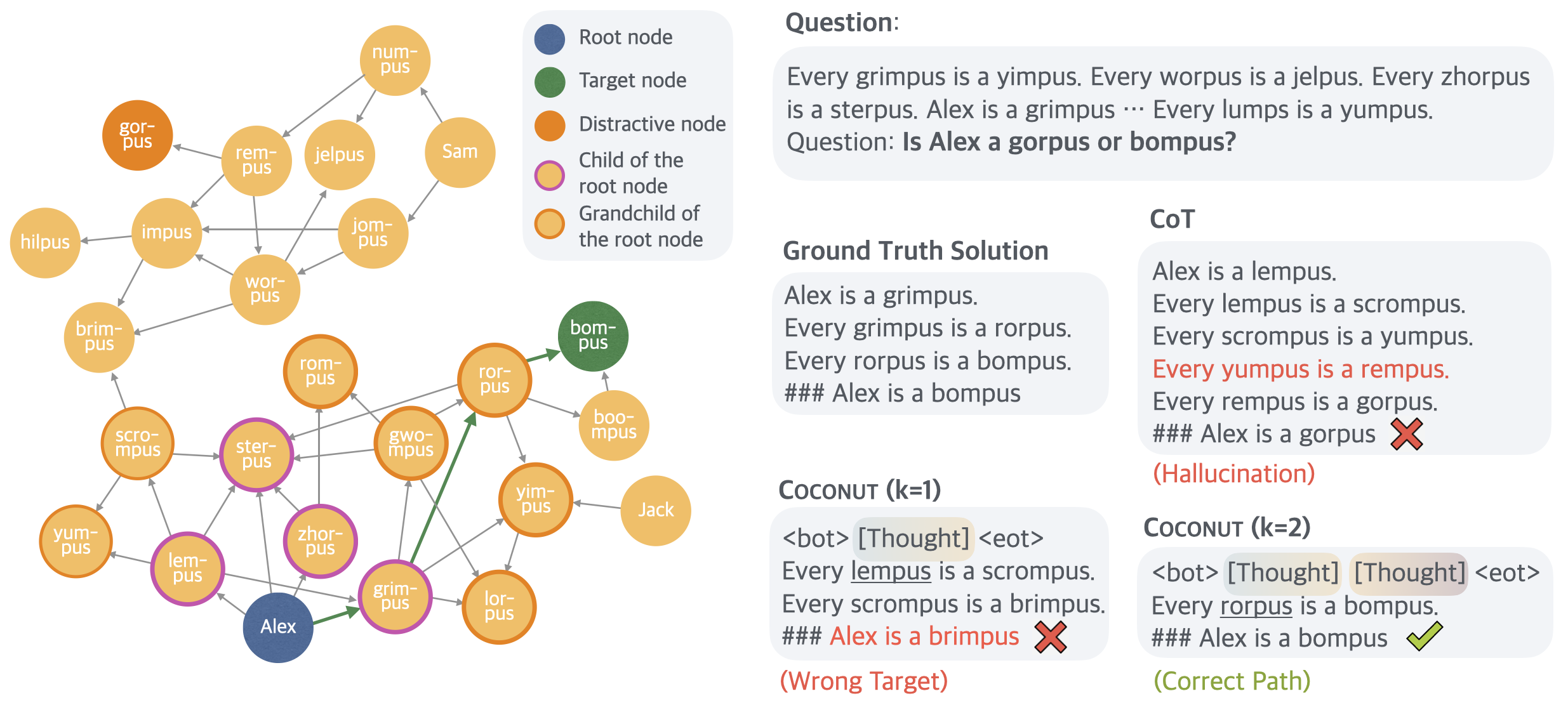
The image presents a diagram illustrating a reasoning path, alongside examples of question answering and solutions. The diagram visualizes relationships between different entities, while the text provides a question, a ground truth solution, and two attempts by a system called "COCONUT" to answer the question using different reasoning depths (k=1 and k=2).
### Components/Axes
* **Diagram Legend (Top-Left)**:
* Blue node: Root node
* Green node: Target node
* Orange node: Distractive node
* Purple outline node: Child of the root node
* Orange outline node: Grandchild of the root node
* **Node Network (Left)**: A network of interconnected nodes, each labeled with a name ending in "-pus". Nodes are connected by gray lines, with green arrows indicating the correct reasoning path.
* **Question (Top-Right)**: A logical reasoning question.
* **Ground Truth Solution (Middle-Right)**: The correct answer and reasoning steps.
* **COCONUT (k=1) (Bottom-Left)**: The system's attempt to answer the question with a reasoning depth of 1.
* **COCONUT (k=2) (Bottom-Right)**: The system's attempt to answer the question with a reasoning depth of 2.
* **Nodes in the Network**:
* Root Node: Alex (Blue)
* Target Node: bom-pus (Green)
* Distractive Nodes: gor-pus, rem-pus, jelpus, Sam, impus, jom-pus, wor-pus, hilpus, boo-mpus, Jack, lor-pus, gwo-mpus, yum-pus, scro-mpus
* Child of the root node: ster-pus, zhor-pus, lem-pus, grim-pus, rom-pus
* Grandchild of the root node: num-pus, brim-pus, ror-pus, yim-pus
### Detailed Analysis
* **Node Network**:
* The network consists of nodes labeled with names like "Alex", "bom-pus", "gor-pus", etc.
* Alex (root node) is connected to ster-pus, zhor-pus, lem-pus, and grim-pus.
* The correct path from Alex to bom-pus is highlighted with green arrows: Alex -> grim-pus -> ror-pus -> bom-pus.
* **Question**:
* The question is: "Every grimpus is a yimpus. Every worpus is a jelpus. Every zhorpus is a sterpus. Alex is a grimpus ... Every lumps is a yumpus. Question: Is Alex a gorpus or bompus?"
* **Ground Truth Solution**:
* "Alex is a grimpus. Every grimpus is a rorpus. Every rorpus is a bompus. ### Alex is a bompus"
* **COCONUT (k=1)**:
* "\<bot> [Thought] Every lempus is a scrompus. Every scrompus is a brimpus. ### Alex is a brimpus X (Wrong Target)"
* The system incorrectly concludes that Alex is a brimpus.
* **COCONUT (k=2)**:
* "\<bot> [Thought] [Thought] Every rorpus is a bompus. ### Alex is a bompus ✓ (Correct Path)"
* The system correctly concludes that Alex is a bompus.
* **COT (Chain of Thought)**:
* "Alex is a lempus. Every lempus is a scrompus. Every scrompus is a yumpus. Every yumpus is a rempus. Every rempus is a gorpus. ### Alex is a gorpus X (Hallucination)"
* The system incorrectly concludes that Alex is a gorpus.
### Key Observations
* The diagram visualizes the relationships between different entities and the reasoning path required to answer the question.
* The COCONUT system with a reasoning depth of 2 (k=2) correctly answers the question, while the system with a reasoning depth of 1 (k=1) fails.
* The COT (Chain of Thought) reasoning also fails to answer the question correctly.
### Interpretation
The image demonstrates the importance of reasoning depth in question answering. The COCONUT system, when allowed to explore a deeper reasoning path (k=2), is able to correctly answer the question. This suggests that a more thorough exploration of the relationships between entities can lead to more accurate conclusions. The failure of the COT reasoning highlights the potential for "hallucinations" or incorrect inferences when relying on a single chain of thought. The diagram provides a visual representation of the reasoning process, making it easier to understand the relationships between entities and the steps required to arrive at the correct answer.