\n
## Diagram: Script Generation Workflow
### Overview
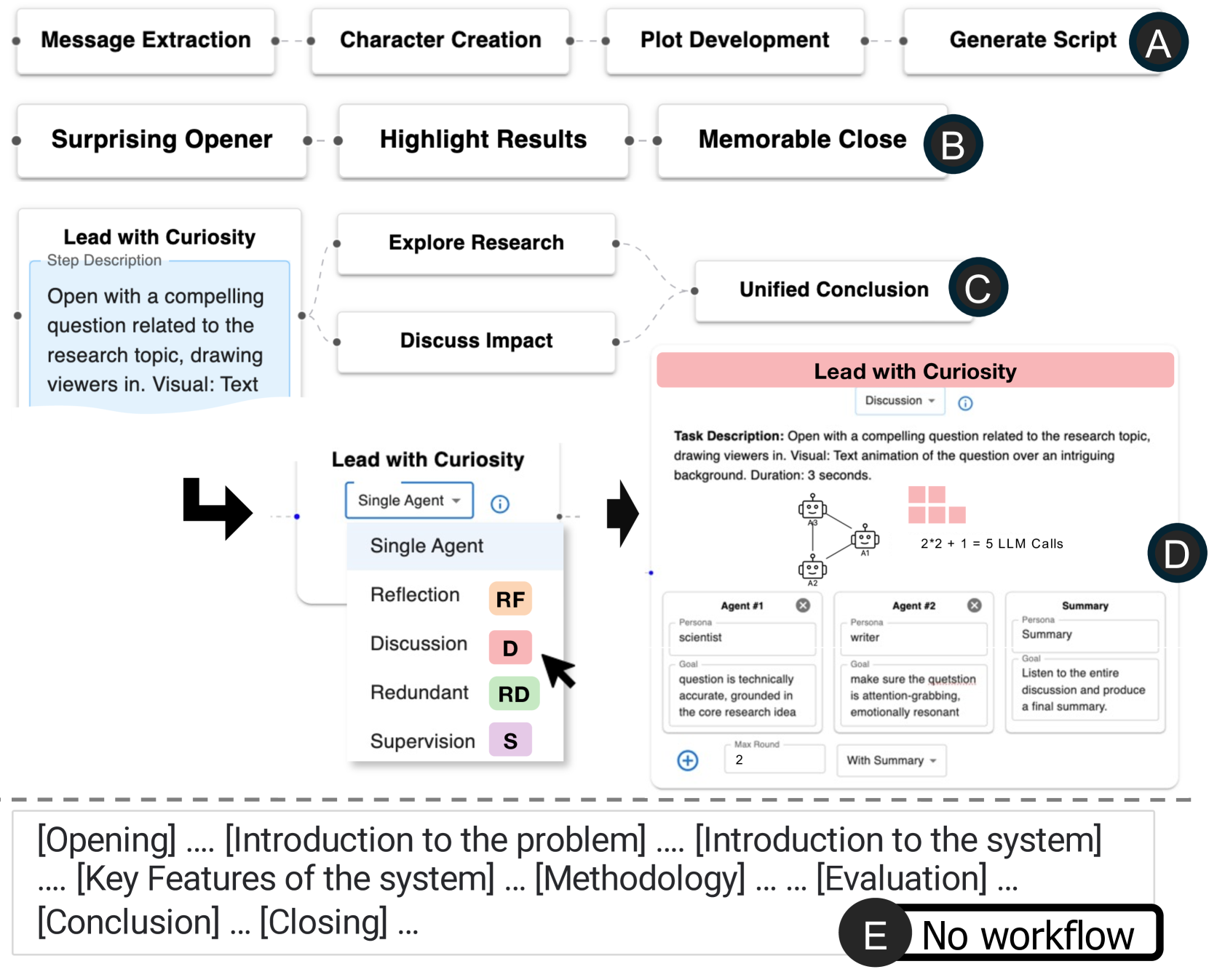
This diagram illustrates a workflow for generating a script, starting from message extraction and culminating in a unified conclusion. It details a process involving multiple stages, agent interactions, and feedback loops. The diagram is segmented into several key areas: a linear script generation process (A), a refinement loop (B), a conclusion stage (C), a multi-agent discussion interface (D), and a failure state (E).
### Components/Axes
The diagram consists of several interconnected components:
* **Linear Workflow (A):** Message Extraction -> Character Creation -> Plot Development -> Generate Script
* **Refinement Loop (B):** Surprising Opener -> Highlight Results -> Memorable Close
* **Conclusion (C):** Explore Research -> Discuss Impact -> Unified Conclusion
* **Multi-Agent Discussion (D):** A user interface for a discussion between two agents (Scientist and Writer) with a summarization agent.
* **Failure State (E):** "No workflow" indicated by a red box.
* **Agent Roles:** Reflection (RF), Discussion (D), Redundant (RD), Supervision (S)
* **Text Blocks:** Step Description, Task Description, and a list of document sections: "[Opening] ... [Introduction to the problem] ... [Introduction to the system] ... [Key Features of the system] ... [Methodology] ... [Evaluation] ... [Conclusion] ... [Closing] ..."
### Detailed Analysis or Content Details
**A - Script Generation:** This is a linear sequence of steps.
* Message Extraction
* Character Creation
* Plot Development
* Generate Script
**B - Refinement Loop:** This loop focuses on improving the script's impact.
* Surprising Opener
* Highlight Results
* Memorable Close
**C - Conclusion:** This stage involves research and impact assessment.
* Explore Research
* Discuss Impact
* Unified Conclusion
**D - Multi-Agent Discussion:** This section details a discussion interface.
* **Title:** Lead with Curiosity - Discussion
* **Task Description:** "Open with a compelling question related to the research topic, drawing viewers in. Visual: Text animation of the question over an intriguing background. Duration: 3 seconds."
* **Agent Configuration:**
* **Agent #1:** Persona: Scientist; Goal: "make sure the question is technically accurate, grounded in the core research idea"; Max Round: 2
* **Agent #2:** Persona: Writer; Goal: "make sure the question is attention-grabbing, emotionally resonant"
* **Summary Agent:** Persona: Summary; Goal: "Listen to the entire discussion and produce a final summary."
* **LLM Calls:** 2 + 2 + 1 = 5 LLM Calls
**E - Failure State:** A red box labeled "No workflow".
**Agent Roles:**
* Reflection (RF) - Associated with a dark purple arrow.
* Discussion (D) - Associated with a light purple arrow.
* Redundant (RD) - Associated with a pink arrow.
* Supervision (S) - Associated with a teal arrow.
**Document Sections:** The text at the bottom lists potential sections for a document: "[Opening] ... [Introduction to the problem] ... [Introduction to the system] ... [Key Features of the system] ... [Methodology] ... [Evaluation] ... [Conclusion] ... [Closing] ..."
### Key Observations
* The workflow emphasizes iterative refinement through the loop (B).
* The multi-agent discussion (D) suggests a collaborative approach to script generation.
* The failure state (E) indicates a potential outcome if the workflow is not successful.
* The agent roles (RF, D, RD, S) suggest different types of feedback and oversight.
* The LLM call count (5) provides a quantitative measure of the computational cost.
### Interpretation
The diagram depicts a sophisticated script generation process that leverages both linear progression and iterative refinement. The inclusion of a multi-agent discussion interface highlights the importance of diverse perspectives and collaborative problem-solving. The agent roles suggest a system designed for quality control and ensuring both technical accuracy and emotional resonance. The "No workflow" state indicates a potential point of failure, suggesting the process isn't guaranteed to succeed. The listed document sections suggest the script is intended to be part of a larger technical or research presentation. The diagram suggests a workflow designed to create engaging and informative scripts, likely for video or presentation purposes, by combining automated generation with human-in-the-loop feedback and refinement. The use of LLM calls indicates a reliance on large language models for various stages of the process.