## Flowchart: Script Generation Workflow with Multi-Agent Collaboration
### Overview
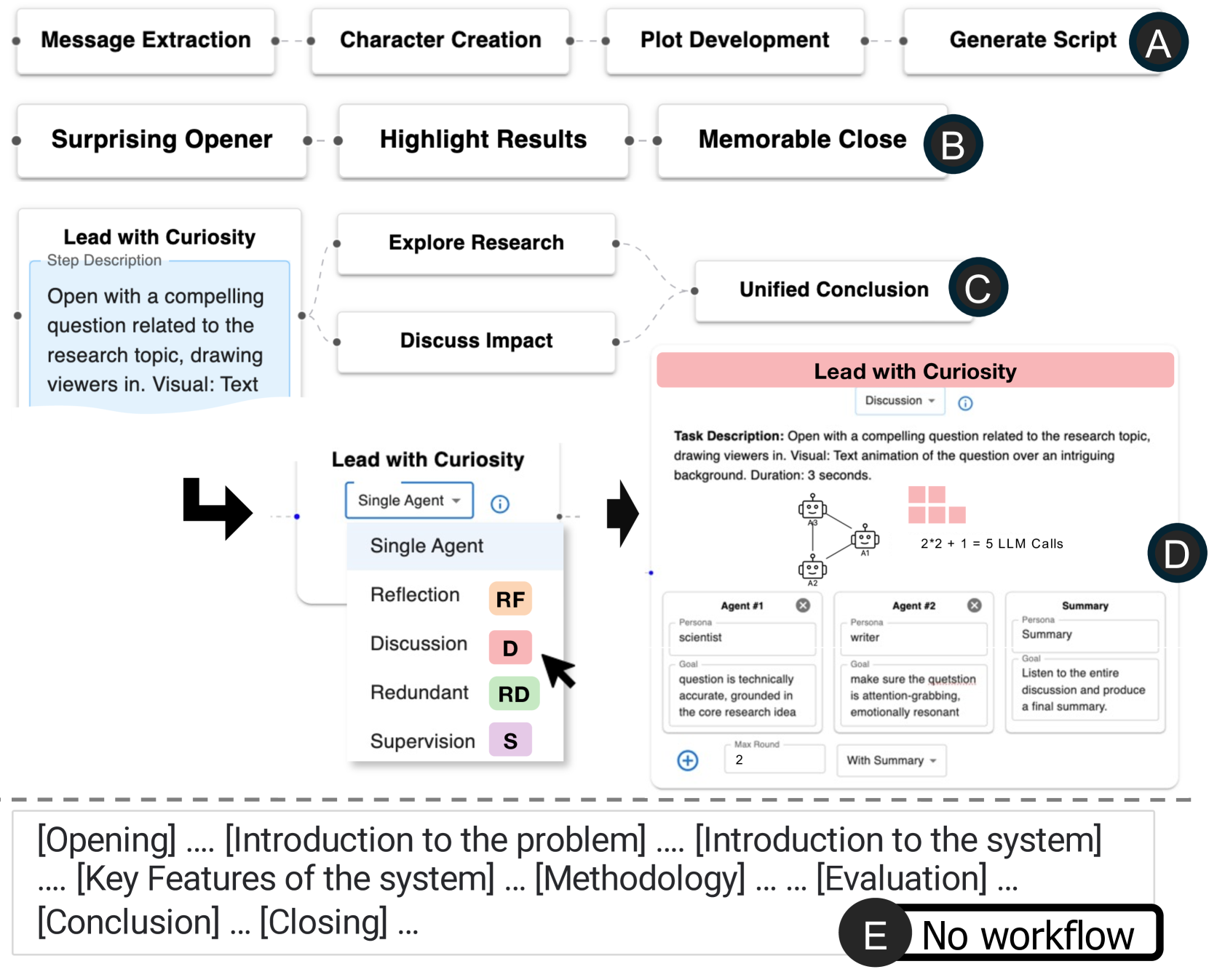
The image depicts a complex workflow diagram for generating educational scripts, combining automated processes with multi-agent collaboration. It includes sequential steps, decision points, and agent roles, with a focus on curiosity-driven content creation.
### Components/Axes
1. **Top Section (A-B)**
- Sequential steps: Message Extraction → Character Creation → Plot Development → Generate Script
- Visual elements: Dashed connections between steps
2. **Middle Section (C)**
- Three parallel tracks:
- Lead with Curiosity (text animation)
- Explore Research (scientist role)
- Discuss Impact (writer role)
- Unified Conclusion (final synthesis)
3. **Agent Collaboration (D)**
- Single Agent interface with:
- Reflection (RF)
- Discussion (D)
- Redundant (RD)
- Supervision (S)
- Task Description: 3-second text animation with question opening
- Agent Roles:
- Scientist (accuracy focus)
- Writer (emotional resonance)
- Summary (final synthesis)
4. **Bottom Section (E)**
- Textual template structure:
[Opening] → [Introduction to problem] → [Introduction to system] → [Key features] → [Methodology] → [Evaluation] → [Conclusion] → [Closing]
### Detailed Analysis
1. **Workflow Structure**
- Primary path (A-B): Traditional script generation pipeline
- Secondary path (C): Curiosity-driven content creation with research integration
- Agent collaboration (D): Multi-perspective content refinement
- Template structure (E): Script organization framework
2. **Agent Collaboration Mechanics**
- 5 LLM calls required for task completion (2*2 + 1)
- Scientist agent ensures technical accuracy
- Writer agent focuses on emotional engagement
- Summary agent synthesizes final output
3. **Visual Elements**
- Color-coded agent roles (RF=orange, D=red, RD=green, S=purple)
- Text animation duration specified (3 seconds)
- Dashed connections indicate optional/alternative paths
### Key Observations
1. The workflow emphasizes curiosity-driven content creation as a parallel process to traditional script development
2. Multi-agent collaboration introduces redundancy checks and perspective balancing
3. The "No workflow" note in section E suggests potential for alternative processing paths
4. Task duration constraints (3 seconds) indicate optimization for viewer engagement
### Interpretation
This diagram represents an advanced content generation system that combines automated script creation with human-like curiosity and multi-perspective analysis. The integration of agent roles suggests a hybrid approach where technical accuracy (scientist) and emotional resonance (writer) are balanced through iterative refinement. The "No workflow" designation implies the system can adapt to different content requirements, potentially bypassing certain steps based on context. The emphasis on curiosity-driven openings indicates a focus on viewer engagement through provocative questions, while the structured template ensures comprehensive content coverage.