\n
## Diagram: Workflow for AI-Driven Video Script Creation
### Overview
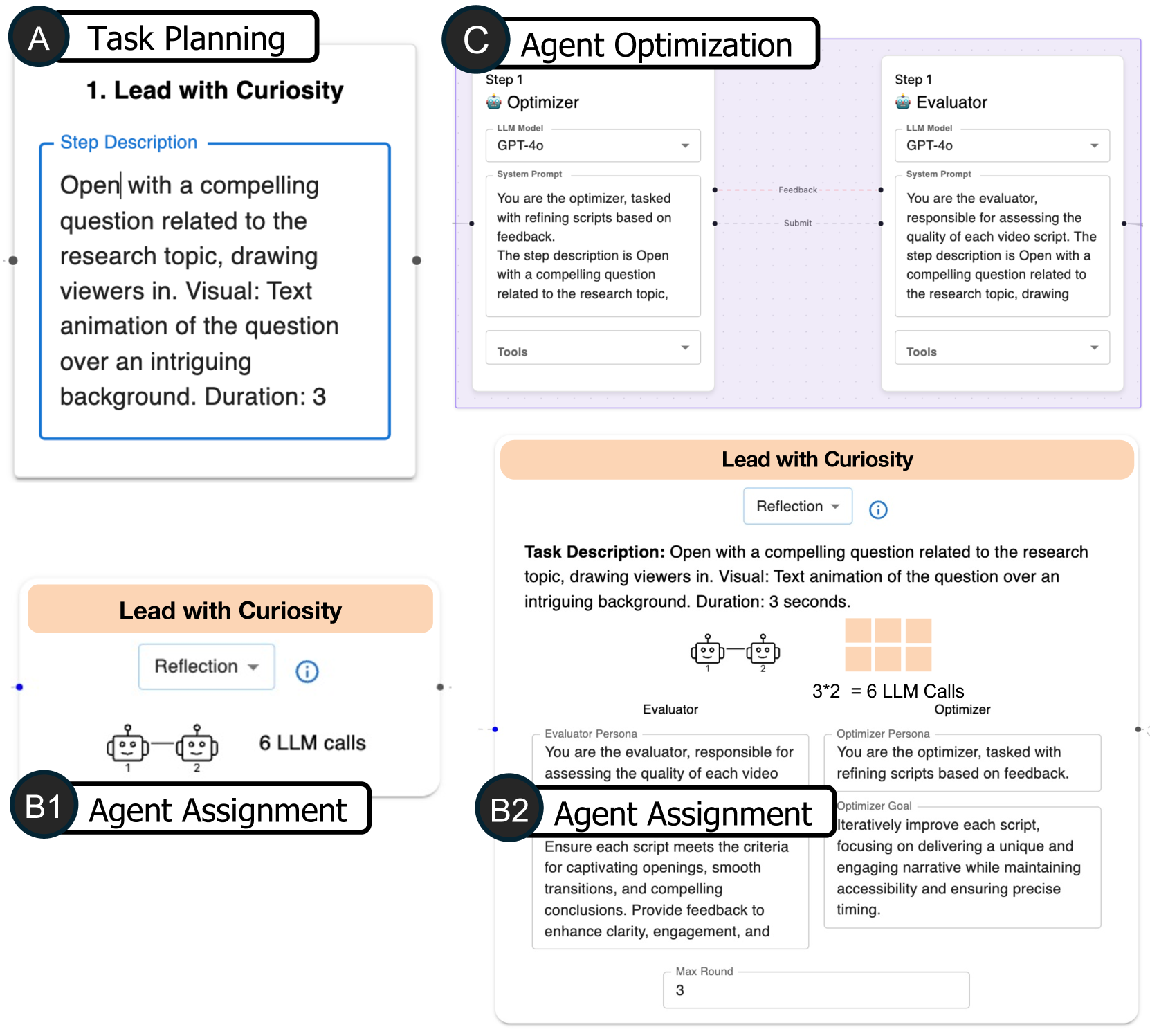
This diagram illustrates a workflow for creating video scripts using AI, specifically focusing on task planning, agent optimization, and agent assignment. It appears to be a process for generating video content based on research topics, utilizing Large Language Models (LLMs) like GPT-4. The diagram is segmented into four main sections labeled A, B1, B2, and C, with a central "Lead with Curiosity" block.
### Components/Axes
The diagram consists of several key components:
* **A: Task Planning:** Outlines the initial step of "Lead with Curiosity," detailing the step description, duration, and visual elements.
* **B1: Agent Assignment:** Focuses on the evaluator role and responsibilities.
* **B2: Agent Assignment:** Focuses on the optimizer role and responsibilities.
* **C: Agent Optimization:** Depicts the interaction between an "Optimizer" and an "Evaluator" agent, both powered by LLMs.
* **Central Block:** "Lead with Curiosity" - serves as the core task description.
* **Icons:** Represent LLM calls and agent interactions.
* **Text Blocks:** Provide detailed descriptions of roles, prompts, and goals.
### Detailed Analysis or Content Details
**A: Task Planning**
* **Step Description:** "Open with a compelling question related to the research topic, drawing viewers in. Visual: Text animation of the question over an intriguing background. Duration: 3"
* **Reflection:** A dropdown menu labeled "Reflection" is present.
**B1: Agent Assignment (Evaluator)**
* **Evaluator Persona:** "You are the evaluator, responsible for assessing the quality of each video script."
* **Max Round:** 3
**B2: Agent Assignment (Optimizer)**
* **Optimizer Goal:** "Iteratively improve each script, focusing on delivering a unique and engaging narrative while maintaining accessibility and ensuring precise timing."
* **3\*2 = 6 LLM Calls** is displayed.
**C: Agent Optimization**
* **Step 1: Optimizer**
* **LLM Model:** GPT-4
* **System Prompt:** "You are the optimizer, tasked with refining scripts based on feedback."
* **Tools:** A section labeled "Tools" is present.
* **Step 1: Evaluator**
* **LLM Model:** GPT-4
* **System Prompt:** "You are the evaluator, responsible for assessing the quality of each video script. The step description is Open with a compelling question related to the research topic, drawing viewers in."
* **Tools:** A section labeled "Tools" is present.
**Central Block: Lead with Curiosity**
* **Task Description:** "Open with a compelling question related to the research topic, drawing viewers in. Visual: Text animation of the question over an intriguing background. Duration: 3 seconds."
* **Reflection:** A dropdown menu labeled "Reflection" is present.
* **Icon:** A graphic depicting two interconnected circles with the number "6" inside, representing 6 LLM calls.
### Key Observations
* The workflow emphasizes iterative refinement through the Optimizer and Evaluator agents.
* GPT-4 is consistently used as the LLM for both roles.
* The process is designed to create engaging video scripts that start with a compelling question.
* The "Lead with Curiosity" concept is central to the entire workflow.
* The process involves 6 LLM calls in total.
* The maximum number of rounds for agent assignment is 3.
### Interpretation
This diagram outlines a structured approach to video script generation leveraging the capabilities of LLMs. The workflow is designed to ensure the scripts are not only informative but also captivating, starting with a thought-provoking question. The use of separate Optimizer and Evaluator agents suggests a quality control loop, where the optimizer refines the script based on the evaluator's feedback. The limited number of LLM calls (6) and max rounds (3) indicate a focused and efficient process. The emphasis on "accessibility" and "precise timing" in the Optimizer's goal suggests a concern for creating videos that are both understandable and well-paced. The diagram represents a practical application of AI in content creation, specifically targeting video scripts that aim to engage viewers from the outset. The "Reflection" dropdowns suggest a mechanism for logging or reviewing the process, potentially for further optimization or analysis. The diagram is a high-level overview and doesn't detail the specific feedback mechanisms between the agents.