## Flow Diagram: Question Answering System
### Overview
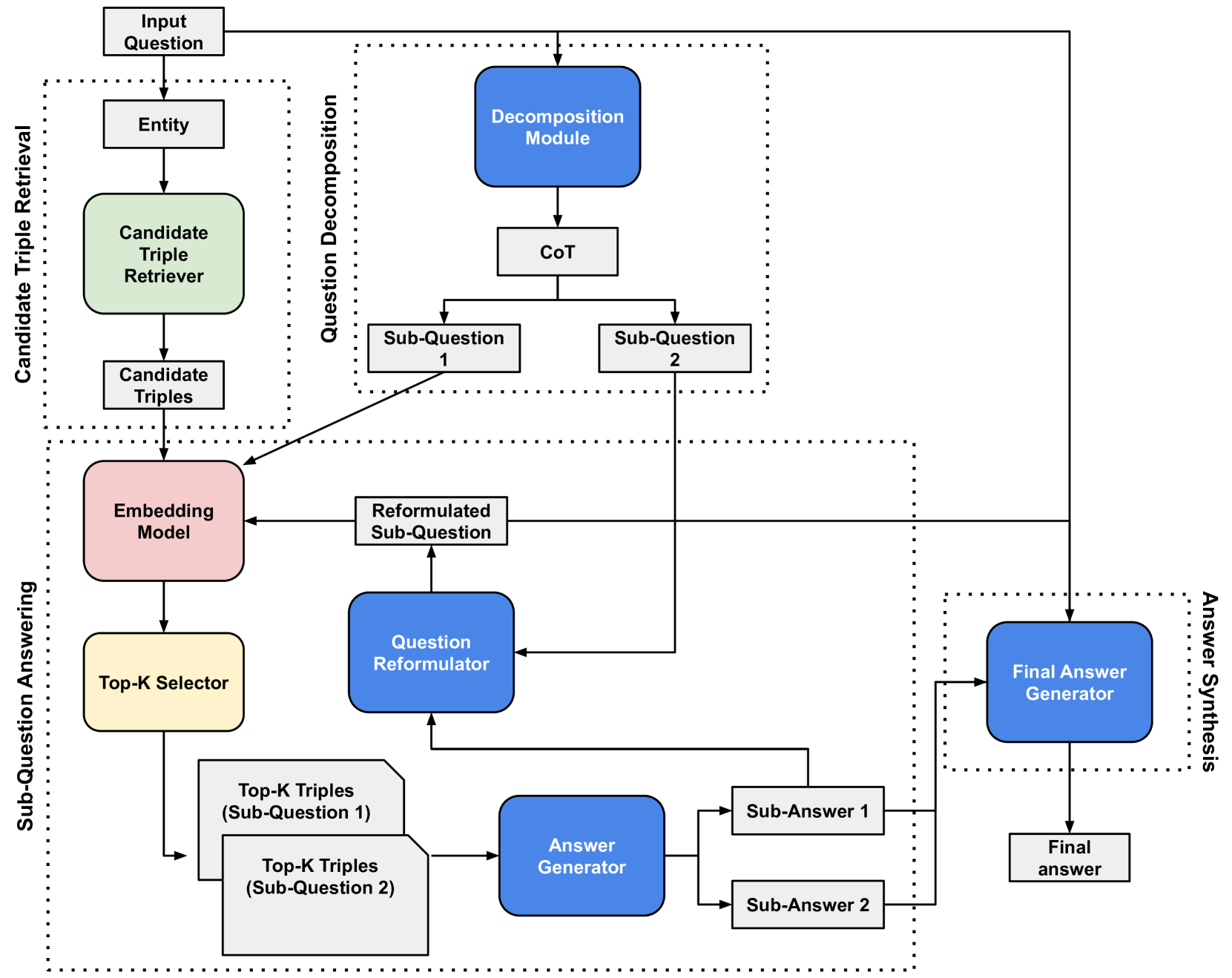
The image is a flow diagram illustrating a question answering system. It outlines the process from receiving an input question to generating a final answer, breaking down the process into several stages: Candidate Triple Retrieval, Question Decomposition, Sub-Question Answering, and Answer Synthesis.
### Components/Axes
* **Input Question:** The starting point of the process.
* **Candidate Triple Retrieval:** This stage involves retrieving candidate triples related to the input question.
* **Entity:** A component within the Candidate Triple Retrieval stage.
* **Candidate Triple Retriever:** A module responsible for retrieving candidate triples.
* **Candidate Triples:** The output of the Candidate Triple Retriever.
* **Question Decomposition:** This stage decomposes the original question into sub-questions.
* **Decomposition Module:** A module responsible for decomposing the question.
* **CoT:** An intermediate step, likely representing "Chain of Thought".
* **Sub-Question 1:** The first sub-question generated.
* **Sub-Question 2:** The second sub-question generated.
* **Sub-Question Answering:** This stage focuses on answering the sub-questions.
* **Embedding Model:** A model used to embed the candidate triples.
* **Reformulated Sub-Question:** The sub-question after reformulation.
* **Top-K Selector:** A module that selects the top-K triples.
* **Question Reformulator:** A module that reformulates the sub-questions.
* **Top-K Triples (Sub-Question 1):** The top-K triples related to Sub-Question 1.
* **Top-K Triples (Sub-Question 2):** The top-K triples related to Sub-Question 2.
* **Answer Generator:** A module that generates answers to the sub-questions.
* **Sub-Answer 1:** The answer to Sub-Question 1.
* **Sub-Answer 2:** The answer to Sub-Question 2.
* **Answer Synthesis:** This stage synthesizes the sub-answers into a final answer.
* **Final Answer Generator:** A module that generates the final answer.
* **Final Answer:** The final answer to the input question.
### Detailed Analysis
The diagram illustrates the flow of information and processing steps in a question answering system.
1. **Input Question:** The process begins with an input question.
2. **Candidate Triple Retrieval:** The input question is used to identify an entity, which is then used to retrieve candidate triples.
3. **Question Decomposition:** The original question is decomposed into two sub-questions (Sub-Question 1 and Sub-Question 2) using a Decomposition Module and a Chain of Thought (CoT) process.
4. **Sub-Question Answering:**
* The candidate triples are processed by an Embedding Model.
* The sub-questions are reformulated.
* A Top-K Selector selects the top-K triples for each sub-question.
* An Answer Generator generates answers for each sub-question (Sub-Answer 1 and Sub-Answer 2).
5. **Answer Synthesis:** The sub-answers are combined by a Final Answer Generator to produce the final answer.
### Key Observations
* The system decomposes the original question into sub-questions to simplify the answering process.
* The system uses candidate triples to provide context and information for answering the questions.
* The system uses an embedding model to represent the candidate triples in a vector space.
* The system reformulates the sub-questions to improve the accuracy of the answers.
* The system synthesizes the sub-answers to generate a final answer.
### Interpretation
The diagram illustrates a complex question answering system that uses a decomposition approach to break down the original question into smaller, more manageable sub-questions. This approach allows the system to focus on specific aspects of the question and retrieve relevant information more effectively. The use of an embedding model and reformulation techniques further enhances the accuracy and relevance of the answers. The system's modular design allows for flexibility and scalability, making it suitable for a wide range of question answering tasks.