\n
## Diagram: Question Decomposition and Answering System
### Overview
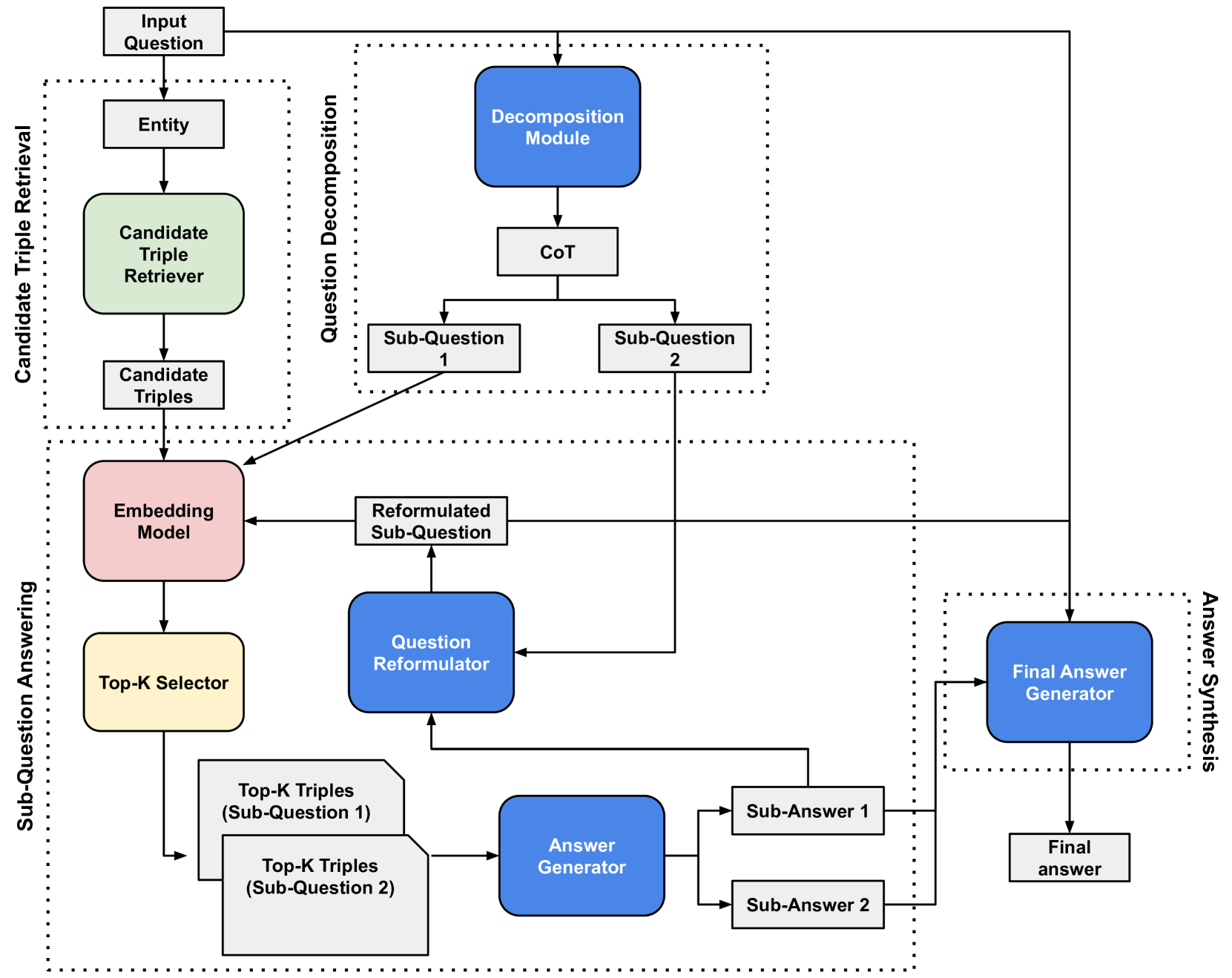
The image depicts a diagram of a question decomposition and answering system. The system is broken down into four main modules: Candidate Triple Retrieval, Question Decomposition, Sub-Question Answering, and Answer Synthesis. The diagram illustrates the flow of information between these modules, starting with an "Input Question" and ending with a "Final answer". The diagram uses boxes to represent modules and arrows to represent the flow of data.
### Components/Axes
The diagram is divided into four main sections, visually demarcated by dotted-line rectangles and labeled as follows:
1. **Candidate Triple Retrieval:** Located in the top-left corner.
2. **Question Decomposition:** Located in the top-right corner.
3. **Sub-Question Answering:** Located in the bottom-left corner.
4. **Answer Synthesis:** Located in the bottom-right corner.
Key components within these modules include:
* **Input Question:** The starting point of the process.
* **Entity:** A component within Candidate Triple Retrieval.
* **Candidate Triple Retriever:** A component within Candidate Triple Retrieval.
* **Candidate Triples:** The output of the Candidate Triple Retriever.
* **Decomposition Module:** A component within Question Decomposition.
* **CoT:** Chain of Thought, a component within Question Decomposition.
* **Sub-Question 1 & 2:** Outputs of the Decomposition Module.
* **Embedding Model:** A component within Sub-Question Answering.
* **Reformulated Sub-Question:** Output of the Embedding Model.
* **Question Reformulator:** A component within Sub-Question Answering.
* **Top-K Selector:** A component within Sub-Question Answering.
* **Top-K Triples (Sub-Question 1 & 2):** Outputs of the Top-K Selector.
* **Answer Generator:** A component within Sub-Question Answering.
* **Sub-Answer 1 & 2:** Outputs of the Answer Generator.
* **Final Answer Generator:** A component within Answer Synthesis.
* **Final answer:** The final output of the system.
Arrows indicate the flow of information between these components. Dotted arrows represent indirect or feedback loops.
### Detailed Analysis or Content Details
The system operates as follows:
1. An **Input Question** is received.
2. The **Candidate Triple Retriever** extracts **Entity** information and generates **Candidate Triples**.
3. The **Decomposition Module** breaks down the input question using **CoT** (Chain of Thought) into **Sub-Question 1** and **Sub-Question 2**.
4. **Sub-Question 1** and **Sub-Question 2** are passed through an **Embedding Model** and then a **Question Reformulator** to create **Reformulated Sub-Question**s.
5. The **Top-K Selector** retrieves the **Top-K Triples** for each sub-question.
6. The **Answer Generator** uses these triples to generate **Sub-Answer 1** and **Sub-Answer 2**.
7. Finally, the **Final Answer Generator** synthesizes these sub-answers into a **Final answer**.
There are feedback loops:
* From the Decomposition Module back to the Candidate Triple Retrieval.
* From the Sub-Question Answering module back to the Answer Synthesis module.
### Key Observations
The diagram highlights a modular approach to question answering, emphasizing the decomposition of complex questions into simpler sub-questions. The use of "Top-K" suggests a ranking or selection process based on relevance. The inclusion of "CoT" indicates the use of Chain of Thought prompting or reasoning. The system appears to leverage knowledge triples for answering.
### Interpretation
This diagram illustrates a sophisticated question answering system that employs a decomposition strategy to tackle complex queries. The system's architecture suggests a focus on knowledge retrieval and reasoning. The decomposition into sub-questions allows for a more targeted search for relevant information. The use of an embedding model and question reformulation likely aims to improve the accuracy and relevance of the retrieved knowledge. The feedback loops suggest a refinement process, where the system iteratively improves its understanding of the question and its answers. The overall design suggests a system intended to handle questions requiring multi-hop reasoning or access to a knowledge base. The diagram does not provide any quantitative data or performance metrics, but it clearly outlines the system's functional components and their interactions.