## Line Chart: Accuracy vs. Thinking Compute
### Overview
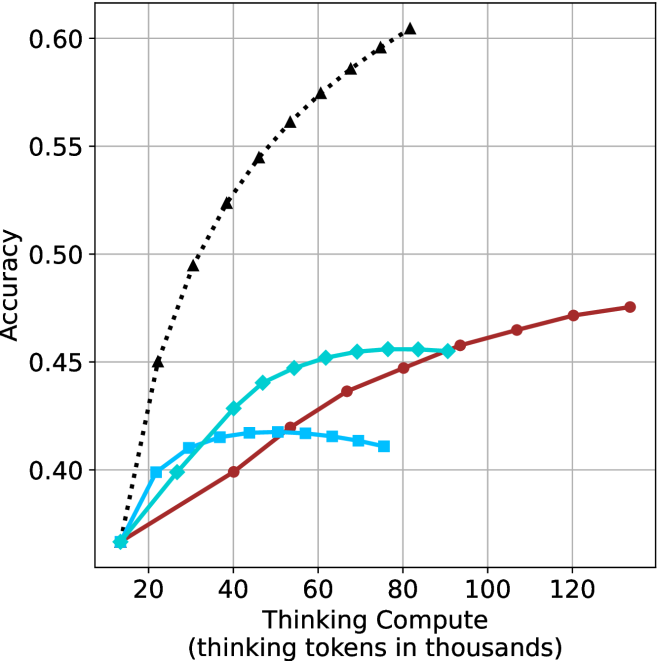
This chart illustrates the relationship between "Thinking Compute" (measured in thousands of thinking tokens) and "Accuracy" for four distinct data series. All four series originate from a common baseline point. The chart demonstrates how different models or configurations respond to increased computational "thinking" time, with some showing consistent gains, others plateauing, and one showing a performance decline after a certain threshold.
### Components/Axes
* **Y-Axis:** Labeled "Accuracy". The scale ranges from 0.40 to 0.60, with grid lines at 0.05 intervals. The origin point is below 0.40, approximately 0.35.
* **X-Axis:** Labeled "Thinking Compute (thinking tokens in thousands)". The scale ranges from 20 to 120, with grid lines at 20-unit intervals. The axis starts at 10.
* **Data Series (Legend inferred from visual markers):**
* **Black Dotted Line (Triangle markers):** Represents the highest-performing model.
* **Dark Red Solid Line (Circle markers):** Represents the model with the longest compute range.
* **Teal Solid Line (Diamond markers):** Represents a mid-range performance model that plateaus.
* **Light Blue Solid Line (Square markers):** Represents a model that exhibits performance degradation after a peak.
### Detailed Analysis
All four series originate at approximately **(15k tokens, 0.37 accuracy)**.
**1. Black Dotted Line (Triangles)**
* **Trend:** Steep, monotonic increase. This series shows the most efficient scaling of accuracy relative to compute.
* **Data Points:**
* Starts at (15, 0.37).
* Rises to (22, 0.45).
* Continues to (30, 0.495).
* Reaches (40, 0.525).
* Reaches (50, 0.545).
* Reaches (60, 0.56).
* Reaches (70, 0.575).
* Reaches (75, 0.59).
* Ends at (82, 0.605).
**2. Dark Red Solid Line (Circles)**
* **Trend:** Steady, monotonic increase. This series has the longest compute range, extending beyond 130k tokens.
* **Data Points:**
* Starts at (15, 0.37).
* (40, 0.40).
* (55, 0.42).
* (65, 0.435).
* (80, 0.445).
* (95, 0.46).
* (105, 0.465).
* (120, 0.47).
* Ends at (132, 0.475).
**3. Teal Solid Line (Diamonds)**
* **Trend:** Rapid increase initially, followed by a plateau.
* **Data Points:**
* Starts at (15, 0.37).
* (22, 0.40).
* (30, 0.40).
* (40, 0.43).
* (45, 0.44).
* (55, 0.445).
* (65, 0.45).
* (75, 0.455).
* Ends at (85, 0.455).
**4. Light Blue Solid Line (Squares)**
* **Trend:** Increases to a peak, then declines. This suggests an "overthinking" penalty.
* **Data Points:**
* Starts at (15, 0.37).
* (22, 0.40).
* (30, 0.41).
* (40, 0.415).
* (50, 0.418).
* (60, 0.415).
* (70, 0.412).
* Ends at (80, 0.41).
### Key Observations
* **Performance Hierarchy:** The Black Dotted model is significantly more accurate than the others at any given compute level above 20k tokens.
* **Overthinking Penalty:** The Light Blue model is the only one to show a clear negative slope after ~50k tokens, indicating that for this specific model, additional thinking tokens are detrimental to accuracy.
* **Scalability:** The Dark Red model is the most scalable, showing consistent, albeit slower, accuracy gains as compute increases, suggesting it does not suffer from the same plateauing or degradation issues as the Teal or Light Blue models within the observed range.
### Interpretation
This chart likely represents the performance of different Large Language Model (LLM) reasoning configurations or different model architectures as they are allowed to generate "thinking" tokens before providing a final answer.
* **The Black Dotted model** represents a highly efficient reasoning architecture, likely optimized to extract maximum utility from every thinking token.
* **The Light Blue model** demonstrates a classic "overthinking" phenomenon, where the model likely begins to hallucinate or lose coherence after a certain amount of compute, causing accuracy to drop.
* **The Teal model** represents a model that reaches a point of diminishing returns, where additional compute provides no further benefit to accuracy.
* **The Dark Red model** represents a robust model that benefits from long-context reasoning, continuing to improve even at very high compute levels, though it starts with a slower rate of improvement compared to the Black Dotted model.