## Diagram: LLM-Powered Node Network Architecture
### Overview
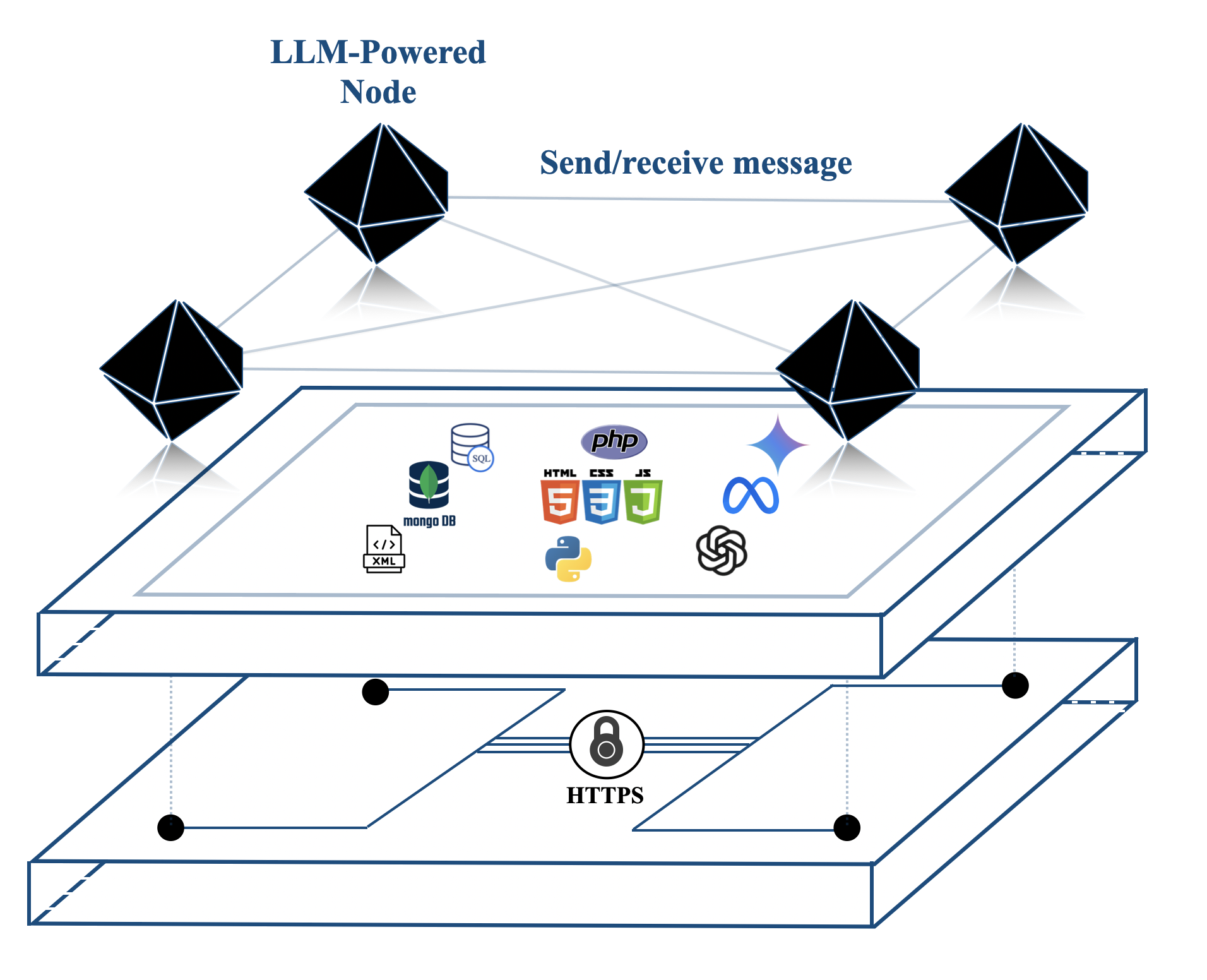
The image is a technical diagram illustrating a multi-layered system architecture. It depicts a network of intelligent nodes at the top, a middle layer representing a technology stack or application environment, and a bottom layer representing a secure communication infrastructure. The diagram uses a 3D isometric perspective with layered planes and connecting lines to show relationships and data flow.
### Components/Axes
The diagram is organized into three distinct horizontal layers or planes, stacked vertically.
**1. Top Layer: Network of LLM-Powered Nodes**
* **Components:** Four identical black, faceted, gem-like 3D shapes (resembling octahedrons or stylized nodes). Each has a subtle reflection beneath it.
* **Labels:**
* "LLM-Powered Node" (Text positioned above the top-left node).
* "Send/receive message" (Text positioned between the top-left and top-right nodes).
* **Connections:** Thin, light gray lines connect all four nodes to each other, forming a mesh network. The label "Send/receive message" is placed along one of these connecting lines, indicating the primary function of these connections.
**2. Middle Layer: Technology Stack / Application Environment**
* **Components:** A collection of software and technology logos/icons placed on a semi-transparent, light blue rectangular plane.
* **Icons & Embedded Text (Transcribed):**
* **Database Icons:**
* A green leaf logo with the text "mongo DB" below it.
* A blue cylinder icon with the text "SQL" on it.
* **Programming/Web Technology Icons:**
* The official logos for HTML5, CSS3, and JavaScript (JS), grouped together.
* The Python programming language logo (blue and yellow snakes).
* The PHP logo (purple oval with "php" text).
* **Data Format Icon:** A document icon with the text "</>" and "XML" below it.
* **AI/Platform Icons:**
* The OpenAI logo (black and white geometric flower).
* The Meta (formerly Facebook) infinity logo (blue).
* A blue, four-pointed star or sparkle icon (unidentified, possibly representing a specific service or generic "AI").
* **Spatial Grounding:** The icons are clustered in the center of the middle plane. The database icons are on the left, web technologies in the center, and AI/platform logos on the right.
**3. Bottom Layer: Secure Communication Layer**
* **Components:** A dark blue, wireframe-style rectangular plane with a circuit-like pattern.
* **Central Element:** A large, circular icon containing a padlock symbol. Below it is the text "HTTPS".
* **Connections:** Four black dots (nodes) are placed at the corners of this layer. Lines connect these dots to the central HTTPS icon and to each other, forming a secure network backbone. Dotted vertical lines connect these corner dots to the corresponding corners of the middle layer above, indicating a foundational or supporting relationship.
### Detailed Analysis
* **Flow and Relationships:** The diagram illustrates a top-down hierarchy and interaction model.
1. **Intelligence Layer (Top):** The "LLM-Powered Nodes" form a peer-to-peer network for messaging. This suggests a distributed system of AI agents.
2. **Application/Resource Layer (Middle):** These nodes have access to or operate within an environment rich with technologies for data storage (MongoDB, SQL), web development (HTML, CSS, JS, PHP), programming (Python), data interchange (XML), and major AI platforms (OpenAI, Meta). This layer represents the tools and data sources the LLM nodes can utilize.
3. **Security/Transport Layer (Bottom):** All communication and operations are underpinned by a secure layer, explicitly labeled "HTTPS," indicating that data in transit is encrypted. The circuit-like pattern suggests this is the underlying network infrastructure.
### Key Observations
* The LLM nodes are depicted as identical, suggesting a homogeneous network of similar agents.
* The technology stack in the middle layer is diverse, covering databases, web, and AI, implying the system is designed for complex, multi-faceted tasks that may involve data retrieval, web interaction, and advanced AI processing.
* The explicit inclusion of both "mongo DB" (NoSQL) and "SQL" indicates support for multiple database paradigms.
* The presence of major platform logos (OpenAI, Meta) alongside generic technology icons suggests the architecture may integrate with or leverage external commercial AI services.
* Security (HTTPS) is presented as a foundational, non-negotiable layer supporting the entire stack.
### Interpretation
This diagram represents a conceptual architecture for a **distributed, multi-agent AI system**. The "LLM-Powered Nodes" are likely autonomous or semi-autonomous agents powered by Large Language Models. They communicate directly with each other (the mesh network) to collaborate on tasks.
The middle layer defines the **operational context and capabilities** of these agents. They are not isolated; they can query databases (both SQL and NoSQL), interact with web technologies, execute code (Python), and call upon powerful external AI models (OpenAI, Meta). This suggests the agents can perform complex workflows like data analysis, content generation, web scraping, and API integration.
The bottom layer emphasizes that **security is a core architectural principle**. All interactions, whether between nodes or with external resources, are secured via HTTPS, which is critical for a system handling potentially sensitive data and commands.
**In essence, the diagram answers the question: "How do intelligent AI agents work together in a secure, real-world environment?"** It shows they form a collaborative network, are equipped with a versatile toolkit for interacting with digital systems, and operate on a secure foundation. The absence of a single central server in the top layer points towards a decentralized or peer-to-peer design philosophy for the agent network itself.