\n
## Document: Geometry Problem Set
### Overview
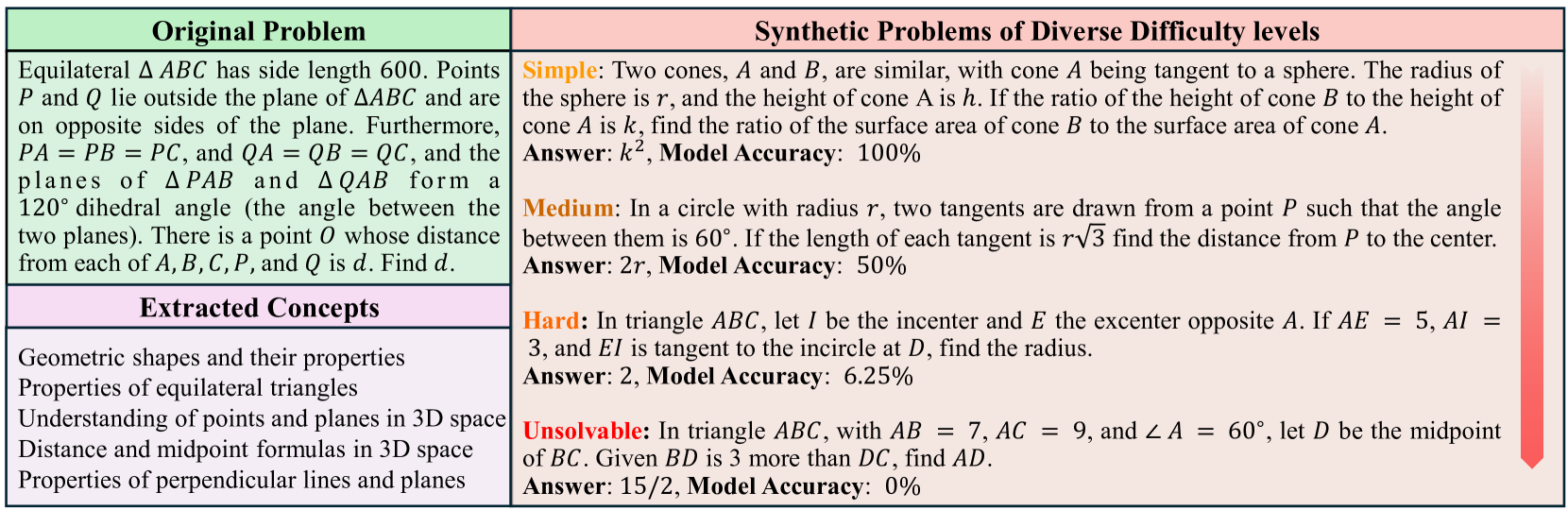
The image presents a document outlining an original geometry problem alongside a series of synthetic problems of varying difficulty levels. It also lists extracted concepts relevant to the original problem. The document appears to be designed for assessing or training problem-solving skills in geometry.
### Components/Axes
The document is divided into three main sections:
1. **Original Problem:** A detailed description of a complex geometric setup.
2. **Synthetic Problems:** Four problems categorized by difficulty (Simple, Medium, Hard, Unsolvable) with their answers and model accuracy.
3. **Extracted Concepts:** A bulleted list of geometric concepts related to the original problem.
### Detailed Analysis or Content Details
**Original Problem:**
* Equilateral triangle *ABC* has side length 600.
* Points *P* and *Q* lie outside the plane of *ΔABC* and are on opposite sides of the plane.
* *PA* = *PB* = *PC*, and *QA* = *QB* = *QC*.
* The planes of *ΔPAB* and *ΔQAB* form a 120° dihedral angle (the angle between the two planes).
* There is a point *O* whose distance from each of *A, B, C, P,* and *Q* is *d*. Find *d*.
**Synthetic Problems:**
* **Simple:** Two cones, A and B, are similar, with cone A being tangent to a sphere. The radius of the sphere is *r*, and the height of cone A is *h*. If the ratio of the height of cone B to the height of cone A is *k*, find the ratio of the surface area of cone B to the surface area of cone A.
* Answer: *k²*, Model Accuracy: 100%
* **Medium:** In a circle with radius *r*, two tangents are drawn from a point *P* such that the angle between them is 60°. If the length of each tangent is *√3* find the distance from *P* to the center.
* Answer: *2r*, Model Accuracy: 50%
* **Hard:** In triangle *ABC*, let *I* be the incenter and *E* the excenter opposite *A*. If *AE* = 5, *AI* = 3, and *EI* is tangent to the incircle at *D*, find the radius.
* Answer: 2, Model Accuracy: 6.25%
* **Unsolvable:** In triangle *ABC*, with *AB* = 7, *AC* = 9, and *∠A* = 60°, let *D* be the midpoint of *BC*. Given *BD* is 3 more than *DC*, find *AD*.
* Answer: 15/2, Model Accuracy: 0%
**Extracted Concepts:**
* Geometric shapes and their properties
* Properties of equilateral triangles
* Understanding of points and planes in 3D space
* Distance and midpoint formulas in 3D space
* Properties of perpendicular lines and planes
### Key Observations
* The "Model Accuracy" for the synthetic problems varies significantly, ranging from 0% to 100%. This suggests the difficulty level assessment is somewhat reliable.
* The "Unsolvable" problem is labeled as such, but still provides an answer (15/2), indicating it might be solvable with more advanced techniques or there is an error.
* The original problem is significantly more complex than the synthetic problems, involving 3D geometry and potentially requiring advanced problem-solving strategies.
### Interpretation
The document serves as a learning resource for geometry, presenting a challenging original problem and a set of related problems with varying difficulty levels. The inclusion of "Model Accuracy" provides a metric for evaluating the effectiveness of a problem-solving approach. The extracted concepts highlight the key geometric principles required to tackle the original problem. The document's structure suggests a pedagogical approach where students are first exposed to a complex problem and then practice with simpler, related problems to build their skills. The "Unsolvable" problem is an interesting case, potentially serving as a discussion point about the limits of certain geometric approaches or the possibility of errors in the problem statement. The document is entirely in English.