## Technical Diagram: Geometry Problem Analysis Table
### Overview
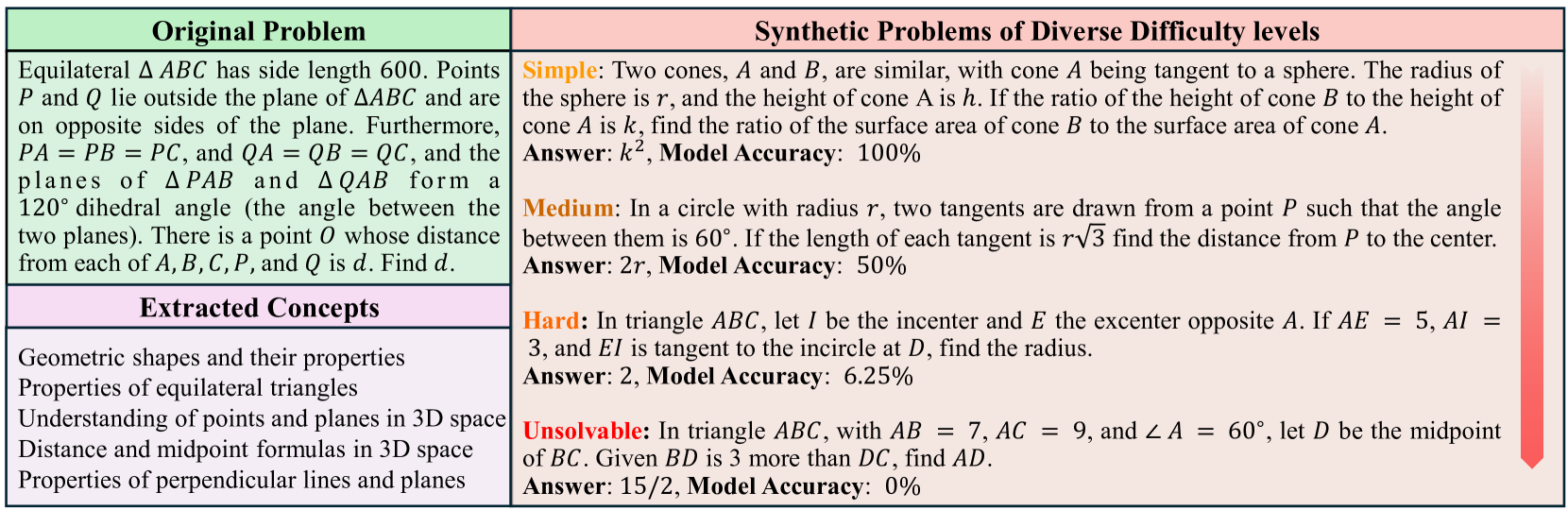
The image displays a structured table comparing a complex original geometry problem with a set of synthetic problems of varying difficulty levels. It also lists the key geometric concepts extracted from the original problem. The table is divided into two main columns, with a vertical gradient bar on the far right indicating a progression of difficulty or model performance.
### Components/Axes
The table has the following structural components:
1. **Header Row**: Contains two main column titles.
* **Left Column Header**: "Original Problem" (green background).
* **Right Column Header**: "Synthetic Problems of Diverse Difficulty levels" (pink background).
2. **Left Column**: Contains two vertically stacked cells.
* **Top Cell**: The "Original Problem" text.
* **Bottom Cell**: Titled "Extracted Concepts" (purple background), containing a bulleted list.
3. **Right Column**: Contains four vertically stacked cells, each presenting a problem at a different difficulty level. The difficulty labels are color-coded.
* **Simple** (orange text)
* **Medium** (orange text)
* **Hard** (orange text)
* **Unsolvable** (red text)
4. **Visual Element**: A vertical gradient bar on the far right edge of the image, transitioning from red at the top to white at the bottom, visually correlating with the increasing difficulty of the problems from top to bottom.
### Detailed Analysis / Content Details
#### **Left Column: Original Problem & Concepts**
* **Original Problem Text**:
> Equilateral Δ ABC has side length 600. Points P and Q lie outside the plane of ΔABC and are on opposite sides of the plane. Furthermore, PA = PB = PC and QA = QB = QC, and the planes of ΔPAB and ΔQAB form a 120° dihedral angle (the angle between the two planes). There is a point O whose distance from each of A, B, C, P, and Q is d. Find d.
* **Extracted Concepts List**:
* Geometric shapes and their properties
* Properties of equilateral triangles
* Understanding of points and planes in 3D space
* Distance and midpoint formulas in 3D space
* Properties of perpendicular lines and planes
#### **Right Column: Synthetic Problems**
Each problem includes a statement, a final answer, and a "Model Accuracy" percentage.
1. **Simple**:
* **Problem**: Two cones, A and B, are similar, with cone A being tangent to a sphere. The radius of the sphere is r, and the height of cone A is h. If the ratio of the height of cone B to the height of cone A is k, find the ratio of the surface area of cone B to the surface area of cone A.
* **Answer**: k²
* **Model Accuracy**: 100%
2. **Medium**:
* **Problem**: In a circle with radius r, two tangents are drawn from a point P such that the angle between them is 60°. If the length of each tangent is r√3 find the distance from P to the center.
* **Answer**: 2r
* **Model Accuracy**: 50%
3. **Hard**:
* **Problem**: In triangle ABC, let I be the incenter and E the excenter opposite A. If AE = 5, AI = 3, and EI is tangent to the incircle at D, find the radius.
* **Answer**: 2
* **Model Accuracy**: 6.25%
4. **Unsolvable**:
* **Problem**: In triangle ABC, with AB = 7, AC = 9, and ∠A = 60°, let D be the midpoint of BC. Given BD is 3 more than DC, find AD.
* **Answer**: 15/2
* **Model Accuracy**: 0%
### Key Observations
1. **Clear Difficulty Progression**: The synthetic problems are explicitly labeled from "Simple" to "Unsolvable," with a corresponding visual gradient bar.
2. **Inverse Relationship with Model Accuracy**: There is a stark, inverse correlation between problem difficulty and the reported "Model Accuracy." Accuracy plummets from 100% for the Simple problem to 0% for the Unsolvable one.
3. **Problem Type Variation**: The synthetic problems cover different geometric domains: 3D similarity (cones), circle tangents, triangle centers (incenter/excenter), and a potentially contradictory planar geometry setup.
4. **"Unsolvable" Problem Anomaly**: The problem labeled "Unsolvable" still provides a definitive answer (15/2). The label and 0% accuracy likely indicate that the problem's given conditions are internally contradictory or impossible to satisfy in Euclidean geometry, making a valid solution unattainable despite the numerical answer provided.
### Interpretation
This table appears to be from a research or evaluation context, likely assessing the performance of an AI or computational model on geometry problems. The "Original Problem" serves as a complex benchmark, from which core concepts are extracted. The "Synthetic Problems" are then generated to test the model's grasp of these concepts at graduated difficulty levels.
The data suggests a significant limitation in the model's reasoning capabilities. While it achieves perfect accuracy on straightforward application of concepts (Simple), its performance degrades rapidly as problems require more integrated knowledge, spatial reasoning, or handling of complex constraints (Medium, Hard). The 0% accuracy on the "Unsolvable" problem is particularly telling; it indicates the model either failed to detect the logical inconsistency in the problem statement or attempted to compute an answer despite the impossibility, highlighting a lack of robust meta-reasoning about problem validity.
The "Extracted Concepts" list acts as a bridge, showing the foundational knowledge the synthetic problems are designed to probe. The overall presentation argues that problem difficulty is not merely about computational complexity but about the depth of conceptual understanding and logical coherence required, areas where the evaluated model shows a clear performance cliff.