## Line Charts: Flexible Optimization Strategy and Scaling Law of SWIFT
### Overview
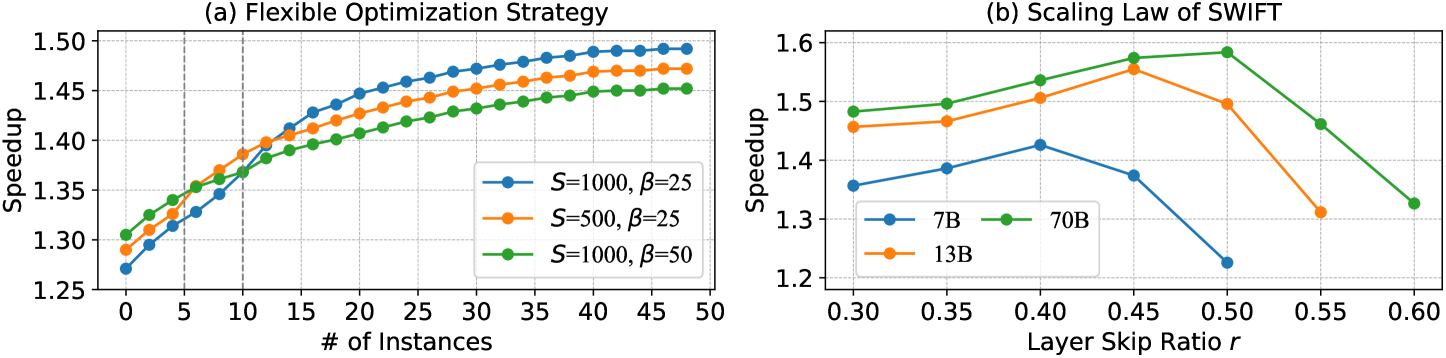
The image presents two line charts comparing the speedup achieved by different optimization strategies and scaling laws. Chart (a) explores the impact of varying the number of instances on speedup for a flexible optimization strategy, while chart (b) examines the scaling law of SWIFT with respect to the layer skip ratio.
### Components/Axes
**Chart (a): Flexible Optimization Strategy**
* **Title:** (a) Flexible Optimization Strategy
* **X-axis:** # of Instances, ranging from 0 to 50 in increments of 5.
* **Y-axis:** Speedup, ranging from 1.25 to 1.50 in increments of 0.05.
* **Legend (bottom-right):**
* Blue: S=1000, β=25
* Orange: S=500, β=25
* Green: S=1000, β=50
**Chart (b): Scaling Law of SWIFT**
* **Title:** (b) Scaling Law of SWIFT
* **X-axis:** Layer Skip Ratio r, ranging from 0.30 to 0.60 in increments of 0.05.
* **Y-axis:** Speedup, ranging from 1.2 to 1.6 in increments of 0.1.
* **Legend (bottom-left):**
* Blue: 7B
* Orange: 13B
* Green: 70B
### Detailed Analysis
**Chart (a): Flexible Optimization Strategy**
* **Blue Line (S=1000, β=25):** The speedup increases rapidly from approximately 1.28 at 0 instances to around 1.44 at 15 instances. It then continues to increase at a slower rate, reaching approximately 1.50 at 45 instances.
* (0, 1.28)
* (5, 1.35)
* (10, 1.40)
* (15, 1.44)
* (20, 1.46)
* (25, 1.47)
* (30, 1.48)
* (35, 1.49)
* (40, 1.495)
* (45, 1.50)
* **Orange Line (S=500, β=25):** The speedup increases from approximately 1.29 at 0 instances to around 1.42 at 15 instances. It then continues to increase at a slower rate, reaching approximately 1.47 at 45 instances.
* (0, 1.29)
* (5, 1.34)
* (10, 1.38)
* (15, 1.42)
* (20, 1.44)
* (25, 1.45)
* (30, 1.46)
* (35, 1.465)
* (40, 1.47)
* (45, 1.47)
* **Green Line (S=1000, β=50):** The speedup increases from approximately 1.29 at 0 instances to around 1.40 at 15 instances. It then continues to increase at a slower rate, reaching approximately 1.45 at 45 instances.
* (0, 1.29)
* (5, 1.33)
* (10, 1.36)
* (15, 1.40)
* (20, 1.42)
* (25, 1.43)
* (30, 1.44)
* (35, 1.445)
* (40, 1.45)
* (45, 1.45)
**Chart (b): Scaling Law of SWIFT**
* **Blue Line (7B):** The speedup increases from approximately 1.36 at a layer skip ratio of 0.30 to a peak of approximately 1.43 at 0.40. It then decreases to approximately 1.23 at 0.50.
* (0.30, 1.36)
* (0.35, 1.39)
* (0.40, 1.43)
* (0.45, 1.33)
* (0.50, 1.23)
* (0.55, N/A)
* (0.60, N/A)
* **Orange Line (13B):** The speedup increases from approximately 1.47 at a layer skip ratio of 0.30 to a peak of approximately 1.53 at 0.45. It then decreases to approximately 1.30 at 0.55.
* (0.30, 1.47)
* (0.35, 1.48)
* (0.40, 1.51)
* (0.45, 1.53)
* (0.50, 1.50)
* (0.55, 1.30)
* (0.60, N/A)
* **Green Line (70B):** The speedup increases from approximately 1.49 at a layer skip ratio of 0.30 to a peak of approximately 1.59 at 0.50. It then decreases to approximately 1.34 at 0.60.
* (0.30, 1.49)
* (0.35, 1.50)
* (0.40, 1.53)
* (0.45, 1.57)
* (0.50, 1.59)
* (0.55, 1.46)
* (0.60, 1.34)
### Key Observations
* **Chart (a):** Increasing the number of instances generally leads to higher speedup, but the rate of increase diminishes as the number of instances grows. The configuration with S=1000 and β=25 consistently achieves the highest speedup.
* **Chart (b):** The optimal layer skip ratio varies depending on the model size. The 70B model achieves the highest speedup at a layer skip ratio of 0.50, while the 13B model peaks at 0.45. The 7B model peaks at 0.40.
### Interpretation
The charts provide insights into optimizing performance through flexible optimization strategies and scaling laws. Chart (a) suggests that increasing the number of instances can improve speedup, but there are diminishing returns. Chart (b) highlights the importance of tuning the layer skip ratio based on the model size to maximize speedup. The data indicates that larger models (70B) benefit from higher layer skip ratios, while smaller models (7B, 13B) perform better with lower ratios. This information is valuable for researchers and practitioners seeking to optimize the performance of SWIFT models.