## Bar Chart: Improvement over Base Model by Medical Specialty
### Overview
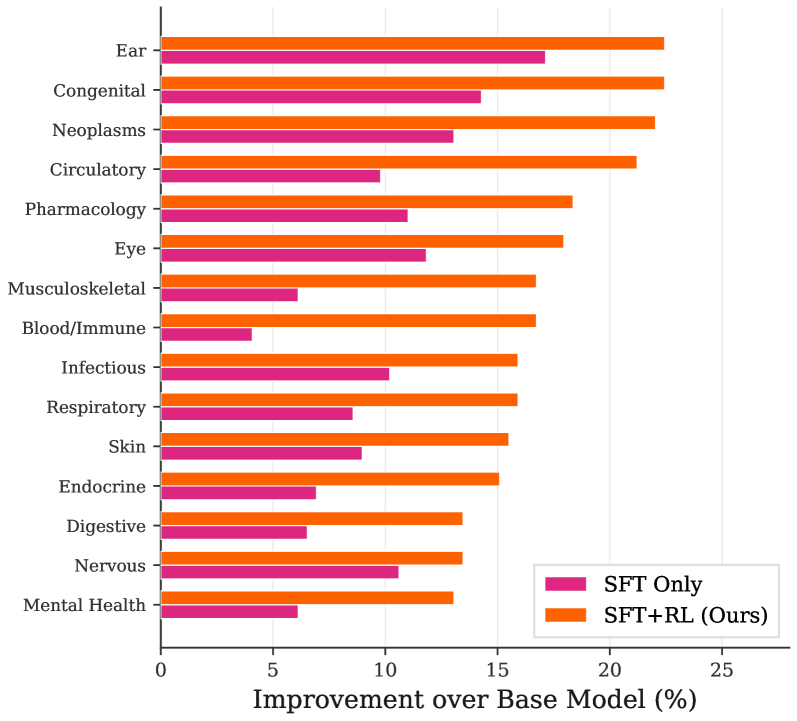
This is a horizontal bar chart comparing the improvement over a base model for two different approaches: "SFT Only" and "SFT+RL (Ours)", across various medical specialties. The improvement is measured in percentage (%). The chart displays the performance gain for each specialty using two distinct colored bars.
### Components/Axes
* **Y-axis (Vertical):** Lists medical specialties: Ear, Congenital, Neoplasms, Circulatory, Pharmacology, Eye, Musculoskeletal, Blood/Immune, Infectious, Respiratory, Skin, Endocrine, Digestive, Nervous, Mental Health.
* **X-axis (Horizontal):** Represents the "Improvement over Base Model (%)", ranging from 0 to 25.
* **Legend (Bottom-Right):**
* Magenta/Purple bar: "SFT Only"
* Orange bar: "SFT+RL (Ours)"
### Detailed Analysis
The chart consists of 15 horizontal bars, grouped by medical specialty. For each specialty, there are two bars representing the improvement achieved by "SFT Only" and "SFT+RL (Ours)".
Here's a breakdown of the approximate improvement percentages for each specialty:
* **Ear:** SFT Only ~14%, SFT+RL ~22%
* **Congenital:** SFT Only ~11%, SFT+RL ~19%
* **Neoplasms:** SFT Only ~12%, SFT+RL ~21%
* **Circulatory:** SFT Only ~8%, SFT+RL ~23%
* **Pharmacology:** SFT Only ~7%, SFT+RL ~16%
* **Eye:** SFT Only ~10%, SFT+RL ~18%
* **Musculoskeletal:** SFT Only ~12%, SFT+RL ~17%
* **Blood/Immune:** SFT Only ~10%, SFT+RL ~19%
* **Infectious:** SFT Only ~8%, SFT+RL ~13%
* **Respiratory:** SFT Only ~9%, SFT+RL ~16%
* **Skin:** SFT Only ~8%, SFT+RL ~18%
* **Endocrine:** SFT Only ~9%, SFT+RL ~17%
* **Digestive:** SFT Only ~7%, SFT+RL ~15%
* **Nervous:** SFT Only ~8%, SFT+RL ~16%
* **Mental Health:** SFT Only ~5%, SFT+RL ~12%
**Trends:**
* The "SFT+RL (Ours)" consistently outperforms "SFT Only" across all medical specialties.
* The orange bars (SFT+RL) generally slope upwards, indicating a positive correlation between specialty and improvement.
* The magenta bars (SFT Only) also show a general upward trend, but less pronounced than the orange bars.
### Key Observations
* The largest improvement difference between the two methods is observed in the "Circulatory" specialty, with SFT+RL achieving approximately 23% improvement compared to SFT Only's 8%.
* The smallest improvement difference is in "Mental Health", with SFT+RL at 12% and SFT Only at 5%.
* "SFT+RL (Ours)" consistently provides a substantial improvement over "SFT Only" in all categories, suggesting the reinforcement learning component is beneficial.
### Interpretation
The data suggests that incorporating Reinforcement Learning (RL) with Supervised Fine-Tuning (SFT) significantly enhances model performance across a diverse range of medical specialties. The consistent outperformance of "SFT+RL (Ours)" indicates that RL effectively refines the model's capabilities beyond what can be achieved through SFT alone. The varying degrees of improvement across specialties might reflect the complexity of each field or the availability of relevant training data. The largest gains in "Circulatory" could indicate that this specialty benefits most from the RL component, potentially due to the intricate relationships within the circulatory system. The relatively smaller gain in "Mental Health" might suggest that this area is already well-represented in the base model or that the RL component has limited impact due to the subjective nature of the data. Overall, the chart demonstrates the potential of RL to improve the accuracy and effectiveness of models in medical applications.