\n
## Diagram: Computing Paradigms Comparison
### Overview
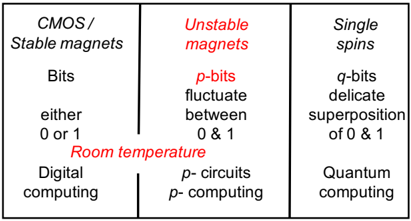
The image is a diagram comparing three computing paradigms: CMOS/Stable Magnets (Digital Computing), Unstable Magnets (p-computing), and Single Spins (Quantum Computing). It visually represents the fundamental differences in how information is stored and processed in each approach. The diagram is divided into three vertical columns, each representing a different paradigm.
### Components/Axes
The diagram does not have traditional axes. Instead, it uses a comparative structure with the following key elements:
* **Column 1 (Left):** CMOS / Stable Magnets
* Information Unit: Bits
* State: either 0 or 1
* Operating Temperature: Room temperature
* Computing Type: Digital computing
* **Column 2 (Center):** Unstable Magnets
* Information Unit: p-bits
* State: fluctuate between 0 & 1
* Computing Type: p-circuits / p-computing
* **Column 3 (Right):** Single Spins
* Information Unit: q-bits
* State: delicate superposition of 0 & 1
* Computing Type: Quantum computing
The text "Room temperature" is highlighted in red. The text "Unstable magnets" and "p-bits" are also highlighted in red.
### Detailed Analysis or Content Details
The diagram presents a qualitative comparison rather than quantitative data. Here's a breakdown of each column:
* **CMOS / Stable Magnets (Digital Computing):** This represents traditional computing. Information is stored as bits, which can be definitively either 0 or 1. This operates at room temperature.
* **Unstable Magnets (p-computing):** This paradigm utilizes p-bits, which are characterized by their fluctuating state between 0 and 1. This suggests a probabilistic or analog nature of information storage.
* **Single Spins (Quantum Computing):** This utilizes q-bits, which exist in a "delicate superposition" of 0 and 1. This is a core concept in quantum computing, where a bit can represent both 0 and 1 simultaneously.
### Key Observations
The diagram highlights the increasing complexity and nuance in information representation as one moves from digital to p-computing to quantum computing. The use of "fluctuate" and "superposition" indicates a departure from the deterministic nature of classical bits. The red highlighting of "Room temperature", "Unstable magnets", and "p-bits" may indicate a focus on the challenges or unique aspects of p-computing.
### Interpretation
The diagram illustrates the evolution of computing paradigms. It suggests that as we move beyond the limitations of classical bits, we encounter systems with more complex and probabilistic states. The diagram implies that p-computing and quantum computing offer potential advantages over traditional digital computing, but also introduce new challenges related to stability and control. The emphasis on "superposition" in quantum computing highlights its potential for parallel processing and solving complex problems that are intractable for classical computers. The diagram is a conceptual overview and does not provide specific performance metrics or technical details. It serves as a high-level comparison of the fundamental principles underlying each computing approach.