## Diagram: FP-INT vs FP-BCQ Method Comparison
### Overview
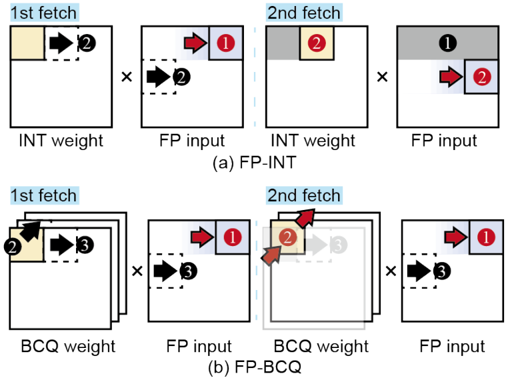
The image compares two computational methods (FP-INT and FP-BCQ) through sequential data processing steps. Each method is visualized with two "fetch" stages, showing interactions between weights (INT/BCQ) and feature processing (FP) inputs. Arrows indicate data flow, and numbered circles (1, 2, 3) highlight priority or sequence.
### Components/Axes
- **Methods**:
- **FP-INT** (top row): Uses "INT weight" in both fetch stages.
- **FP-BCQ** (bottom row): Uses "BCQ weight" in the first fetch and combines BCQ/INT in the second.
- **Elements**:
- **1st fetch**: Initial data block (light yellow) with an arrow pointing to a numbered circle (2).
- **2nd fetch**: Subsequent data block (gray/light yellow) with arrows pointing to numbered circles (1, 2).
- **FP input**: Rectangular blocks labeled "FP input" receiving data from weights.
- **Weights**:
- **INT weight**: Black arrow with a dashed box (FP-INT).
- **BCQ weight**: Stacked blocks with arrows (FP-BCQ).
### Detailed Analysis
#### FP-INT (Top Row)
1. **1st fetch**:
- A light yellow block labeled "INT weight" sends data via a black arrow to a dashed box containing "2".
- A red arrow points to a gray box labeled "1" (FP input).
2. **2nd fetch**:
- The gray box ("1") sends data via a red arrow to a light gray box labeled "2" (FP input).
#### FP-BCQ (Bottom Row)
1. **1st fetch**:
- Stacked blocks labeled "BCQ weight" send data via a black arrow to a dashed box containing "3".
- A red arrow points to a gray box labeled "1" (FP input).
2. **2nd fetch**:
- The gray box ("1") sends data via a red arrow to a light gray box labeled "2" (FP input).
- A secondary red arrow from the BCQ weight block points to a dashed box containing "3".
### Key Observations
- **FP-INT** maintains a consistent use of "INT weight" across both fetch stages.
- **FP-BCQ** introduces "BCQ weight" in the first fetch and integrates it with "INT weight" in the second fetch (implied by the dual arrows).
- Numbered circles (1, 2, 3) likely denote processing priorities or sequential steps, with "1" and "2" appearing in both methods but "3" exclusive to FP-BCQ.
### Interpretation
The diagrams illustrate how FP-INT and FP-BCQ differ in weight utilization:
- **FP-INT** relies solely on INT weight for sequential processing, suggesting a simpler, unified approach.
- **FP-BCQ** employs BCQ weight initially and combines it with INT weight later, indicating a hybrid or adaptive strategy.
- The presence of "3" in FP-BCQ’s second fetch implies additional complexity or a third processing layer not present in FP-INT.
This comparison highlights trade-offs between simplicity (FP-INT) and flexibility (FP-BCQ), with the latter potentially offering more nuanced data handling at the cost of increased computational steps.