## Mathematical Text Snippet: Branch Number Computation
### Overview
The image displays a segment of a mathematical proof or derivation, likely from a paper on coding theory or linear algebra. It contains two paragraphs of explanatory text and one displayed equation, labeled as equation (3). The content focuses on simplifying the computation of a "branch number," denoted as \(\mathcal{B}(M)\), by eliminating a non-contributing term from a previous equation.
### Components/Axes
This is not a chart or diagram with axes. The components are:
1. **Explanatory Text:** Two paragraphs of English text with embedded mathematical notation.
2. **Displayed Equation:** A multi-line mathematical definition for \(\mathcal{B}(M)\), labeled as equation (3) on the right margin.
3. **Mathematical Notation:** Includes symbols for functions (\(h(M,x)\), \(w_h(x)\)), sets (\(\mathbb{F}_q^n\)), floor functions (\(\lfloor \cdot \rfloor\)), inequalities, and the minimum operator (\(\min\)).
### Detailed Analysis / Content Details
**Transcription of Text and Equations:**
**First Paragraph:**
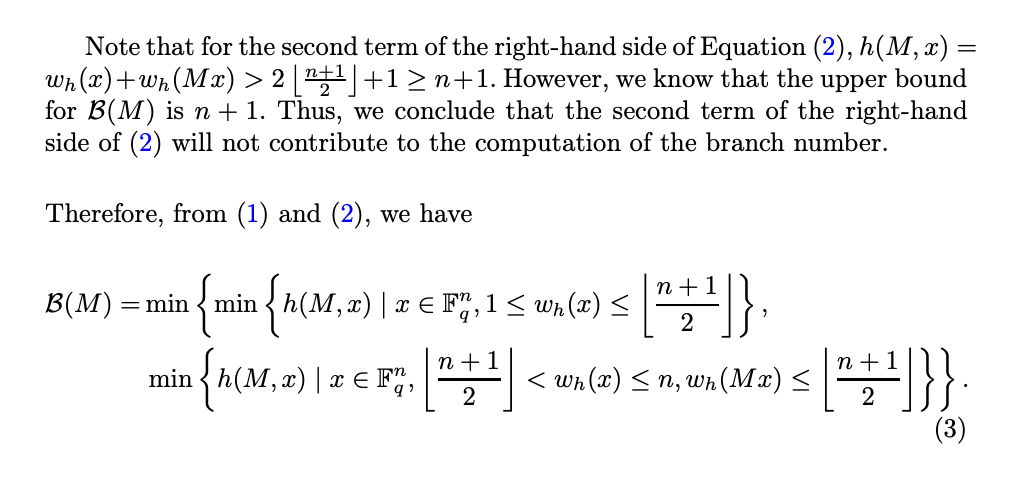
"Note that for the second term of the right-hand side of Equation (2), \(h(M, x) = w_h(x) + w_h(Mx) > 2 \lfloor \frac{n+1}{2} \rfloor + 1 \geq n+1\). However, we know that the upper bound for \(\mathcal{B}(M)\) is \(n + 1\). Thus, we conclude that the second term of the right-hand side of (2) will not contribute to the computation of the branch number."
**Second Paragraph:**
"Therefore, from (1) and (2), we have"
**Displayed Equation (3):**
\[
\mathcal{B}(M) = \min \left\{ \min \left\{ h(M, x) \mid x \in \mathbb{F}_q^n, 1 \leq w_h(x) \leq \left\lfloor \frac{n+1}{2} \right\rfloor \right\}, \right.
\]
\[
\left. \min \left\{ h(M, x) \mid x \in \mathbb{F}_q^n, \left\lfloor \frac{n+1}{2} \right\rfloor < w_h(x) \leq n, w_h(Mx) \leq \left\lfloor \frac{n+1}{2} \right\rfloor \right\} \right\}.
\]
The label "(3)" appears to the right of the second line of the equation.
**Key Mathematical Relationships Extracted:**
1. **Inequality Chain:** \(h(M, x) = w_h(x) + w_h(Mx) > 2 \lfloor \frac{n+1}{2} \rfloor + 1 \geq n+1\).
2. **Known Bound:** The upper bound for \(\mathcal{B}(M)\) is \(n+1\).
3. **Logical Conclusion:** Because the value of the "second term" (from an unshown Equation (2)) is strictly greater than \(n+1\), it cannot be the minimum value defining \(\mathcal{B}(M)\) and is therefore irrelevant to its computation.
4. **Final Definition (Eq. 3):** \(\mathcal{B}(M)\) is defined as the minimum of two separate minima:
* **First Minimum:** Over all vectors \(x\) in the space \(\mathbb{F}_q^n\) where the Hamming weight \(w_h(x)\) is between 1 and \(\lfloor \frac{n+1}{2} \rfloor\) (inclusive).
* **Second Minimum:** Over all vectors \(x\) in \(\mathbb{F}_q^n\) where \(w_h(x)\) is strictly greater than \(\lfloor \frac{n+1}{2} \rfloor\) and at most \(n\), **and** where the Hamming weight of \(Mx\), \(w_h(Mx)\), is at most \(\lfloor \frac{n+1}{2} \rfloor\).
### Key Observations
* The text performs a **proof by elimination**. It uses a known upper bound (\(n+1\)) to discard a part of a previous formula that could never achieve the minimum value.
* The final definition of \(\mathcal{B}(M)\) in equation (3) is **partitioned based on the Hamming weight** \(w_h(x)\) of the input vector \(x\). The partition point is \(\lfloor \frac{n+1}{2} \rfloor\).
* The second minimum in equation (3) has an **additional constraint** (\(w_h(Mx) \leq \lfloor \frac{n+1}{2} \rfloor\)) not present in the first minimum. This suggests a symmetry or complementary condition is being exploited.
### Interpretation
This snippet illustrates a common technique in theoretical computer science and coding theory: **simplifying an optimization problem by proving that certain candidate solutions are suboptimal**. The branch number \(\mathcal{B}(M)\) is a critical parameter for evaluating the strength of a linear transformation \(M\) (often a generator matrix for a code), related to its resistance against certain cryptanalytic attacks like linear cryptanalysis.
The derivation shows that to compute \(\mathcal{B}(M)\), one does not need to check all possible input vectors \(x\). Instead, the search can be restricted to two specific, complementary subsets of vectors defined by their Hamming weights. This partitioning likely makes the computation more efficient or analytically tractable. The inequality \(h(M, x) > n+1\) for the discarded case implies that vectors with a certain weight profile produce a sum \(w_h(x) + w_h(Mx)\) that is too large to be the defining minimum, hence they can be ignored. The final equation (3) provides a precise, actionable formula for calculating the branch number under these refined conditions.