## Textual Content Extraction: Typical Reasoning Tasks under Spatio-temporal Scenario
### Overview
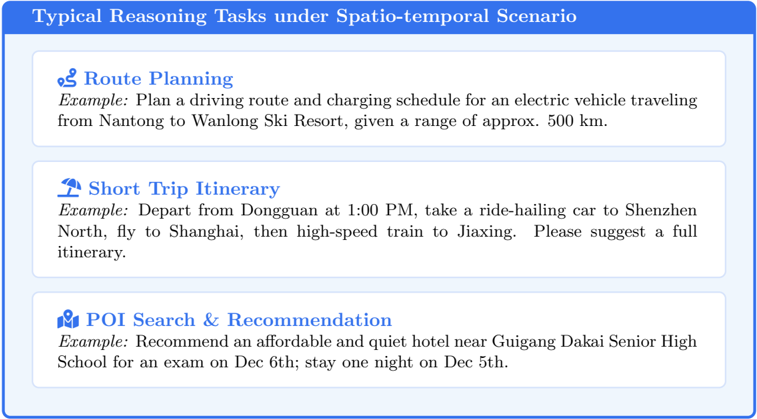
The image presents a structured overview of three reasoning tasks related to spatio-temporal planning, each with a labeled example. The content is organized into three distinct sections, each with an icon, title, and descriptive example.
### Components/Axes
- **Main Title**: "Typical Reasoning Tasks under Spatio-temporal Scenario" (top banner, blue background).
- **Section 1**:
- **Icon**: Person with a route symbol (🧭).
- **Title**: "Route Planning" (bold blue text).
- **Example**: "Plan a driving route and charging schedule for an electric vehicle traveling from Nantong to Wanlong Ski Resort, given a range of approx. 500 km."
- **Section 2**:
- **Icon**: Umbrella with a suitcase (🌂🧳).
- **Title**: "Short Trip Itinerary" (bold blue text).
- **Example**: "Depart from Dongguan at 1:00 PM, take a ride-hailing car to Shenzhen North, fly to Shanghai, then high-speed train to Jiaxing. Please suggest a full itinerary."
- **Section 3**:
- **Icon**: Person with a speech bubble (👤💬).
- **Title**: "POI Search & Recommendation" (bold blue text).
- **Example**: "Recommend an affordable and quiet hotel near Guigang Dakai Senior High School for an exam on Dec 6th; stay one night on Dec 5th."
### Detailed Analysis
- **Route Planning**: Focuses on optimizing travel logistics (route + charging schedule) for an electric vehicle with a 500 km range.
- **Short Trip Itinerary**: Involves multi-modal transportation (ride-hailing, flight, high-speed rail) with a fixed departure time and sequence.
- **POI Search & Recommendation**: Requires contextual awareness (exam date, location proximity, duration of stay).
### Key Observations
1. All examples emphasize **spatio-temporal constraints** (e.g., departure times, travel durations, location proximity).
2. Tasks involve **multi-step reasoning**:
- Route Planning: Combines distance, vehicle range, and charging infrastructure.
- Itinerary: Sequences transportation modes with time dependencies.
- POI Search: Balances affordability, quietness, and temporal alignment with an exam.
3. No numerical data or visualizations (e.g., charts, graphs) are present.
### Interpretation
The image outlines **spatio-temporal reasoning tasks** that require integrating geographic, temporal, and contextual variables. Each example demonstrates:
- **Route Planning**: Logistical optimization under resource constraints (e.g., EV battery limits).
- **Itinerary Design**: Sequential decision-making across transportation modes with fixed schedules.
- **POI Recommendation**: Context-aware suggestions based on user needs (e.g., exam timing, accommodation preferences).
These tasks likely serve as benchmarks for evaluating AI systems' ability to handle real-world planning scenarios requiring spatial awareness and temporal sequencing. The absence of numerical data suggests the focus is on qualitative task definitions rather than quantitative analysis.