\n
## Diagram: Natural Language Inference Examples
### Overview
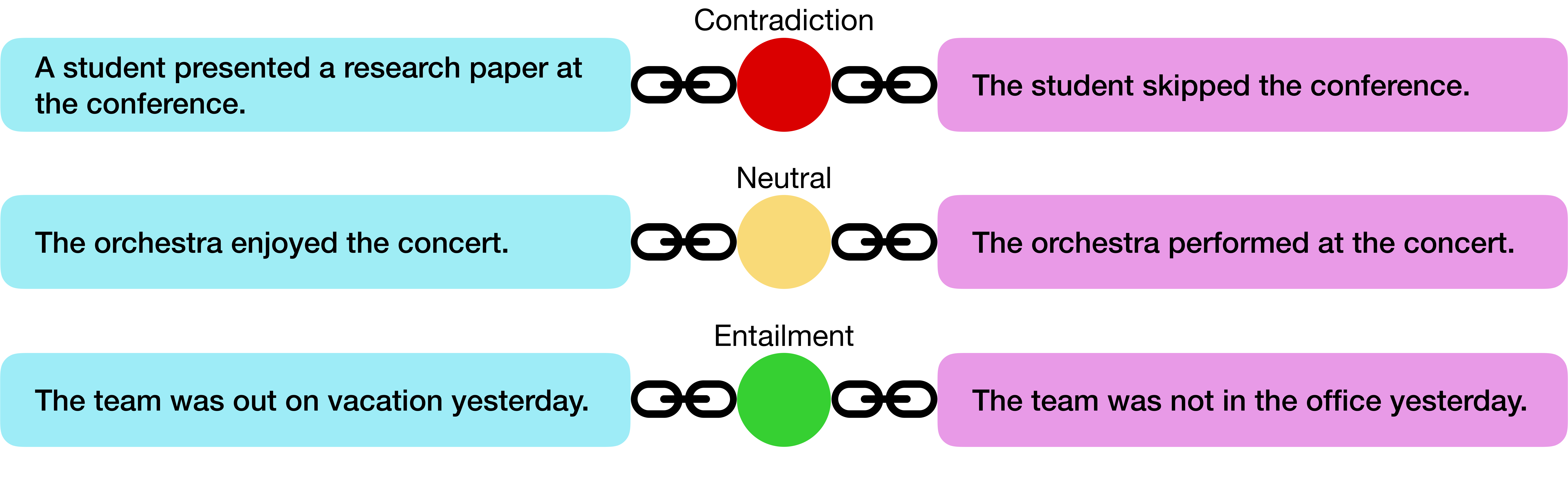
The image presents three examples illustrating different relationships between pairs of sentences in the context of Natural Language Inference (NLI). Each example consists of a premise sentence on the left, a hypothesis sentence on the right, and a label indicating the relationship between them. The relationships are categorized as "Contradiction", "Neutral", and "Entailment". Each pair of sentences is visually connected by a series of interconnected circles.
### Components/Axes
The diagram consists of three horizontally stacked sections, each representing a different NLI relationship. Each section contains:
* **Premise:** A sentence presented on the left side.
* **Hypothesis:** A sentence presented on the right side.
* **Relationship Label:** A label (Contradiction, Neutral, Entailment) positioned above the connecting circles.
* **Connecting Circles:** A series of interconnected circles visually linking the premise and hypothesis. The circles are white with black outlines.
* **Color Coding:** Each section is color-coded:
* Contradiction: Pink
* Neutral: Light Yellow/Peach
* Entailment: Light Green
### Detailed Analysis / Content Details
**1. Contradiction (Pink Section)**
* **Premise:** "A student presented a research paper at the conference."
* **Hypothesis:** "The student skipped the conference."
* **Relationship:** Contradiction
* **Connecting Circles:** Four circles are present.
**2. Neutral (Light Yellow/Peach Section)**
* **Premise:** "The orchestra enjoyed the concert."
* **Hypothesis:** "The orchestra performed at the concert."
* **Relationship:** Neutral
* **Connecting Circles:** Four circles are present.
**3. Entailment (Light Green Section)**
* **Premise:** "The team was out on vacation yesterday."
* **Hypothesis:** "The team was not in the office yesterday."
* **Relationship:** Entailment
* **Connecting Circles:** Four circles are present.
### Key Observations
The diagram visually demonstrates the three core relationships in NLI:
* **Contradiction:** The hypothesis asserts something that logically conflicts with the premise.
* **Neutral:** The hypothesis neither confirms nor denies the premise; it's independent.
* **Entailment:** The hypothesis logically follows from the premise; if the premise is true, the hypothesis must also be true.
The connecting circles, while visually present, do not appear to convey any specific information beyond linking the premise and hypothesis. The color coding effectively distinguishes the different relationship types.
### Interpretation
This diagram serves as a clear and concise illustration of the fundamental concepts in Natural Language Inference. It highlights how understanding the relationship between sentences is crucial for tasks like question answering, text summarization, and dialogue systems. The examples chosen are relatively simple, making the concepts accessible. The use of color and visual connections aids in quick comprehension. The diagram doesn't present any quantitative data, but rather focuses on qualitative examples to define the NLI categories. The consistent structure across the three examples reinforces the understanding of each relationship type.