\n
## Pie Chart: Distribution of Navigation Errors
### Overview
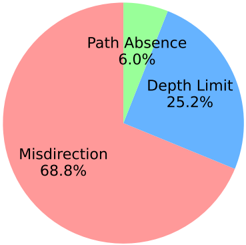
The image is a pie chart illustrating the distribution of different types of navigation errors. The chart is divided into three segments, each representing a specific error type and its corresponding percentage of the total.
### Components/Axes
The chart does not have traditional axes. It is a circular representation where the entire circle represents 100% of the navigation errors. The segments are labeled with the error type and percentage. The legend is embedded directly within the chart, with each segment labeled.
### Detailed Analysis
The pie chart shows the following distribution of navigation errors:
* **Misdirection:** This segment occupies the largest portion of the pie chart, representing approximately 68.8% of the total navigation errors. It is colored in a shade of red.
* **Depth Limit:** This segment represents 25.2% of the total errors. It is colored in a shade of blue.
* **Path Absence:** This segment is the smallest, representing 6.0% of the total errors. It is colored in a shade of green.
The percentages sum to 100% (68.8% + 25.2% + 6.0% = 100.0%).
### Key Observations
The most significant observation is the dominance of "Misdirection" as the primary cause of navigation errors, accounting for over two-thirds of all errors. "Depth Limit" is the second most frequent error, while "Path Absence" is relatively rare.
### Interpretation
The data suggests that the primary challenge in navigation is not a lack of a path ("Path Absence") or reaching a maximum depth ("Depth Limit"), but rather being led astray ("Misdirection"). This could indicate issues with the clarity of directions, misleading signage, or inaccurate mapping. The relatively low percentage of "Path Absence" suggests that paths are generally available, but the problem lies in guiding users along the correct path. The "Depth Limit" error could be related to limitations in the navigation system or the environment itself. Further investigation into the causes of "Misdirection" would likely yield the most significant improvements in navigation accuracy and user experience.