## Heatmap: Alignment of Child Utterances with Environment and Language
### Overview
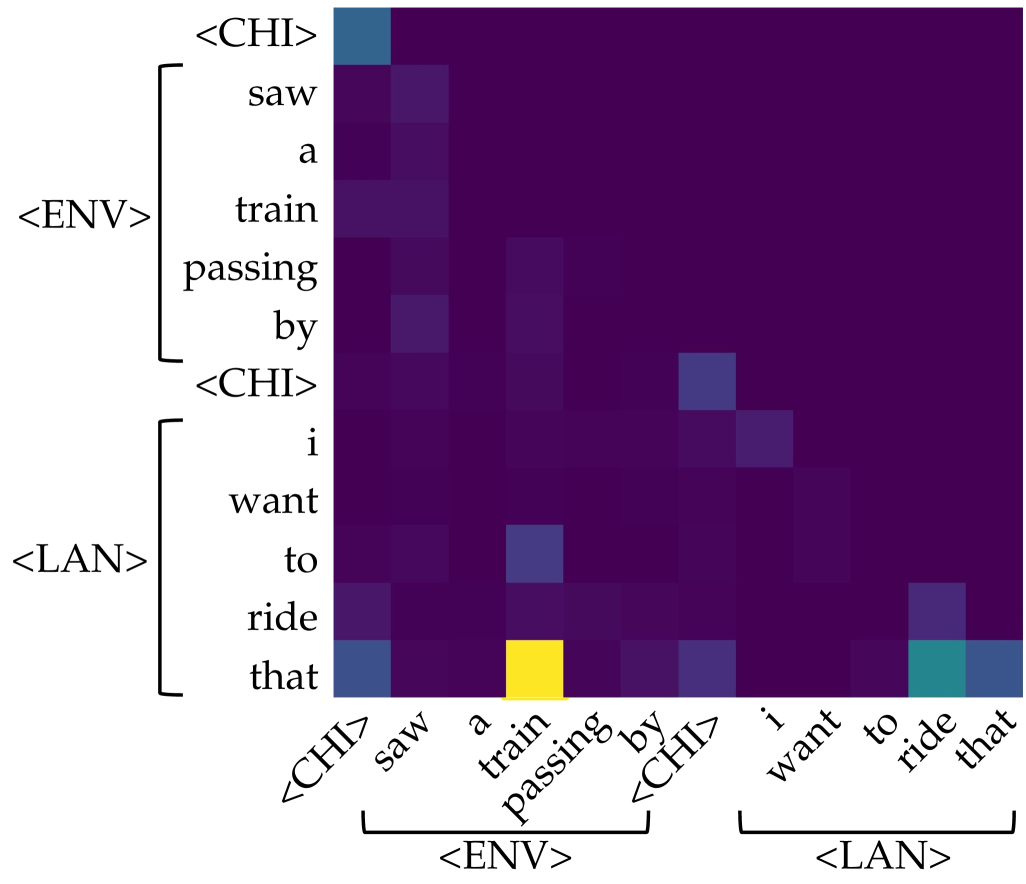
The image is a heatmap visualizing the alignment between a child's utterances and segments representing the environment (ENV) and language (LAN). The heatmap uses color intensity to represent the strength of the alignment, with brighter colors indicating stronger alignment. The x-axis and y-axis represent the same sequence of words, segmented into <CHI>, <ENV>, and <LAN> categories.
### Components/Axes
* **X-axis:** Represents the sequence of words: "<CHI> saw a train passing by <CHI> i want to ride that", segmented into <CHI>, <ENV>, and <LAN> categories.
* **Y-axis:** Represents the same sequence of words as the x-axis: "<CHI> saw a train passing by <CHI> i want to ride that", segmented into <CHI>, <ENV>, and <LAN> categories.
* **Color Scale:** The heatmap uses a color gradient where darker colors (purple) indicate weaker or no alignment, and brighter colors (yellow) indicate stronger alignment.
### Detailed Analysis
The heatmap shows the alignment between different parts of the child's utterance.
* **<CHI> (Child Utterance 1):** The first "<CHI>" on the y-axis aligns strongly with the first "<CHI>" on the x-axis (top-left corner, dark blue).
* **"saw":** "saw" on the y-axis shows some alignment with "saw" and "a" on the x-axis (dark blue).
* **"a":** "a" on the y-axis shows some alignment with "a" and "train" on the x-axis (dark blue).
* **<ENV> (Environment):** The "<ENV>" segment ("train passing by") on the y-axis shows a strong alignment with the "<ENV>" segment on the x-axis. Specifically, "train" aligns strongly with "train" (yellow), and "passing" aligns with "passing" (dark blue).
* **<CHI> (Child Utterance 2):** The second "<CHI>" on the y-axis aligns strongly with the second "<CHI>" on the x-axis (dark blue).
* **"i":** "i" on the y-axis shows some alignment with "i" on the x-axis (dark blue).
* **<LAN> (Language):** The "<LAN>" segment ("want to ride that") on the y-axis shows alignment with the "<LAN>" segment on the x-axis. "to" aligns with "to" (dark blue), and "that" aligns with "that" (green).
### Key Observations
* The strongest alignments occur within the same segments (e.g., <CHI> with <CHI>, <ENV> with <ENV>, <LAN> with <LAN>).
* The word "train" within the <ENV> segment shows the strongest alignment (yellow).
* The word "that" within the <LAN> segment shows a moderate alignment (green).
* There is weaker alignment between different segments, suggesting that the child's utterances are more strongly related to the corresponding environment or language segments.
### Interpretation
The heatmap visualizes how a child's utterances align with environmental and language contexts. The strong diagonal alignment suggests that the child's speech is highly correlated with the immediate context (environment) and the broader language input. The intensity variations indicate the degree of association between specific words or phrases. The child's utterance "train" is strongly associated with the environment, while "that" is associated with the language segment. This visualization can be used to understand how children learn language by associating words and phrases with their environment and the language they hear.