## Diagram: 5x5 Grid Matrix with Iconographic Cells and Shading Patterns
### Overview
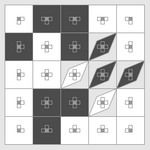
The image displays a 5x5 grid (matrix) composed of 25 square cells. Each cell contains a small, monochromatic icon or symbol at its center. The grid uses a grayscale shading scheme where some cells are filled with a dark gray/black color, while others remain white or very light gray. There is no visible text, labels, axis titles, or numerical data present in the image. The diagram appears to be a conceptual or symbolic matrix, possibly representing relationships, states, or categories through the arrangement of icons and shading.
### Components/Axes
* **Grid Structure:** A perfect 5x5 matrix with clearly defined cell borders.
* **Cell Content:** Each of the 25 cells contains a small, centered icon. The icons are not uniform; they appear to be different simplified line drawings or symbols. Due to the image resolution, precise identification of each icon is challenging, but they resemble abstract representations of objects, tools, or concepts (e.g., a square with a dot, a shape with protruding lines, a circle within a square).
* **Shading/Legend:** There is no explicit legend. The primary visual variable is cell fill color (dark vs. light). The shading pattern is the key to interpreting the diagram's structure.
* **Spatial Layout:** The grid is presented flat, with no 3D perspective or additional graphical elements outside the grid boundaries.
### Detailed Analysis
**Shading Pattern Analysis (Spatial Grounding):**
The dark shading is not random and forms distinct geometric patterns within the grid. Let's define the grid with rows 1-5 (top to bottom) and columns A-E (left to right).
| Pattern | Description | Cells (Row, Column) |
| :--- | :--- | :--- |
| **Corner and Center Emphasis** | Creates a diagonal axis of emphasis from the top-left to the bottom-right. | A1 (dark), C3 (dark), E5 (dark) |
| **Diagonal Band** | A prominent diagonal band runs from the top-right to the bottom-left, orthogonal to the main corner-to-corner diagonal. | B5, C4, D3, E2 |
| **Additional Dark Cells** | Cells that do not lie on the two main diagonals. | A2, D5, E4 |
**Iconography:**
While specific icons cannot be cataloged with certainty due to resolution, their presence in every cell suggests each cell represents a unique item, state, or data point. The variation in icons implies categorical differences, while the shading likely indicates a higher-order grouping, status (e.g., active/inactive, selected/unselected), or a relationship pattern (e.g., connectivity, conflict).
### Key Observations
1. **Symmetry and Pattern:** The shading exhibits a strong, intentional geometric pattern rather than a data-driven distribution (like a heatmap). The combination of the corner-center diagonal and the orthogonal diagonal band creates a visually balanced, almost heraldic or symbolic layout.
2. **Lack of Quantitative Data:** There are no numbers, percentages, scales, or axes. The diagram is purely qualitative and relational.
3. **Dual Information Channels:** Information is conveyed through two parallel channels: the **icon** within each cell (likely denoting type or identity) and the **shading** of the cell (likely denoting group, status, or relationship).
4. **Central Focal Point:** The dark center cell (C3) acts as a visual anchor, surrounded by a complex interplay of the two diagonal shading patterns.
### Interpretation
This diagram is not a chart of empirical data but a **conceptual model or schematic**. Its purpose is to visualize relationships or a structure within a defined 5x5 system.
* **What it Suggests:** The diagram likely maps a system where elements (icons) are categorized or connected according to a specific logic. The shading pattern could represent:
* A **conflict or interaction map** (e.g., in game theory or network analysis), where dark cells indicate opposing or interacting pairs.
* A **state matrix** for a process or machine, where shading indicates active, blocked, or key transition states.
* A **classification schema**, where dark cells belong to one or more intersecting categories (the two diagonals).
* A **spatial or organizational chart**, where position and shading denote hierarchy, department, or function.
* **Relationships Between Elements:** The two crossing diagonals suggest two independent but intersecting classification systems or forces acting upon the grid's elements. An element's properties would be defined by its icon *and* its position relative to these shaded diagonals (e.g., an element on both diagonals, on one, or on none).
* **Notable Anomalies:** The dark cells at A2, D5, and E4 do not lie on the two main diagonals. These could represent exceptions, special cases, or elements that belong to a third, less prominent category. Their placement breaks perfect symmetry, indicating the model accommodates irregularities.
**In essence, this is a visual logic puzzle or a framework for thinking about a 25-component system. To extract its full meaning, one would need the accompanying key or text that defines what the icons represent and what the shading signifies.** The image itself provides only the structural relationship between the components.