## Bar Chart: Mean Accuracy by Problem Type
### Overview
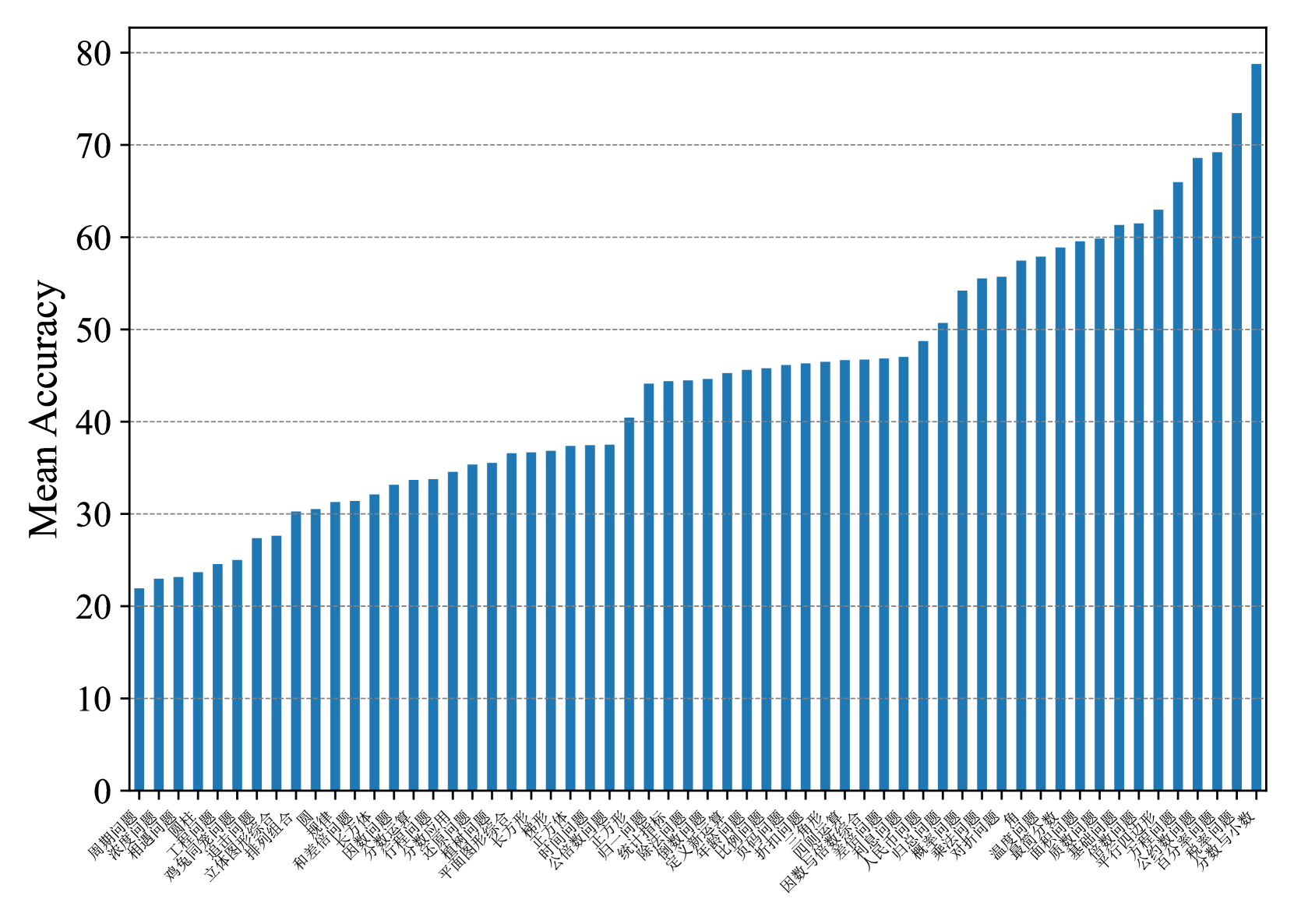
The image is a bar chart displaying the mean accuracy for different problem types. The x-axis represents various problem types (in Chinese), and the y-axis represents the mean accuracy, ranging from 0 to 80. The bars are arranged in ascending order of mean accuracy.
### Components/Axes
* **X-axis:** Problem Types (in Chinese). The labels are oriented vertically.
* **Y-axis:** Mean Accuracy, with a scale from 0 to 80 in increments of 10.
* **Bars:** Each bar represents a problem type, with the height indicating the mean accuracy. The bars are all blue.
* **Gridlines:** Horizontal gridlines are present at intervals of 10 on the y-axis.
### Detailed Analysis
The following is a transcription of the x-axis labels (problem types) from left to right, along with their approximate mean accuracy values. Note that the labels are in Chinese, and translations are provided where possible.
1. **周期问题 (Zhōu qī wèn tí):** Periodic Problem - Accuracy ~22
2. **浓度问题 (Nóng dù wèn tí):** Concentration Problem - Accuracy ~23
3. **相遇问题 (Xiāng yù wèn tí):** Meeting Problem - Accuracy ~24
4. **鸡兔同笼 (Jī tù tóng lóng):** Chicken and Rabbit in the Same Cage (a classic math problem) - Accuracy ~25
5. **工程问题 (Gōng chéng wèn tí):** Engineering Problem - Accuracy ~26
6. **立体图形 (Lì tǐ tú xíng):** 3D Shapes - Accuracy ~27
7. **排列组合 (Pái liè zǔ hé):** Permutation and Combination - Accuracy ~28
8. **和差倍问题 (Hé chā bèi wèn tí):** Sum, Difference, and Multiple Problem - Accuracy ~30
9. **圆锥 (Yuán zhuī):** Cone - Accuracy ~31
10. **圆 (Yuán):** Circle - Accuracy ~32
11. **面积 (Miàn jī):** Area - Accuracy ~33
12. **长方体 (Cháng fāng tǐ):** Cuboid - Accuracy ~34
13. **因数问题 (Yīn shù wèn tí):** Factor Problem - Accuracy ~34
14. **分数应用 (Fēn shù yìng yòng):** Fraction Application - Accuracy ~35
15. **行程问题 (Xíng chéng wèn tí):** Travel Problem - Accuracy ~36
16. **平面图形 (Píng miàn tú xíng):** Plane Figure - Accuracy ~37
17. **长方形 (Cháng fāng xíng):** Rectangle - Accuracy ~37
18. **正方体 (Zhèng fāng tǐ):** Cube - Accuracy ~38
19. **公倍数问题 (Gōng bèi shù wèn tí):** Common Multiple Problem - Accuracy ~39
20. **正方形 (Zhèng fāng xíng):** Square - Accuracy ~40
21. **统计 (Tǒng jì):** Statistics - Accuracy ~41
22. **定义新运算 (Dìng yì xīn yùn suàn):** Define New Operation - Accuracy ~42
23. **除法问题 (Chú fǎ wèn tí):** Division Problem - Accuracy ~43
24. **年龄问题 (Nián líng wèn tí):** Age Problem - Accuracy ~44
25. **平均数问题 (Píng jūn shù wèn tí):** Average Problem - Accuracy ~45
26. **简单计算 (Jiǎn dān jì suàn):** Simple Calculation - Accuracy ~45
27. **比例问题 (Bǐ lì wèn tí):** Ratio Problem - Accuracy ~46
28. **页码问题 (Yè mǎ wèn tí):** Page Number Problem - Accuracy ~46
29. **折扣问题 (Zhé kòu wèn tí):** Discount Problem - Accuracy ~47
30. **三角形 (Sān jiǎo xíng):** Triangle - Accuracy ~48
31. **四则运算 (Sì zé yùn suàn):** Four Arithmetic Operations - Accuracy ~49
32. **因数与倍数 (Yīn shù yǔ bèi shù):** Factors and Multiples - Accuracy ~50
33. **复合问题 (Fù hé wèn tí):** Composite Problem - Accuracy ~51
34. **植树问题 (Zhí shù wèn tí):** Tree Planting Problem - Accuracy ~52
35. **人民币问题 (Rén mín bì wèn tí):** RMB (Chinese currency) Problem - Accuracy ~53
36. **归一问题 (Guī yī wèn tí):** Reduction to Unity Problem - Accuracy ~54
37. **概率问题 (Gài lǜ wèn tí):** Probability Problem - Accuracy ~55
38. **对称问题 (Duì chèn wèn tí):** Symmetry Problem - Accuracy ~56
39. **温度问题 (Wēn dù wèn tí):** Temperature Problem - Accuracy ~57
40. **最值问题 (Zuì zhí wèn tí):** Max/Min Problem - Accuracy ~58
41. **基础分数 (Jī chǔ fēn shù):** Basic Fractions - Accuracy ~59
42. **平行四边形 (Píng xíng sì biān xíng):** Parallelogram - Accuracy ~60
43. **工程效率 (Gōng chéng xiào lǜ):** Engineering Efficiency - Accuracy ~61
44. **百分数问题 (Bǎi fēn shù wèn tí):** Percentage Problem - Accuracy ~62
45. **分数与小数 (Fēn shù yǔ xiǎo shù):** Fractions and Decimals - Accuracy ~63
### Key Observations
* The mean accuracy varies significantly across different problem types.
* The problem types are sorted in ascending order of mean accuracy.
* The accuracy ranges from approximately 22 to 75.
* Problems related to basic arithmetic and geometry (e.g., fractions, percentages, parallelograms) tend to have higher mean accuracy compared to more complex problems (e.g., probability, permutations).
### Interpretation
The bar chart provides insights into the relative difficulty of different problem types. The data suggests that certain mathematical concepts are more easily grasped or applied than others. This information could be valuable for educators in identifying areas where students may need additional support or focused instruction. The ascending order of accuracy highlights a progression of difficulty, potentially reflecting the complexity of the underlying concepts or the cognitive skills required to solve them.