\n
## Diagram: Federated Learning Process
### Overview
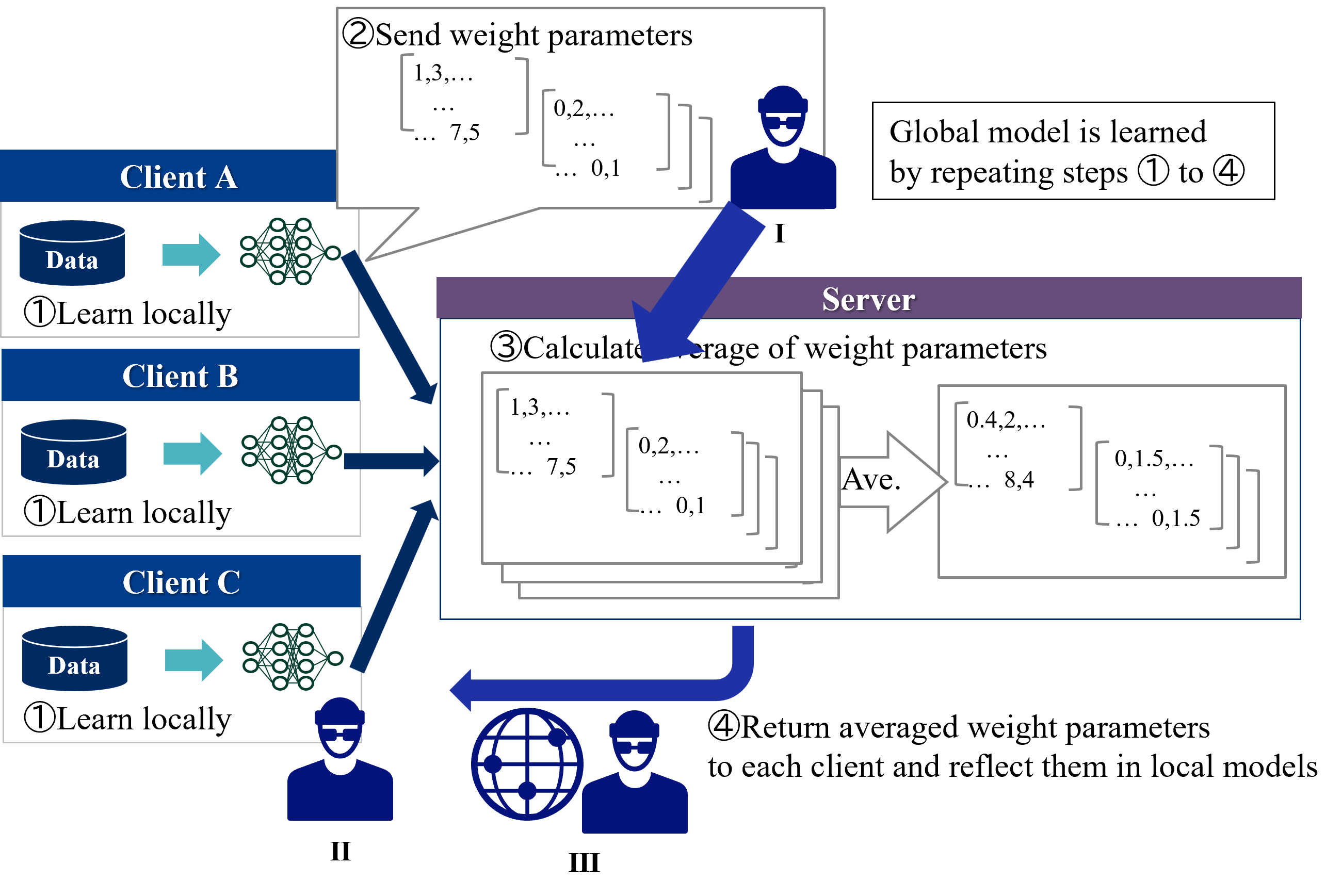
The image is a technical diagram illustrating the four-step cycle of a federated learning system. It shows how multiple clients (Client A, Client B, Client C) collaboratively train a shared global model without centralizing their local data. The process involves local training, parameter aggregation on a server, and distribution of the updated global model.
### Components/Axes
The diagram is organized into three main spatial regions:
1. **Left Column (Clients):** Three vertically stacked client blocks (Client A, Client B, Client C). Each block contains:
* A blue cylinder labeled **"Data"**.
* A teal arrow pointing right.
* A green neural network icon.
* The text **"①Learn locally"**.
2. **Center (Server):** A large central block labeled **"Server"** in a purple header. It contains:
* The text **"③Calculate average of weight parameters"**.
* A stack of three matrices on the left, representing received parameters.
* A large arrow labeled **"Ave."** pointing right.
* A single matrix on the right, representing the averaged result.
3. **Right Side & Flow Arrows:**
* A text box in the top-right states: **"Global model is learned by repeating steps ① to ④"**.
* A large blue arrow labeled **"②Send weight parameters"** points from the clients up to the server. A callout bubble from this arrow shows example matrix values: `[1,3,... ... 7,5]` and `[0,2,... ... 0,1]`.
* A large blue arrow labeled **"④Return averaged weight parameters to each client and reflect them in local models"** points from the server back to the clients.
* Three stylized human icons with Roman numerals:
* **I** (top-right, near step 2 arrow).
* **II** (bottom-left, below Client C).
* **III** (bottom-center, next to a globe icon).
### Detailed Analysis
The process flow is explicitly numbered:
* **Step ① (Learn locally):** Each client (A, B, C) uses its local **"Data"** to train its own neural network model. The data does not leave the client.
* **Step ② (Send weight parameters):** Each client sends its locally updated model parameters (weights) to the central **Server**. The diagram provides example parameter values in matrix notation: `[1,3,... ... 7,5]` and `[0,2,... ... 0,1]`.
* **Step ③ (Calculate average of weight parameters):** The **Server** collects the parameter sets from all clients. It then computes an average (indicated by **"Ave."**) of these parameters. The output is a single, averaged parameter set shown as `[0.4,2,... ... 8,4]` and `[0,1.5,... ... 0,1.5]`.
* **Step ④ (Return averaged weight parameters...):** The server sends the newly computed global model parameters back to all clients. Each client then updates its local model with these averaged parameters.
* **Iteration:** The text box confirms this is a cyclic process: **"Global model is learned by repeating steps ① to ④"**.
### Key Observations
1. **Data Privacy:** The core principle is visually emphasized: raw **"Data"** remains within each client's cylinder. Only model parameters (weights) are transmitted.
2. **Centralized Aggregation:** The **Server** acts solely as an aggregator. It does not possess or train on raw data; it only computes the average of received parameters.
3. **Homogeneous Model Architecture:** The identical neural network icons for all clients and the server's averaging operation imply all clients are training the same model architecture.
4. **Parameter Example Discrepancy:** The example parameters sent by clients (`[1,3,...]`) differ from the averaged result (`[0.4,2,...]`), illustrating the aggregation effect. The values are illustrative, not mathematically precise averages of the shown inputs.
5. **Human/System Icons:** The icons labeled **I**, **II**, and **III** likely represent different roles or system components (e.g., **I**: Client Device, **II**: Local User, **III**: Global Coordinator/Network), though their specific functions are not detailed in the text.
### Interpretation
This diagram succinctly explains the federated learning paradigm, a machine learning approach designed for privacy and distributed data.
* **What it demonstrates:** It shows a decentralized training workflow where intelligence is improved collaboratively. The "global model" evolves through iterative consensus, learning patterns from diverse, isolated datasets without compromising data locality.
* **Relationships:** The clients are peers contributing to a common goal. The server is a facilitator, not a data holder. The arrows define a clear, closed-loop communication protocol.
* **Notable Implications:**
* **Privacy-Preserving:** The primary benefit is keeping sensitive data on local devices.
* **Communication Efficiency:** Only model updates (which can be compressed) are sent, not raw data.
* **Iterative Convergence:** The note about repeating steps highlights that the global model improves gradually over many cycles.
* **Assumption of Homogeneity:** The diagram assumes all clients can train the same model structure, which may not hold in more complex, real-world scenarios with heterogeneous devices.
The diagram serves as a high-level conceptual map for understanding how federated learning systems operate, emphasizing the sequence of operations and the flow of information (parameters) rather than specific algorithms or mathematical details.