## Screenshot: Code Snippet in Theorem Prover
### Overview
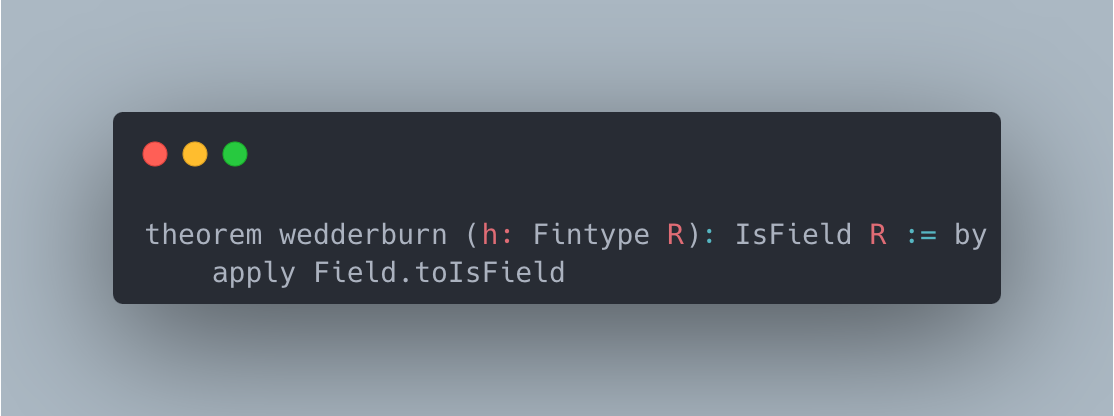
The image shows a code snippet from a theorem prover or formal verification system, likely in a functional programming language (e.g., Haskell, Coq, or Lean). The code defines a theorem named `wedderburn` with a hypothesis `h` of type `Fintype R`, asserting that `IsField R` holds, and provides a proof using the `apply` tactic.
### Components/Axes
- **Window Controls**: Three colored circles (red, yellow, green) at the top-left of the black rectangle, typical of macOS window management.
- **Code Text**:
- Theorem name: `theorem wedderburn`
- Hypothesis: `(h: Fintype R)`
- Result type: `: IsField R`
- Proof body: `:= by apply Field.toIsField`
### Detailed Analysis
- **Theorem Statement**:
The theorem `wedderburn` asserts that if a ring `R` is a finite type (`Fintype R`), then it is a field (`IsField R`).
- **Proof Structure**:
The proof uses the `by apply` tactic, which is common in proof assistants like Coq or Lean. The `Field.toIsField` function likely converts a `Field` instance into an `IsField` instance, leveraging type class resolution.
### Key Observations
- The code is syntactically minimal, focusing on the theorem's statement and its proof via type class application.
- No numerical data, charts, or diagrams are present.
### Interpretation
This snippet demonstrates a formal verification of the Wedderburn theorem, which states that finite division rings are fields. The use of `Fintype R` (a finite type) and `IsField R` (a field instance) aligns with the theorem's mathematical premise. The `apply Field.toIsField` line suggests the proof relies on an existing type class instance for `Field`, automating the verification process. This reflects the interplay between mathematical logic and computational formalism in theorem proving systems.