\n
## Commutative Diagram: Morphisms Between Objects X', X'', X, Y', Y
### Overview
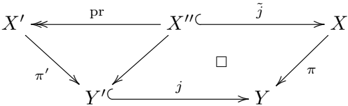
The image displays a commutative diagram from mathematics, likely within the fields of category theory, homological algebra, or algebraic topology. It illustrates a network of objects (denoted by letters) and morphisms (arrows) between them, forming a diamond-shaped structure with a central object. The diagram implies specific relationships and compositions between these morphisms.
### Components/Axes
The diagram consists of five objects and six morphisms (arrows). There are no traditional axes, as this is not a data chart.
**Objects (Nodes):**
* **X'**: Located at the top-left corner.
* **X''**: Located at the center of the diagram.
* **X**: Located at the top-right corner.
* **Y'**: Located at the bottom-left corner.
* **Y**: Located at the bottom-right corner.
**Morphisms (Arrows) and Labels:**
1. **pr**: An arrow from **X''** to **X'**. Label "pr" is positioned above the arrow.
2. **j̄** (j-bar): An arrow from **X''** to **X**. Label "j̄" is positioned above the arrow.
3. **π'** (pi-prime): An arrow from **X'** to **Y'**. Label "π'" is positioned to the left of the arrow.
4. **j**: An arrow from **X''** to **Y'**. This arrow runs diagonally from the center to the bottom-left. No explicit label is placed directly on this arrow in the provided image.
5. **j**: An arrow from **Y'** to **Y**. Label "j" is positioned below the arrow.
6. **π** (pi): An arrow from **X** to **Y**. Label "π" is positioned to the right of the arrow.
**Other Symbols:**
* A small, empty square symbol (□) is located in the space between the arrows connecting X'', X, Y', and Y. This often denotes a **pullback square** or **pushout square** in category theory, indicating a universal property for the diagram formed by those four objects and the arrows between them.
### Detailed Analysis
The diagram is structured as a diamond with a central node.
* **Top Path**: From X'' to X' (via `pr`) and from X'' to X (via `j̄`).
* **Bottom Path**: From Y' to Y (via `j`).
* **Left Side**: From X' down to Y' (via `π'`).
* **Right Side**: From X down to Y (via `π`).
* **Central Connections**: From X'' down to Y' (via an unlabeled diagonal arrow). The square symbol (□) is positioned to suggest that the sub-diagram involving X'', X, Y', and Y (with morphisms `j̄`, `π`, `j`, and the diagonal from X'' to Y') forms a commutative square with a special universal property (pullback/pushout).
The labeling uses standard mathematical notation: primes (') and double primes ('') to denote related objects, and Greek letters (π) and Latin letters (j, pr) for morphisms. The bar over the j (`j̄`) indicates it is a distinct morphism from the other `j`.
### Key Observations
1. **Structural Symmetry**: The diagram has a rough left-right symmetry in its layout, with X'/Y' on the left and X/Y on the right, connected through the central X''.
2. **Ambiguous Label**: The diagonal arrow from X'' to Y' does not have a label placed directly on it in this rendering. It is possible the label is implied by the context of the square (□) or is simply omitted.
3. **Notation Consistency**: The use of `j` for two different morphisms (X''→Y' and Y'→Y) is notable. Typically, distinct morphisms would have distinct labels. This could be a notational shorthand where the context (domain/codomain) clarifies which `j` is meant, or it might be an oversight in the diagram's rendering.
4. **Central Square**: The presence of the □ symbol is a critical piece of information, transforming the diagram from a simple collection of arrows into one asserting a specific categorical construction (like a pullback).
### Interpretation
This diagram is a formal representation of relationships between mathematical objects. It does not present empirical data but rather abstract structural information.
* **What it Demonstrates**: The diagram asserts the existence of morphisms (`pr`, `j̄`, `π'`, `j`, `π`) between the objects X', X'', X, Y', and Y. The central square symbol (□) strongly suggests that the square formed by X'', X, Y, and Y' is a **pullback** (or possibly a pushout). If it is a pullback, it means X'' is the "most general" object that maps to both X and Y' in a way that makes the diagram commute (i.e., the composition `π ∘ j̄` equals `j ∘ (diagonal morphism)`).
* **Relationships**: The morphisms `pr` and `j̄` can be seen as projections or inclusions from the central object X''. The morphisms `π'` and `π` are likely projections or maps to the "Y" objects. The structure is common in defining fiber products, kernels, cokernels, or in the context of exact sequences.
* **Notable Anomaly**: The dual use of the label `j` for two different arrows is the most striking anomaly. In a rigorous mathematical text, this would typically be avoided to prevent confusion. It forces the reader to disambiguate based on the domain and codomain of each arrow.
* **Underlying Meaning**: Without additional context (e.g., the surrounding text in the document it came from), the precise mathematical meaning is open to interpretation. However, the diagram's form is archetypal for expressing that a certain construction (X'') universalizes the relationship between X and Y' over Y. It visually encodes a system of equations (commutativity conditions) and a universal property.