## Schematic Diagram Series: Hexagonal State Configurations
### Overview
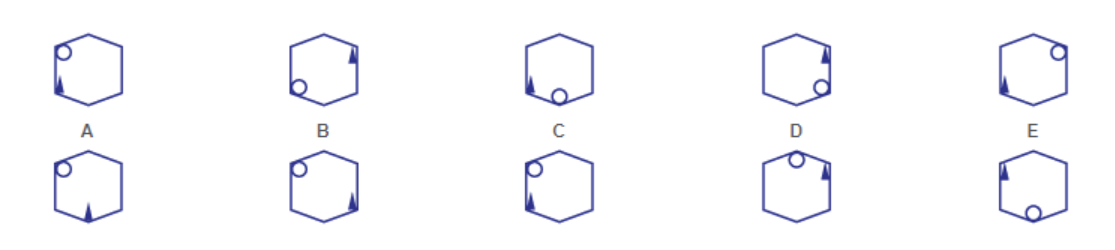
The image displays a series of ten schematic diagrams arranged in two horizontal rows of five. Each diagram consists of a regular hexagon containing two elements: a small circle and an arrow. The top row is labeled with the letters A, B, C, D, and E, centered beneath each respective hexagon. The bottom row contains five additional, unlabeled hexagons positioned directly below their counterparts in the top row. The diagrams appear to represent different states or configurations within a system, possibly illustrating a sequence, rule set, or puzzle.
### Components/Axes
* **Primary Shape:** A regular hexagon, drawn with a blue outline and a white interior.
* **Internal Elements:**
1. **Circle:** A small, solid blue circle. Its position varies, located either at a vertex (corner) or the midpoint of an edge of the hexagon.
2. **Arrow:** A solid blue arrow. Its position is always on an edge of the hexagon, and it points either directly up, down, left, or right relative to the page.
* **Labels:** The letters "A", "B", "C", "D", and "E" are present in a sans-serif font, centered below the five hexagons in the top row. No other text is present in the image.
### Detailed Analysis
The configuration of each hexagon is defined by the position of the circle and the arrow. Below is a precise description of each labeled diagram (Top Row) and its corresponding diagram directly below it (Bottom Row).
**Top Row (Labeled A-E):**
* **A:** Circle is at the top-left vertex. Arrow is on the left vertical edge, pointing **up**.
* **B:** Circle is at the bottom-left vertex. Arrow is on the right vertical edge, pointing **up**.
* **C:** Circle is at the midpoint of the bottom edge. Arrow is on the left vertical edge, pointing **up**.
* **D:** Circle is at the bottom-right vertex. Arrow is on the right vertical edge, pointing **up**.
* **E:** Circle is at the top-right vertex. Arrow is on the left vertical edge, pointing **up**.
**Bottom Row (Unlabeled, corresponding to A-E above):**
* **Below A:** Circle is at the top-left vertex. Arrow is on the bottom horizontal edge, pointing **down**.
* **Below B:** Circle is at the top-left vertex. Arrow is on the right vertical edge, pointing **down**.
* **Below C:** Circle is at the top-left vertex. Arrow is on the left vertical edge, pointing **up**.
* **Below D:** Circle is at the top horizontal edge (midpoint). Arrow is on the right vertical edge, pointing **up**.
* **Below E:** Circle is at the bottom horizontal edge (midpoint). Arrow is on the left vertical edge, pointing **up**.
### Key Observations
1. **Circle Movement (Top Row):** The circle in the top row (A-E) appears to move clockwise around the hexagon's perimeter. It starts at the top-left vertex (A), moves to the bottom-left vertex (B), then to the bottom edge midpoint (C), then to the bottom-right vertex (D), and finally to the top-right vertex (E).
2. **Arrow Consistency (Top Row):** In all five labeled diagrams (A-E), the arrow is consistently on a vertical edge (left or right) and always points **up**.
3. **Relationship Between Rows:** There is no immediately obvious, consistent transformation rule from the top row to the bottom row. For example:
* The circle in the bottom row is **not** in a simple next clockwise position from its top-row counterpart.
* The arrow direction changes inconsistently (e.g., from up in A to down below A; remains up in C and below C).
4. **Repetition:** The configuration of the hexagon labeled **C** (circle bottom edge, arrow left-up) is **identical** to the unlabeled hexagon directly below it.
### Interpretation
This image likely presents a visual logic puzzle or a set of examples for a pattern recognition task. The data suggests the following:
* **The system has defined states:** Each hexagon represents a discrete state defined by two variables: circle position and arrow direction/orientation.
* **The top row (A-E) may demonstrate a primary sequence:** The clockwise movement of the circle is a clear, ordered pattern. The constant upward arrow in this row might indicate a "default" or "input" condition.
* **The bottom row introduces complexity:** The lack of a simple, uniform rule connecting the top and bottom rows implies the relationship is either non-linear, governed by a more complex hidden rule, or that the bottom row represents outputs or transformations based on an external logic not fully depicted.
* **The identical pair (C and below C) is a critical clue:** This suggests that under certain conditions (specific circle and arrow placement in the top state), the resulting state is unchanged. This could be a key to deciphering the underlying rule.
* **Purpose:** The set is designed to test or teach the ability to infer rules from visual examples. The viewer is meant to analyze the relationships between the circle's position, the arrow's properties, and the transition from the top state to the bottom state to deduce the governing principle.