## Heatmap: Data Distribution and Clustering
### Overview
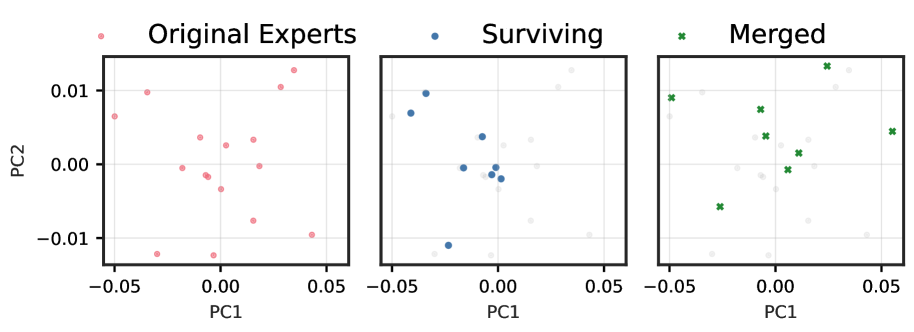
The heatmap displays the distribution of data points across two principal components (PC1 and PC2). The data is clustered into three groups: Original Experts, Surviving, and Merged. Each group is represented by a different color, and the data points are plotted to show their positions relative to each other.
### Components/Axes
- **X-axis (PC1)**: Represents the first principal component, ranging from -0.05 to 0.05.
- **Y-axis (PC2)**: Represents the second principal component, ranging from -0.01 to 0.01.
- **Legend**: Shows the color coding for each group: Original Experts (red), Surviving (blue), and Merged (green).
- **Data Points**: Each point represents an individual data point, with its position determined by its values on PC1 and PC2.
### Detailed Analysis or ### Content Details
- **Original Experts**: The data points for Original Experts are scattered across the entire range of PC1 and PC2, indicating a diverse distribution.
- **Surviving**: The data points for Surviving are more concentrated towards the center of the heatmap, suggesting a more clustered distribution.
- **Merged**: The data points for Merged are also clustered but are more spread out compared to the Surviving group, indicating a mix of Original Experts and Surviving data points.
### Key Observations
- **Clusters**: There are distinct clusters of data points for each group, with Original Experts showing the most spread out distribution.
- **Outliers**: No single data point stands out as an outlier in any group.
- **Trends**: The data points for Merged show a trend of being more spread out compared to the other two groups.
### Interpretation
The heatmap suggests that the data is clustered into three distinct groups, with Original Experts showing the most spread out distribution. The Surviving group is more concentrated, and the Merged group is a mix of both Original Experts and Surviving data points. This clustering could indicate different characteristics or behaviors within each group. The trend of the Merged group being more spread out suggests a mix of characteristics from both Original Experts and Surviving groups.