## Line Graph: Path Trajectories Comparison
### Overview
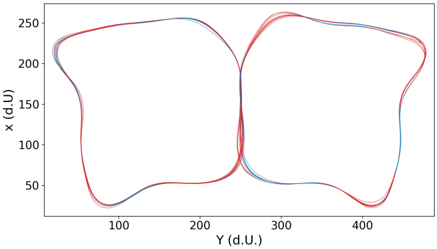
The image depicts a line graph with two intersecting loops representing two distinct paths (red and blue). The graph spans a coordinate system with X (d.U.) and Y (d.U.) axes, where "d.U." likely denotes "deci-units" or a domain-specific measurement. The red and blue lines form mirrored, figure-eight-like trajectories that intersect near the center of the graph.
### Components/Axes
- **X-axis (Horizontal)**: Labeled "Y (d.U.)", scaled from 0 to 400 in increments of 100.
- **Y-axis (Vertical)**: Labeled "X (d.U.)", scaled from 0 to 250 in increments of 50.
- **Legend**: Located in the top-right corner, associating:
- **Red line**: "Path A"
- **Blue line**: "Path B"
### Detailed Analysis
1. **Path A (Red Line)**:
- Starts at approximately (50, 50).
- Rises sharply to a peak near (250, 250).
- Descends diagonally to a trough at (350, 50).
- Forms a clockwise loop intersecting Path B at (250, 125).
2. **Path B (Blue Line)**:
- Starts at approximately (50, 200).
- Descends to a trough near (250, 50).
- Rises diagonally to a peak at (350, 200).
- Forms a counterclockwise loop intersecting Path A at (250, 125).
3. **Intersection Point**:
- Both paths cross at (250, 125), forming an "X" shape.
- The red line dominates the upper-right quadrant, while the blue line dominates the lower-left.
### Key Observations
- **Symmetry**: The paths exhibit mirrored behavior, suggesting a balanced or reciprocal relationship.
- **Intersection Significance**: The crossing at (250, 125) may represent a critical junction or equilibrium point.
- **Loop Dynamics**: Both paths complete a single loop, indicating cyclical or periodic behavior.
### Interpretation
The graph likely models two competing or complementary processes (e.g., opposing forces, dual trajectories) that intersect at a shared reference point. The symmetry implies a designed balance, while the intersection could signify a convergence of goals, resources, or states. The loops suggest cyclical activity, possibly representing periodic events or feedback mechanisms. The absence of additional data points or annotations leaves the exact context ambiguous, but the structure hints at a system where dual trajectories interact dynamically.